
IBPS SO IT Officer professional knowledge notes are the most important part of your preparation because Professional Knowledge is the section that directly tests your IT subject command.
Reasoning, English and Quant can help you clear the first stage, but for IT Officer selection, your technical subjects decide your real strength. If your DBMS, Operating System, Computer Networks, Data Structures, SQL, OOP and basic web technology are clear, you can score well with focused revision.
IBPS conducts Specialist Officer recruitment for Scale-I posts in participating public sector banks, and the SO recruitment cycle is an important exam path for candidates who want specialist banking roles. The 2026–27 IBPS exam calendar and recruitment updates have already been reported around the July–August exam cycle, so this is the right time to revise in a structured way.
This guide is written for quick revision. You can use it as your notebook-style preparation page before solving MCQs and previous year questions.
Why Professional Knowledge Is Important in IBPS SO IT Officer
Professional Knowledge is different from general aptitude sections. In this section, IBPS checks whether you understand the core IT concepts needed for an IT Officer role.
The questions are usually based on:
- DBMS
- SQL
- Operating System
- Computer Networks
- Data Structures
- Programming basics
- OOP concepts
- Software Engineering
- Web technology
- Cyber security basics
- Computer fundamentals
The biggest mistake students make is studying these subjects like college theory. IBPS questions are usually direct, concept-based and MCQ-oriented. You do not need PhD-level depth, but you need clear fundamentals.
For example, in DBMS, you should know normalization, keys, joins, transactions and ACID properties. In Operating System, you should know process management, deadlock, scheduling, memory management and paging. In Computer Networks, you should know OSI model, TCP/IP, protocols, IP addressing and network devices.
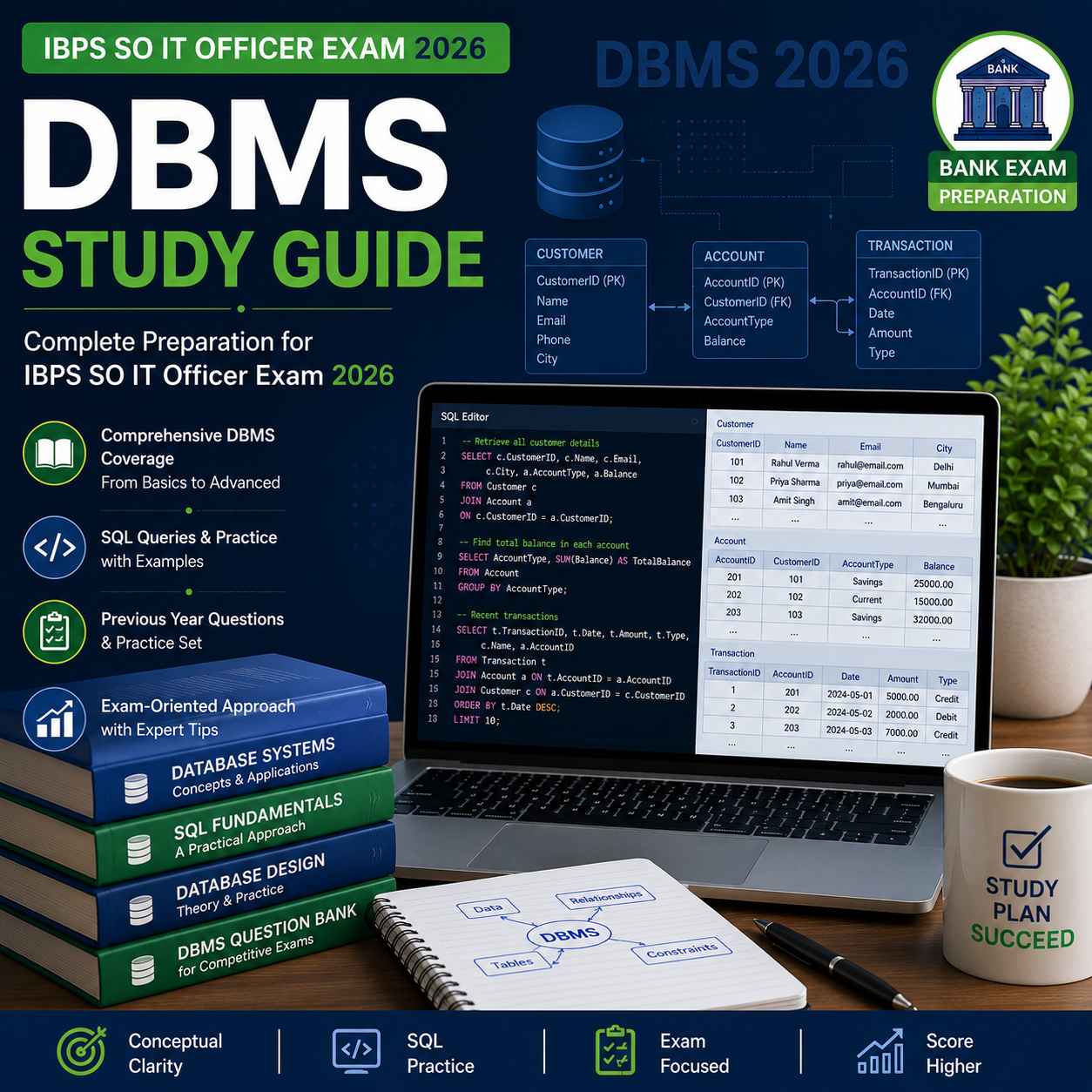
You can also strengthen your DBMS preparation from our detailed guide on DBMS for IBPS SO IT Officer 2026.
IBPS SO IT Officer Professional Knowledge Notes: Subject-Wise Strategy
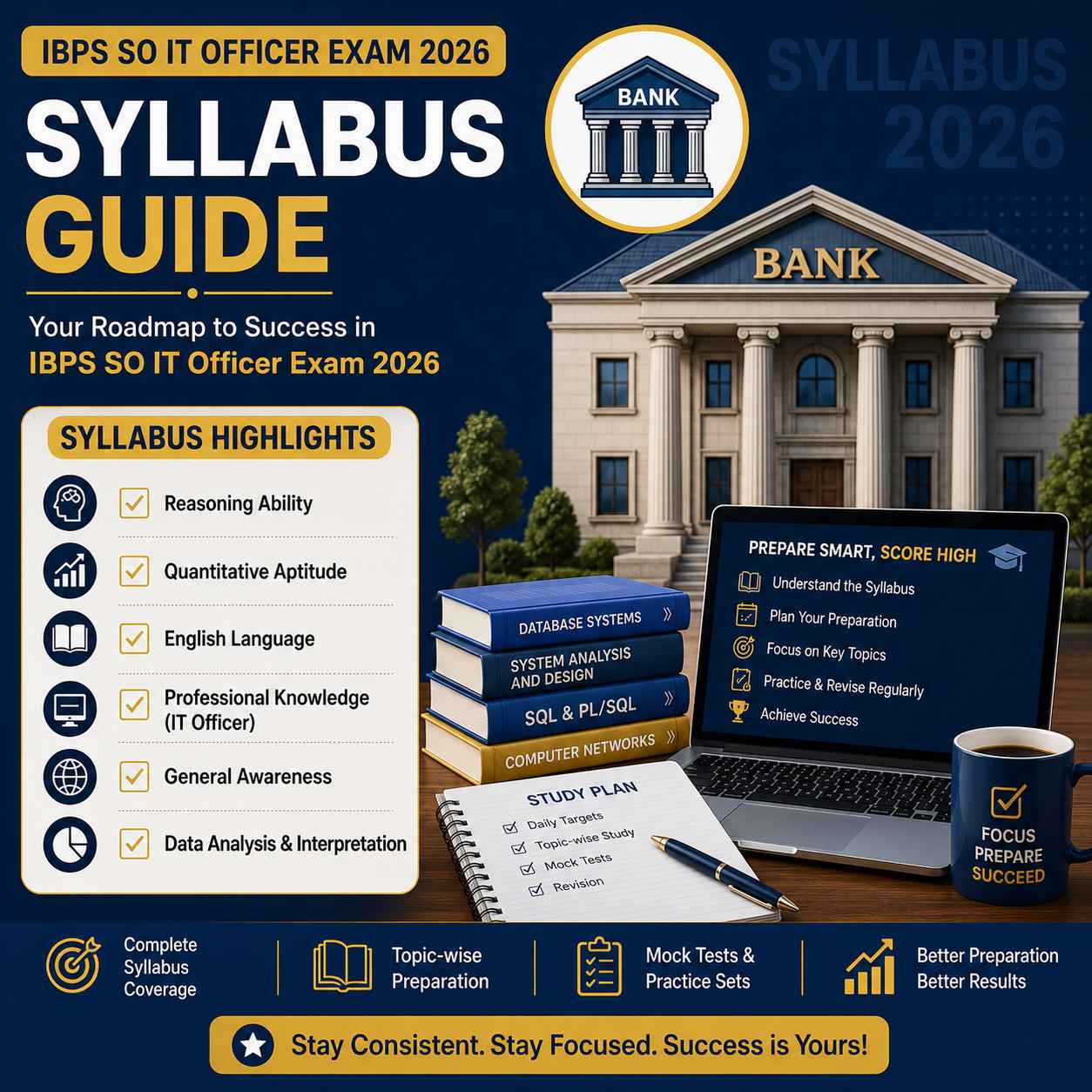
The best way to prepare Professional Knowledge is not to study randomly. Divide the syllabus into high-scoring blocks.
Use this order:
| Priority | Subject | Why Important |
|---|---|---|
| High | DBMS + SQL | Frequently asked and scoring |
| High | Computer Networks | Direct factual + concept questions |
| High | Operating System | Important for process, memory, deadlock |
| Medium | Data Structures | Logic-based and definition-based |
| Medium | OOP | Easy scoring if concepts are clear |
| Medium | Software Engineering | Theory-based questions |
| Medium | Web Technology | HTML, CSS, JS, internet basics |
| Medium | Security | Important for banking IT environment |
If you have less time, start with DBMS, SQL, Computer Networks and Operating System. These subjects give better return in limited revision time.
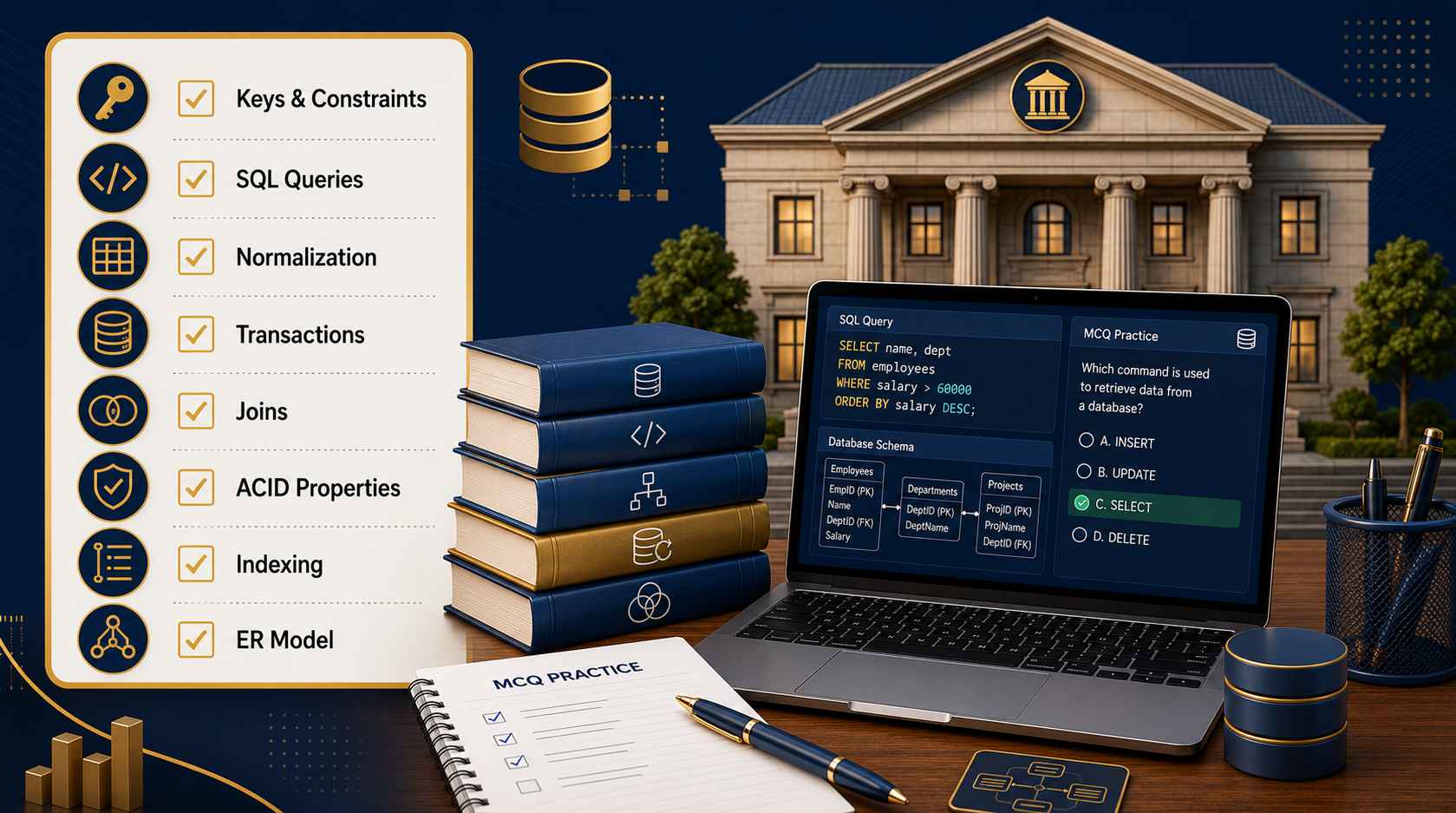
1. DBMS Notes for IBPS SO IT Officer
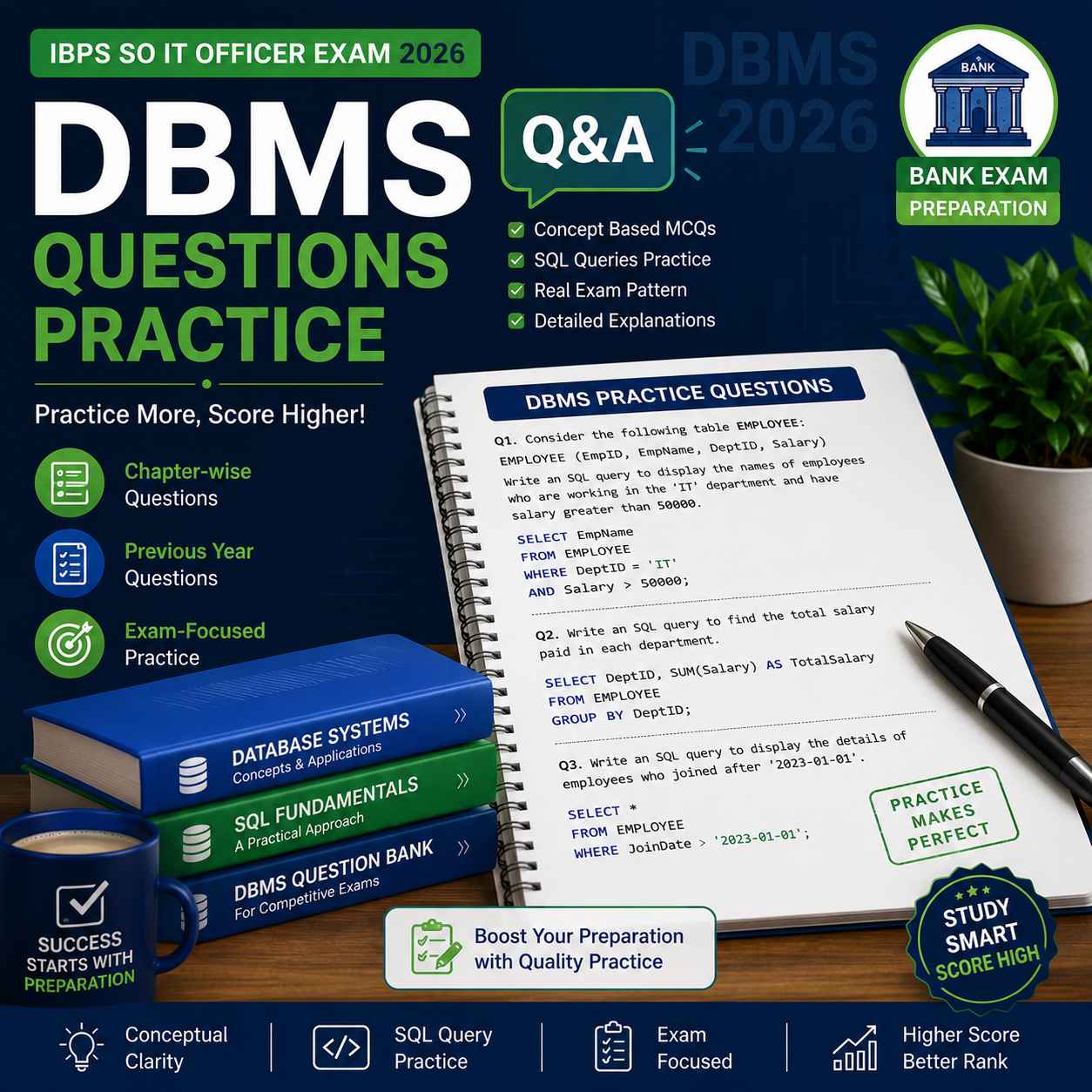
DBMS stands for Database Management System. It is software used to store, manage, retrieve and organize data. In banking systems, databases are extremely important because customer accounts, transactions, loans, KYC records and digital banking data are stored and managed through database systems.
Important DBMS topics:
- Database models
- Keys
- Functional dependency
- Normalization
- SQL
- Transactions
- ACID properties
- Concurrency control
- Indexing
- Relational algebra basics
Important Keys in DBMS
| Key | Meaning |
|---|---|
| Super Key | Set of attributes that can uniquely identify a row |
| Candidate Key | Minimal super key |
| Primary Key | Candidate key selected to identify records |
| Foreign Key | Attribute that refers to primary key of another table |
| Composite Key | Key made using more than one attribute |
Example:
CREATE TABLE Students (
  student_id INT PRIMARY KEY,
  name VARCHAR(50),
  email VARCHAR(100)
);
Here, student_id is the primary key because it uniquely identifies every student.
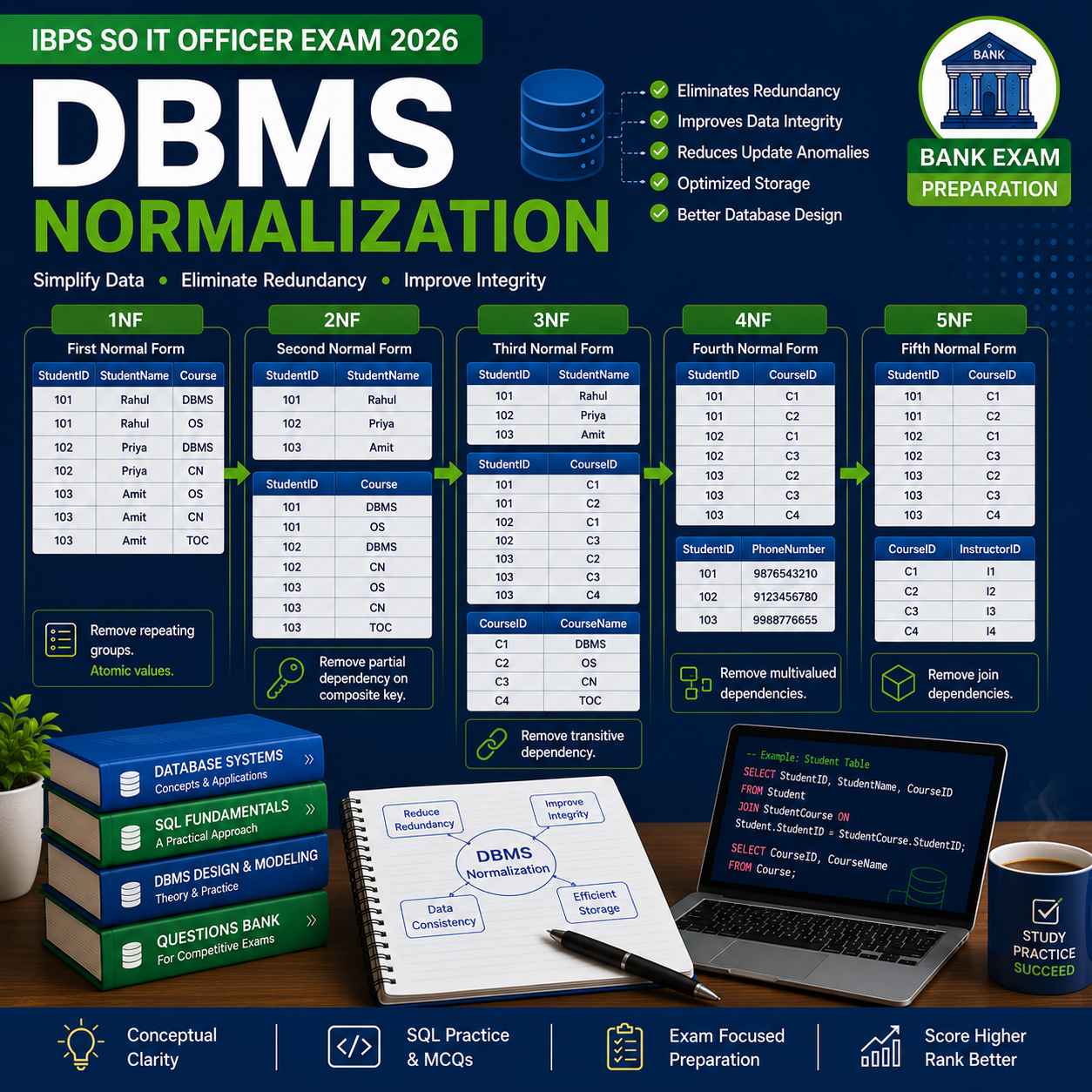
For deeper revision, read DBMS Normalization for IBPS SO IT Officer.
2. Normalization Notes
Normalization is the process of organizing data to reduce redundancy and improve data integrity.
Important normal forms:
| Normal Form | Basic Rule |
|---|---|
| 1NF | Atomic values, no repeating groups |
| 2NF | 1NF + no partial dependency |
| 3NF | 2NF + no transitive dependency |
| BCNF | Stronger version of 3NF |
Example:
Bad table:
| Student | Course1 | Course2 |
|---|---|---|
| Ravi | DBMS | OS |
This violates 1NF because Course1 and Course2 are repeating groups.
Better table:
| Student | Course |
|---|---|
| Ravi | DBMS |
| Ravi | OS |
This is better because each cell contains atomic value.
Normalization questions are common in Professional Knowledge because they test logic as well as theory.
3. SQL Notes for IBPS SO IT Officer
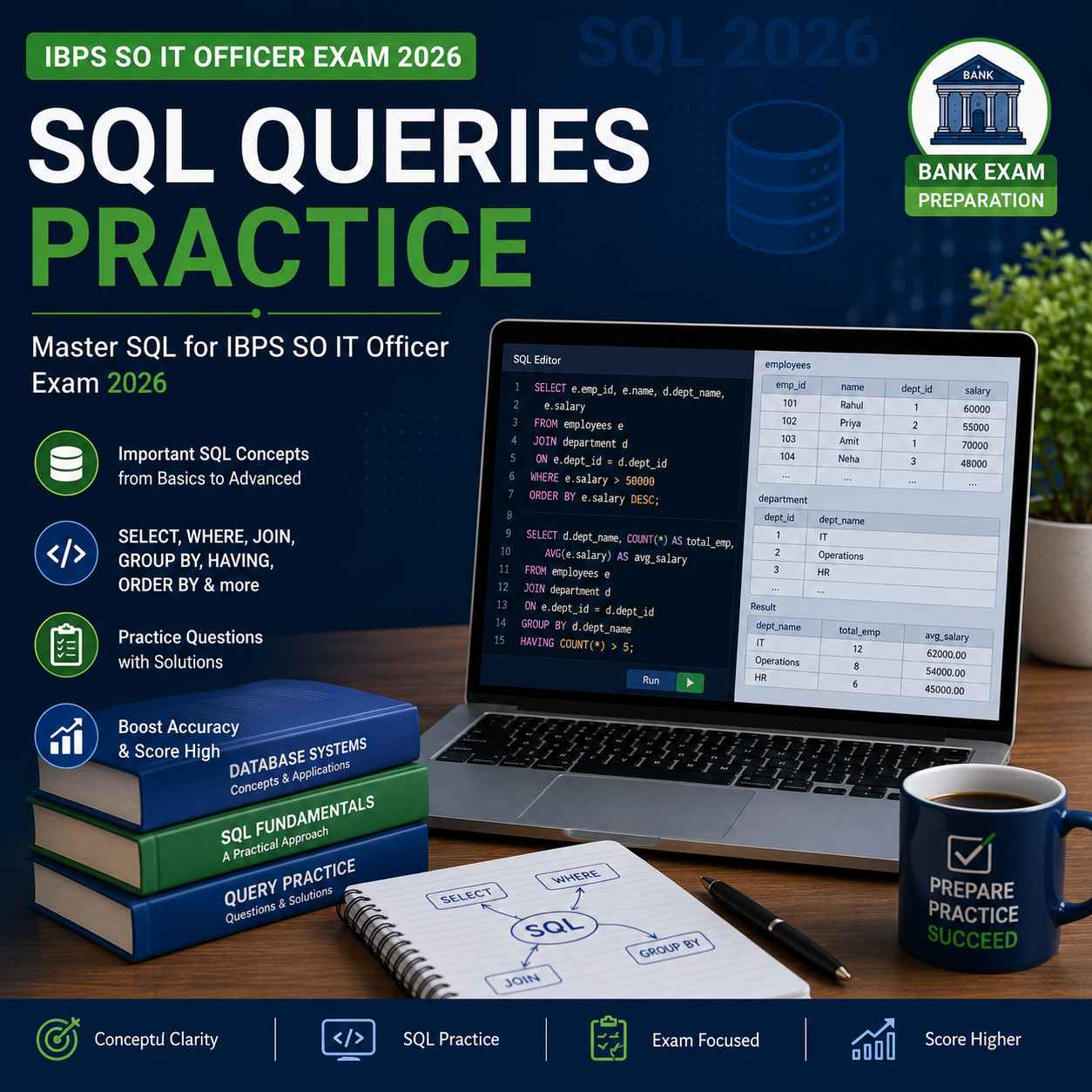
SQL stands for Structured Query Language. It is used to create, access and manage relational databases.
Main SQL categories:
| Category | Commands |
|---|---|
| DDL | CREATE, ALTER, DROP, TRUNCATE, RENAME |
| DML | INSERT, UPDATE, DELETE |
| DQL | SELECT |
| DCL | GRANT, REVOKE |
| TCL | COMMIT, ROLLBACK, SAVEPOINT |
Example:
SELECT name, salary
FROM employees
WHERE salary > 50000;
This query selects employee names and salaries where salary is greater than 50000.
Important SQL joins:
| Join | Meaning |
|---|---|
| INNER JOIN | Returns matching records from both tables |
| LEFT JOIN | All records from left table + matching from right |
| RIGHT JOIN | All records from right table + matching from left |
| FULL JOIN | All records from both tables |
SQL is one of the most scoring areas. Revise it from our guide on SQL for IBPS SO IT Officer 2026.
4. Operating System Notes
Operating System is system software that manages hardware, software resources and provides services to programs.
Examples:
- Windows
- Linux
- macOS
- Android
- iOS
Important OS topics:
- Process management
- Threads
- CPU scheduling
- Deadlock
- Memory management
- Paging
- Segmentation
- File system
- Virtual memory
- Semaphores
Process vs Program
| Program | Process |
|---|---|
| Passive entity | Active entity |
| Stored on disk | Loaded in memory |
| Does not execute by itself | Executes under CPU control |
A program becomes a process when it is loaded into memory and starts execution.
CPU Scheduling Algorithms
| Algorithm | Meaning |
|---|---|
| FCFS | First Come First Serve |
| SJF | Shortest Job First |
| Round Robin | Time quantum based scheduling |
| Priority Scheduling | Higher priority process executes first |
Round Robin is important in time-sharing systems because each process gets CPU for a fixed time quantum.
Deadlock Conditions
Deadlock occurs when processes wait forever for resources.
Four necessary conditions:
1. Mutual Exclusion
2. Hold and Wait
3. No Preemption
4. Circular Wait
If all four conditions exist together, deadlock can occur.
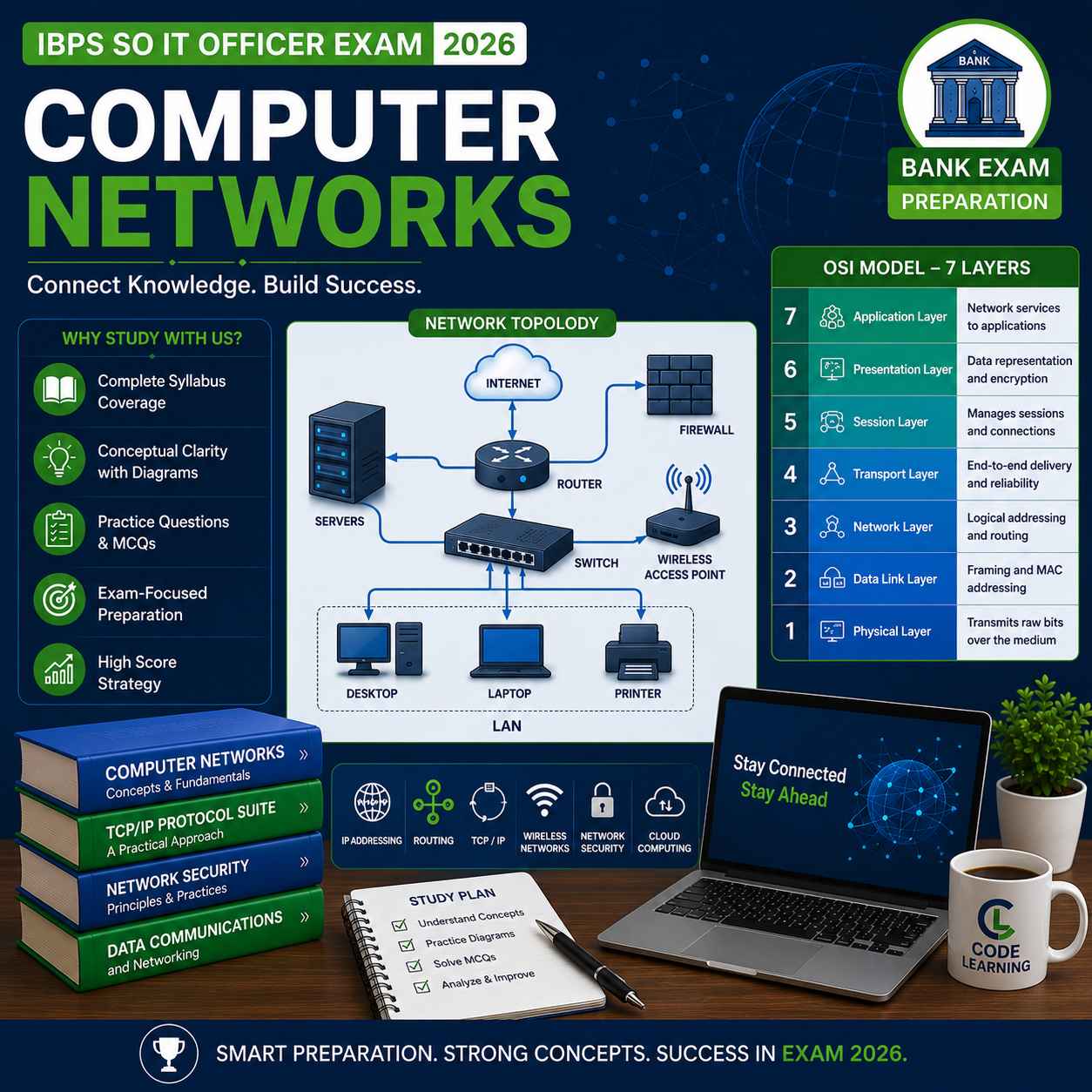
5. Computer Networks Notes
Computer Networks is one of the most important topics for IBPS SO IT Officer professional knowledge notes because many questions are direct and fact-based.
Important topics:
- OSI model
- TCP/IP model
- IP address
- DNS
- HTTP/HTTPS
- FTP
- SMTP
- POP3
- IMAP
- TCP vs UDP
- Network devices
- Routing basics
- LAN, MAN, WAN
OSI Model Layers
| Layer No. | Layer Name | Main Function |
|---|---|---|
| 7 | Application | User services like HTTP, FTP, SMTP |
| 6 | Presentation | Encryption, compression, translation |
| 5 | Session | Session management |
| 4 | Transport | End-to-end delivery |
| 3 | Network | Routing and IP addressing |
| 2 | Data Link | MAC address, frames |
| 1 | Physical | Transmission of bits |
Shortcut to remember:
All People Seem To Need Data ProcessingApplication, Presentation, Session, Transport, Network, Data Link, Physical.
TCP vs UDP
| TCP | UDP |
|---|---|
| Connection-oriented | Connectionless |
| Reliable | Fast but less reliable |
| Error checking available | Limited reliability |
| Used in HTTP, FTP, email | Used in streaming, gaming, DNS |
For full subject revision, read Computer Networks for IBPS SO IT Officer 2026.
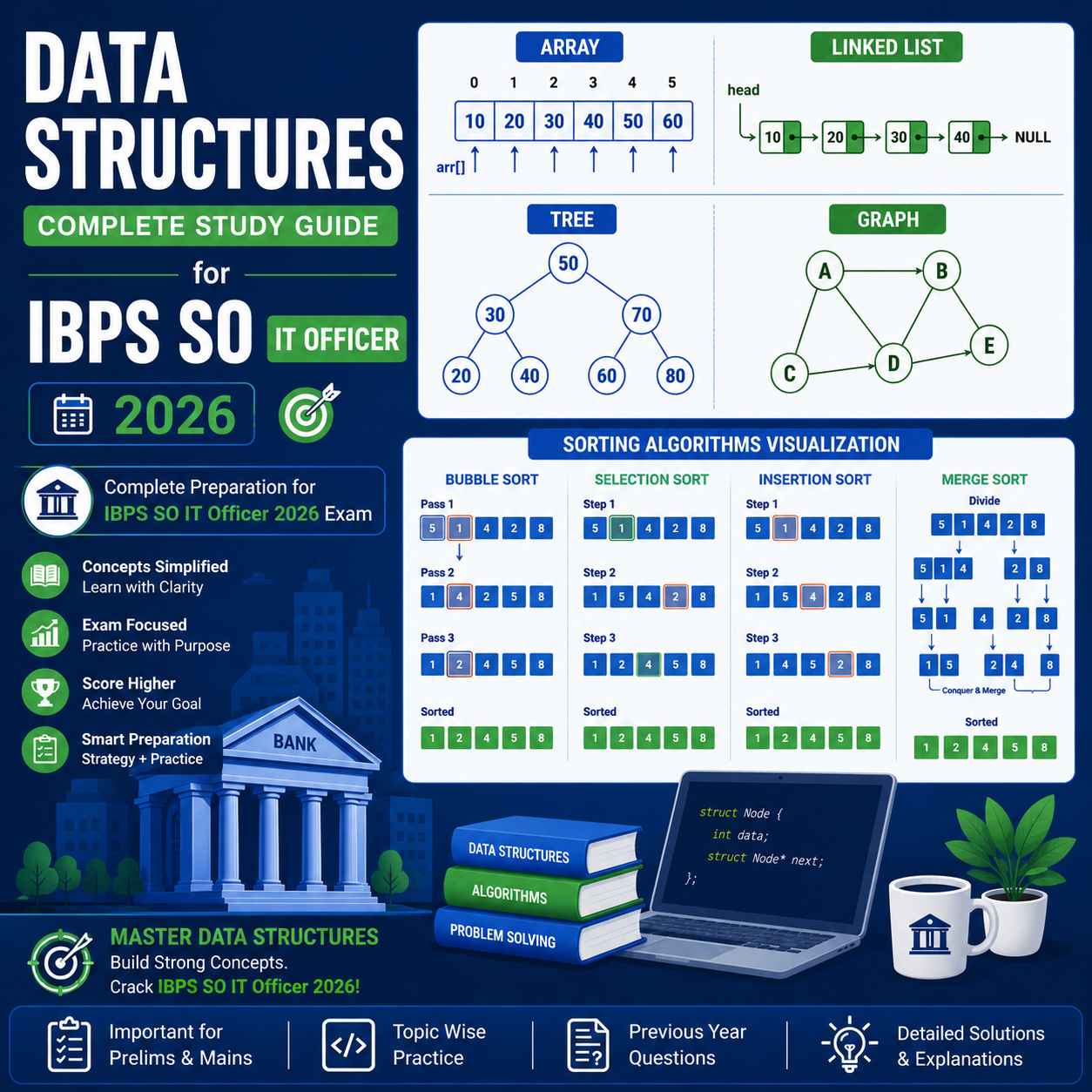
6. Data Structures Notes
Data Structure is a method of organizing data so that it can be used efficiently.
Important topics:
- Array
- Stack
- Queue
- Linked List
- Tree
- Graph
- Hashing
- Searching
- Sorting
Linear vs Non-Linear Data Structure
| Linear | Non-Linear |
|---|---|
| Data arranged sequentially | Data arranged hierarchically or graph form |
| Array, Stack, Queue, Linked List | Tree, Graph |
Stack
Stack follows LIFO:
Last In, First OutExample: Undo operation, browser back button, function call stack.
Main stack operations:
push
pop
peek
isEmpty
Queue
Queue follows FIFO:
First In, First OutExample: Printer queue, ticket counter queue, CPU scheduling queue.
Main queue operations:
enqueue
dequeue
front
rear
Data Structures can be revised from our detailed guide on Data Structures for IBPS SO IT Officer 2026.
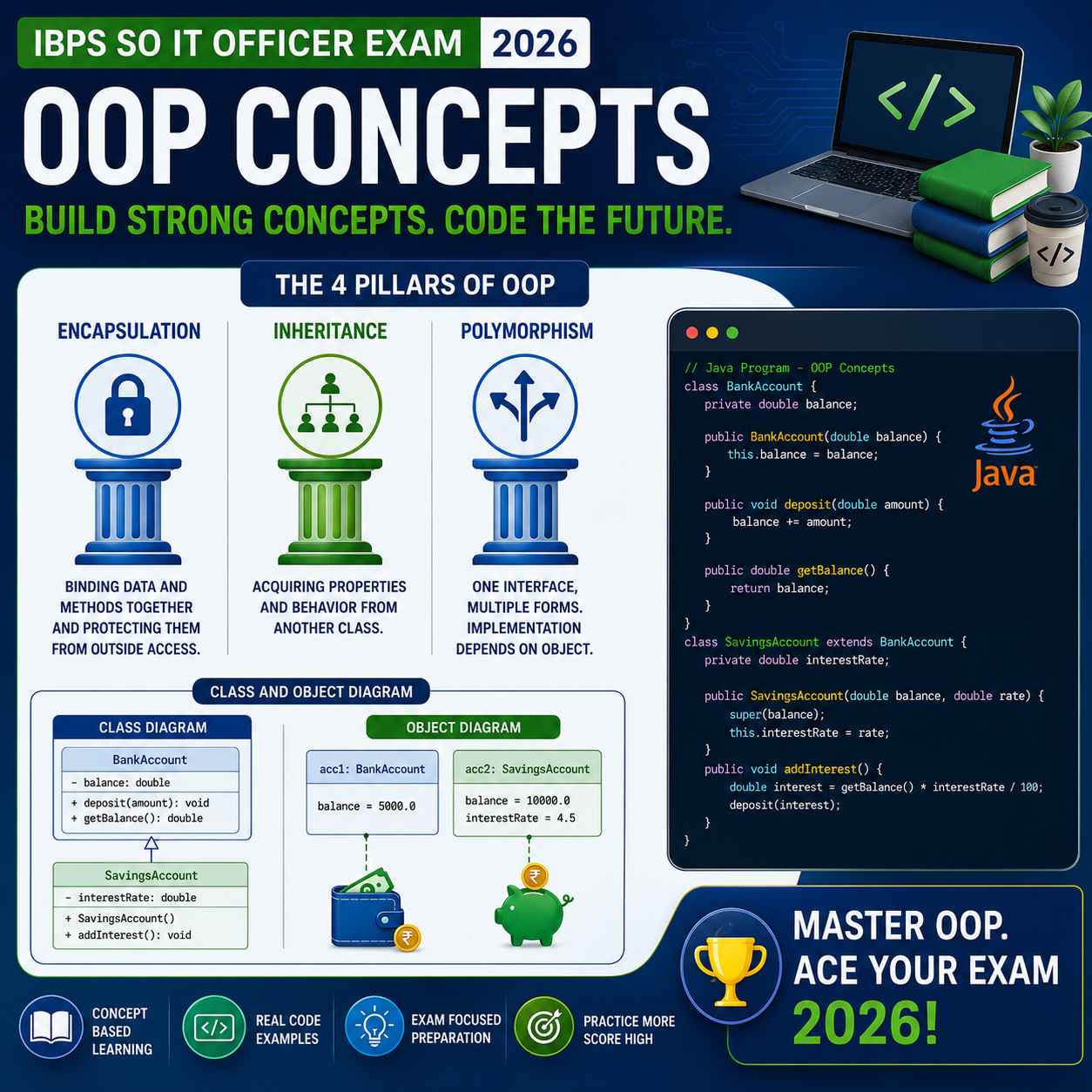
7. OOP Concepts Notes
OOP stands for Object-Oriented Programming. It is based on objects and classes.
Important OOP concepts:
- Class
- Object
- Encapsulation
- Inheritance
- Polymorphism
- Abstraction
Class and Object
A class is a blueprint. An object is an instance of a class.
Example:
class Student {
  String name;
  int marks;
}

Student s1 = new Student();
Here, Student is a class and s1 is an object.
Four Pillars of OOP
| Concept | Meaning |
|---|---|
| Encapsulation | Wrapping data and methods together |
| Inheritance | Acquiring properties of another class |
| Polymorphism | Same name, different behavior |
| Abstraction | Hiding internal details |
Example of polymorphism:
class Calculator {
  int add(int a, int b) {
    return a + b;
  }

  int add(int a, int b, int c) {
    return a + b + c;
  }
}
Here, method name is same, but parameters are different. This is method overloading.
Read our full article on OOP Concepts for IBPS SO IT Officer 2026 for complete revision.
8. Software Engineering Notes
Software Engineering deals with systematic development, testing and maintenance of software.
Important topics:
- SDLC
- Waterfall model
- Spiral model
- Agile model
- Testing
- Verification and validation
- Software maintenance
- Requirement analysis
SDLC Phases
| Phase | Work |
|---|---|
| Requirement Analysis | Understand user needs |
| Design | Plan architecture and design |
| Implementation | Coding |
| Testing | Find and fix bugs |
| Deployment | Release software |
| Maintenance | Updates and support |
Verification vs Validation
| Verification | Validation |
|---|---|
| Are we building the product right? | Are we building the right product? |
| Process-focused | Product-focused |
| Done before validation | Done after verification |
Software Engineering questions are usually theory-based and scoring if you revise definitions properly.
9. Computer Fundamentals Notes
Computer fundamentals questions are easy but should not be ignored.
Important topics:
- Input/output devices
- Memory
- CPU
- Cache
- RAM and ROM
- Primary and secondary storage
- Compiler and interpreter
- Number system
- Operating system basics
RAM vs ROM
| RAM | ROM |
|---|---|
| Volatile memory | Non-volatile memory |
| Temporary storage | Permanent instructions |
| Data lost when power off | Data retained |
| Faster access | Used for firmware |
Compiler vs Interpreter
| Compiler | Interpreter |
|---|---|
| Translates whole program at once | Translates line by line |
| Faster execution after compilation | Slower execution |
| Error shown after compilation | Error shown line by line |
Examples:
C/C++ → Compiler based
Python → Interpreter based
10. Web Technology Notes
Basic web technology is also useful for IT Officer exams.
Important topics:
- HTML
- CSS
- JavaScript basics
- HTTP
- HTTPS
- URL
- Browser
- Web server
- Client-server architecture
- Cookies
- Sessions
HTTP vs HTTPS
| HTTP | HTTPS |
|---|---|
| Not encrypted | Encrypted |
| Less secure | More secure |
| Port 80 | Port 443 |
| Uses no SSL/TLS | Uses SSL/TLS |
In banking, HTTPS is very important because secure communication is required for online transactions.
Client and Server
Client requests service. Server provides service.
Example:
Browser → Client
Website hosting machine → Server
When you open a banking website, your browser sends a request to the server, and the server sends back the web page.
11. Cyber Security Basics
Cyber security is important because banking systems handle sensitive customer and transaction data.
Important topics:
- Malware
- Virus
- Worm
- Trojan
- Phishing
- Firewall
- Encryption
- Digital signature
- Authentication
- Authorization
- Two-factor authentication
Authentication vs Authorization
| Authentication | Authorization |
|---|---|
| Confirms who you are | Confirms what you can access |
| Login with username/password | Access control after login |
Example:
First you log in to internet banking. That is authentication. Then the system checks whether you can view account details, transfer money or download statements. That is authorization.
Symmetric vs Asymmetric Encryption
| Symmetric Encryption | Asymmetric Encryption |
|---|---|
| Same key for encryption and decryption | Public key and private key pair |
| Faster | More secure for key exchange |
| Example: AES | Example: RSA |
Security questions are usually basic, but they are very relevant for banking IT roles.
High-Scoring Topics for Quick Revision
If you have limited time, revise these topics first:
| Subject | Must-Revise Topics |
|---|---|
| DBMS | Keys, normalization, SQL, ACID, transactions |
| OS | Process, scheduling, deadlock, memory management |
| CN | OSI, TCP/IP, protocols, IP address, devices |
| DSA | Stack, queue, tree, sorting, searching |
| OOP | Class, object, inheritance, polymorphism |
| Software Engineering | SDLC, testing, models |
| Security | Firewall, encryption, authentication |
These topics should be revised multiple times before the exam.
IBPS SO IT Officer Professional Knowledge Revision Plan
Use this 10-day revision plan:
| Day | Subject |
|---|---|
| Day 1 | DBMS keys, ER model, relational model |
| Day 2 | Normalization + SQL |
| Day 3 | Operating System process and scheduling |
| Day 4 | Deadlock + memory management |
| Day 5 | Computer Networks OSI + TCP/IP |
| Day 6 | Protocols + IP addressing |
| Day 7 | Data Structures |
| Day 8 | OOP + Programming basics |
| Day 9 | Software Engineering + Security |
| Day 10 | Full revision + MCQs |
Daily routine:
2 hours theory revision
1 hour MCQ practice
30 minutes error notebook revision
The error notebook is very important. Write every wrong question with the correct concept. Revise this notebook every 2 days.
25 Quick MCQs for IBPS SO IT Officer Professional Knowledge
Q1. Which key uniquely identifies a record in a table?
A. Foreign key
B. Primary key
C. Secondary key
D. Alternate file
Answer: B. Primary key
Q2. Which normal form removes partial dependency?
A. 1NF
B. 2NF
C. 3NF
D. BCNF
Answer: B. 2NF
Q3. Which SQL command is used to remove all rows from a table quickly?
A. DELETE
B. REMOVE
C. TRUNCATE
D. CLEAR
Answer: C. TRUNCATE
Q4. Which property of ACID ensures all-or-nothing transaction?
A. Atomicity
B. Consistency
C. Isolation
D. Durability
Answer: A. Atomicity
Q5. Which scheduling algorithm uses time quantum?
A. FCFS
B. SJF
C. Round Robin
D. Priority
Answer: C. Round Robin
Q6. Deadlock requires how many necessary conditions?
A. 2
B. 3
C. 4
D. 5
Answer: C. 4
Q7. Which OSI layer handles routing?
A. Data Link
B. Network
C. Transport
D. Session
Answer: B. Network
Q8. TCP is:
A. Connectionless
B. Connection-oriented
C. Unreliable
D. Only used in LAN
Answer: B. Connection-oriented
Q9. Which data structure follows LIFO?
A. Queue
B. Array
C. Stack
D. Tree
Answer: C. Stack
Q10. Queue follows:
A. LIFO
B. FIFO
C. FILO
D. Random order
Answer: B. FIFO
Q11. Which OOP concept hides implementation details?
A. Inheritance
B. Abstraction
C. Polymorphism
D. Compilation
Answer: B. Abstraction
Q12. Which model follows linear sequential approach?
A. Agile
B. Spiral
C. Waterfall
D. Prototype
Answer: C. Waterfall
Q13. HTTPS uses which default port?
A. 21
B. 25
C. 80
D. 443
Answer: D. 443
Q14. DNS is used to:
A. Encrypt files
B. Translate domain names to IP addresses
C. Store passwords
D. Format disks
Answer: B. Translate domain names to IP addresses
Q15. Which memory is volatile?
A. ROM
B. Hard Disk
C. RAM
D. DVD
Answer: C. RAM
Q16. Which command gives permission in SQL?
A. GRANT
B. TAKE
C. ALLOW
D. PERMIT
Answer: A. GRANT
Q17. Which is a DML command?
A. CREATE
B. INSERT
C. GRANT
D. COMMIT
Answer: B. INSERT
Q18. Which layer provides end-to-end delivery?
A. Physical
B. Data Link
C. Transport
D. Application
Answer: C. Transport
Q19. Firewall is used for:
A. Printing
B. Network security
C. File compression
D. Data entry
Answer: B. Network security
Q20. Which is an example of asymmetric encryption?
A. AES
B. RSA
C. DES
D. Caesar cipher
Answer: B. RSA
Q21. Which data structure is used in recursion internally?
A. Queue
B. Stack
C. Graph
D. Hash table
Answer: B. Stack
Q22. Which SQL clause is used for filtering rows?
A. ORDER BY
B. WHERE
C. GROUP BY
D. SELECT
Answer: B. WHERE
Q23. Which testing checks individual modules?
A. Unit testing
B. System testing
C. Acceptance testing
D. Regression testing
Answer: A. Unit testing
Q24. Which protocol is used for sending email?
A. FTP
B. SMTP
C. HTTP
D. DNS
Answer: B. SMTP
Q25. Which concept means same function name with different parameters?
A. Inheritance
B. Encapsulation
C. Method overloading
D. Abstraction
Answer: C. Method overloading
Frequently Asked Questions
Q1: What are IBPS SO IT Officer professional knowledge notes?
IBPS SO IT Officer professional knowledge notes are short revision notes covering technical subjects like DBMS, SQL, Operating System, Computer Networks, Data Structures, OOP, Software Engineering, Web Technology and Cyber Security.
Q2: Which subject is most important for IBPS SO IT Officer Professional Knowledge?
DBMS, SQL, Operating System and Computer Networks are among the most important subjects. These topics are concept-based, frequently revised by aspirants and useful for scoring in Professional Knowledge.
Q3: Is SQL important for IBPS SO IT Officer?
Yes, SQL is very important. You should revise DDL, DML, DCL, TCL, joins, keys, constraints, aggregate functions and basic query writing.
Q4: How many days are enough to revise Professional Knowledge?
If your basics are already clear, 10–15 days of focused revision can help. If you are starting from zero, you need more time and should study subject-wise.
Q5: Should I study deep theory for IBPS SO IT Officer?
No, you should focus on exam-oriented theory, definitions, differences, commands, MCQs and previous year pattern. Very deep college-level theory is not needed for every topic.
Q6: Are Computer Networks important for IBPS SO IT Officer?
Yes, Computer Networks is important. Revise OSI model, TCP/IP, protocols, IP address, DNS, HTTP, HTTPS, SMTP, FTP, routers, switches and firewalls.
Q7: How should I practice MCQs for Professional Knowledge?
Study one topic first, then solve 20–30 MCQs from that topic. Mark wrong questions and revise the related concept. This is better than solving random MCQs without revision.
Q8: What should I revise in the last week before IBPS SO IT Officer exam?
In the last week, revise DBMS, SQL, OS, CN, DSA basics, OOP, Software Engineering models, security basics and your error notebook. Avoid starting completely new topics at the last moment.









5 comments on “IBPS SO IT Officer Professional Knowledge Notes 2026: Complete Revision Guide”