

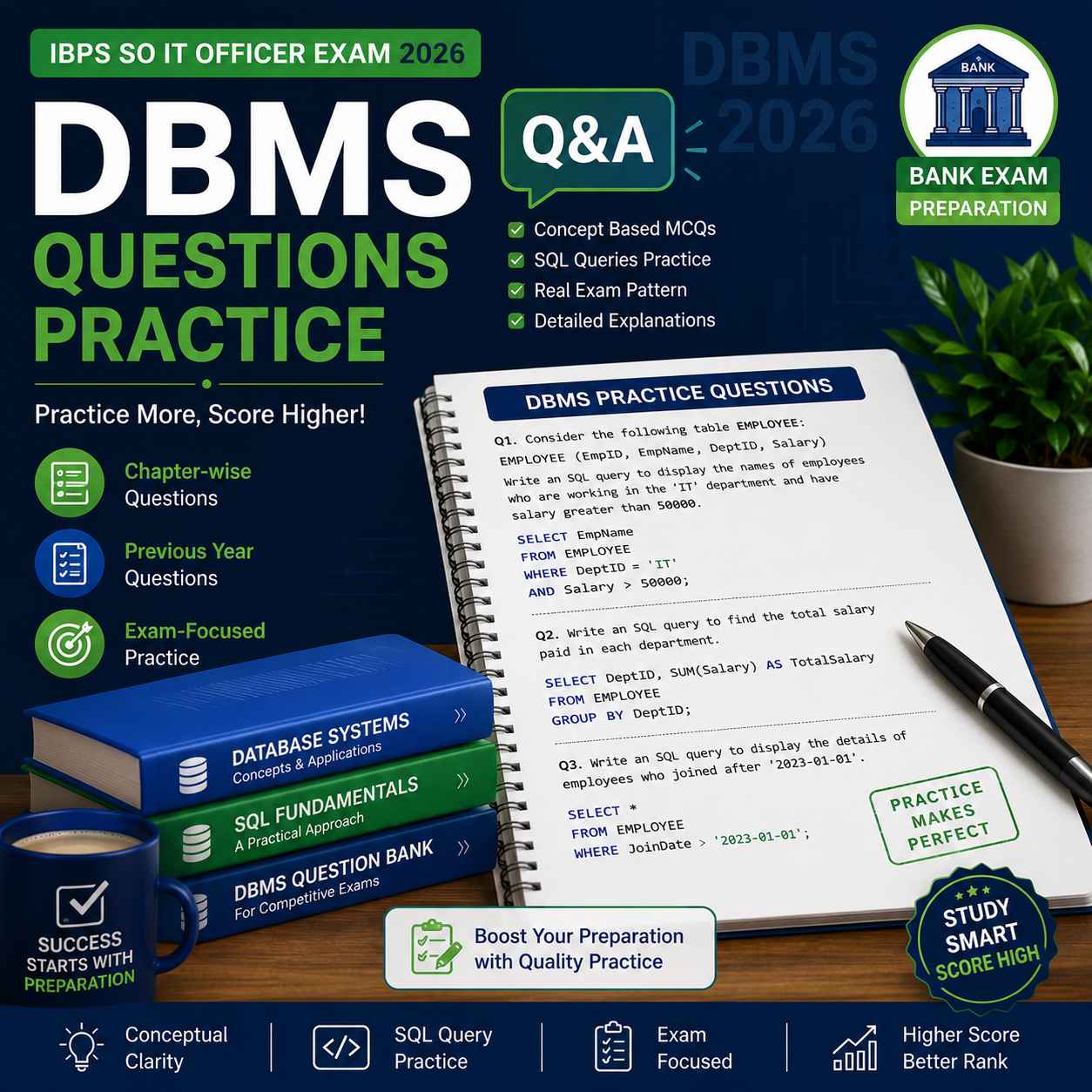
IBPS SO IT Officer DBMS MCQ 2026 practice is very important if you want to score well in the Professional Knowledge section.
DBMS is one of the most scoring subjects for IT Officer exams because many questions are direct, concept-based and easy to revise. Topics like keys, normalization, SQL commands, transactions, ACID properties, joins, relational model and indexing are repeatedly asked in banking IT exams.
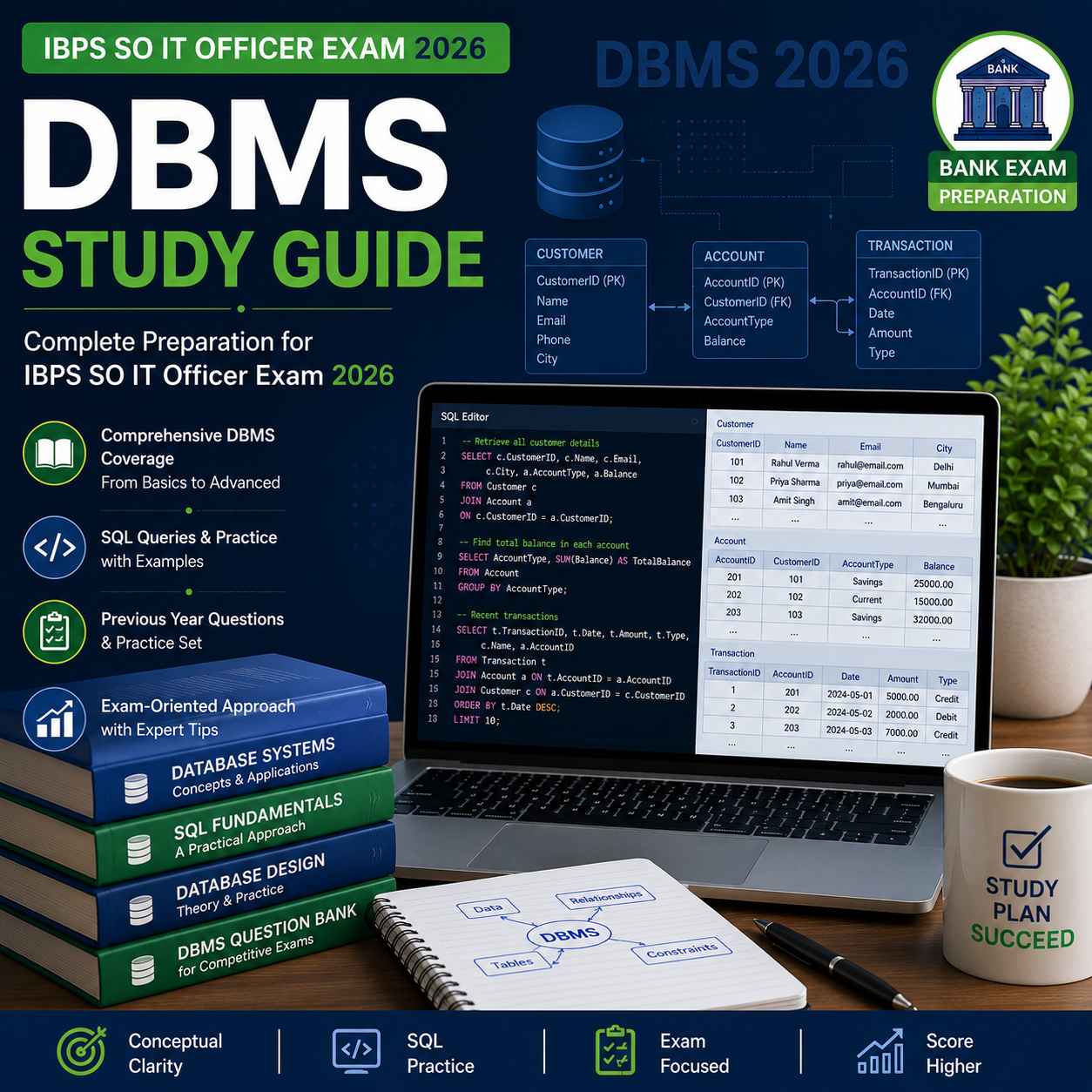
This article gives you 50 important DBMS MCQs with answers. These questions are useful for quick revision, last-minute practice and topic-wise preparation. Before solving MCQs, you can also revise our complete DBMS for IBPS SO IT Officer 2026 guide.
For official recruitment updates, always check the IBPS official website. For deeper DBMS concepts, you can refer to the GeeksforGeeks DBMS tutorial.
This IBPS SO IT Officer DBMS MCQ 2026 practice guide is created for quick revision, so you can revise important DBMS topics and solve exam-style questions in one place.
Why DBMS Is Important for IBPS SO IT Officer
DBMS stands for Database Management System. It is software used to store, manage, retrieve and organize data. In banking systems, DBMS is very important because customer details, account records, transactions, loans, cards, KYC data and digital banking logs are stored in databases.
For IBPS SO IT Officer, DBMS questions usually come from:
Database basics
Relational model
Keys
SQL commands
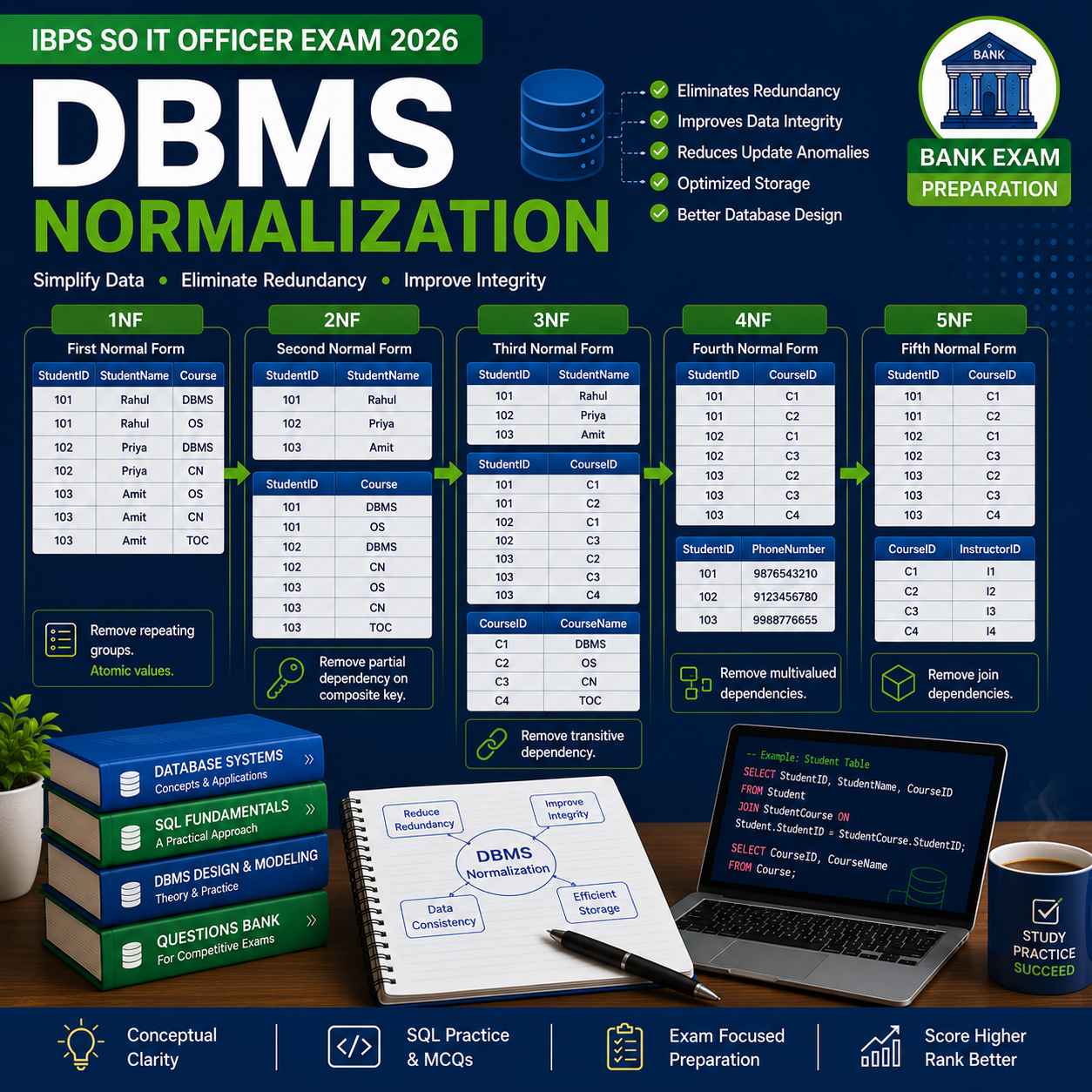
Normalization
Functional dependency
Transactions
ACID properties
Concurrency control
Indexing
Joins
Views
Constraints
DBMS is scoring because most questions are not lengthy. If your concepts are clear, you can answer quickly. You should revise theory first, then solve MCQs daily.
If you want subject-wise preparation, also read IBPS SO IT Officer Professional Knowledge Notes.
If you are short on time, this IBPS SO IT Officer DBMS MCQ 2026 set will help you revise high-priority topics quickly.
How to Practice IBPS SO IT Officer DBMS MCQ 2026
Do not solve MCQs randomly. Follow this method:
Step 1: Revise one topic
Step 2: Solve 20–30 MCQs
Step 3: Mark wrong questions
Step 4: Read the explanation
Step 5: Revise mistakes next day
For example, if you are revising normalization, first understand 1NF, 2NF, 3NF and BCNF. Then solve only normalization MCQs. This gives better clarity.
For normalization revision, you can use our detailed article on DBMS Normalization for IBPS SO IT Officer.
Important DBMS Topics for IBPS SO IT Officer
| Topic | Priority |
|---|---|
| Keys | High |
| SQL Commands | High |
| Normalization | High |
| Functional Dependency | High |
| Transactions | High |
| ACID Properties | High |
| Joins | High |
| Relational Model | Medium |
| Indexing | Medium |
| Concurrency Control | Medium |
| ER Model | Medium |
| Views | Medium |
If you have limited time, focus on keys, SQL, normalization, transactions and joins first.
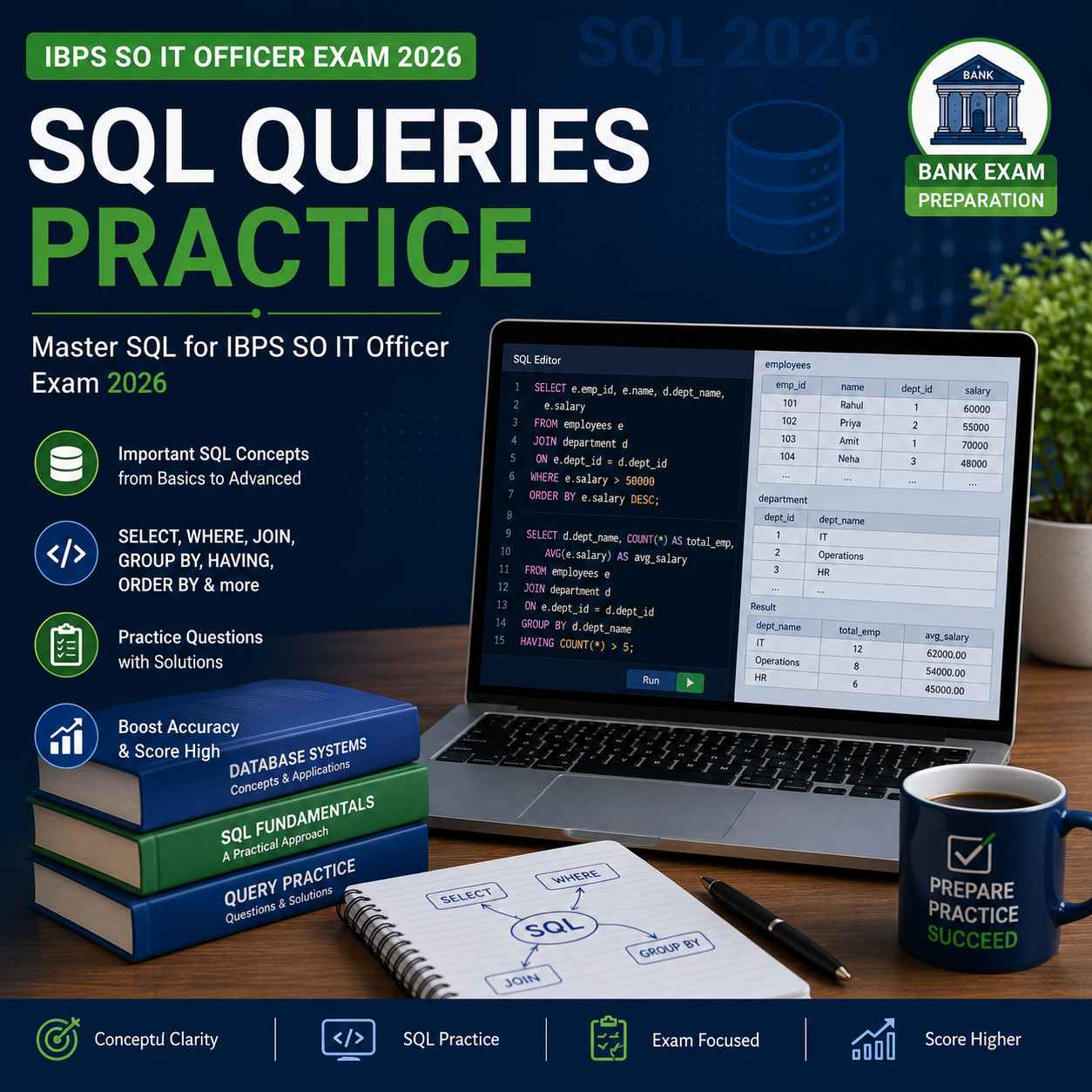
For SQL-specific revision, read SQL for IBPS SO IT Officer 2026.
IBPS SO IT Officer DBMS MCQ 2026 — 50 Questions with Answers
Q1. DBMS stands for:
A. Data Backup Management System
B. Database Management System
C. Data Binary Management Software
D. Database Machine System
Answer: B. Database Management System
Q2. Which of the following is not a DBMS?
A. MySQL
B. Oracle
C. MS Word
D. PostgreSQL
Answer: C. MS Word
Q3. A collection of related data is called:
A. Table
B. Database
C. Tuple
D. Attribute
Answer: B. Database
Q4. In relational database, a row is also called:
A. Attribute
B. Domain
C. Tuple
D. Field
Answer: C. Tuple
Q5. In relational database, a column is also called:
A. Tuple
B. Attribute
C. Record
D. Relation
Answer: B. Attribute
Q6. Which key uniquely identifies each record in a table?
A. Foreign key
B. Primary key
C. Secondary key
D. Duplicate key
Answer: B. Primary key
Q7. A primary key can contain:
A. Only duplicate values
B. Only null values
C. Unique and non-null values
D. Random values
Answer: C. Unique and non-null values
Q8. A foreign key is used to:
A. Delete all records
B. Connect two tables
C. Encrypt database
D. Create duplicate data
Answer: B. Connect two tables
Q9. A candidate key is:
A. A key that can uniquely identify records
B. A duplicate key
C. A key with only null values
D. A password key
Answer: A. A key that can uniquely identify records
Q10. A super key is:
A. Any set of attributes that can uniquely identify a tuple
B. Only one attribute
C. Always a foreign key
D. Always duplicate
Answer: A. Any set of attributes that can uniquely identify a tuple
Q11. Which SQL command is used to create a table?
A. MAKE
B. CREATE
C. INSERT
D. ADD
Answer: B. CREATE
Q12. Which SQL command is used to insert data into a table?
A. ADD
B. INSERT
C. PUT
D. INCLUDE
Answer: B. INSERT
Q13. Which SQL command is used to remove a table structure permanently?
A. DELETE
B. REMOVE
C. DROP
D. CLEAR
Answer: C. DROP
Q14. Which SQL command removes all rows but keeps table structure?
A. DROP
B. TRUNCATE
C. DELETE DATABASE
D. REMOVE TABLE
Answer: B. TRUNCATE
Q15. Which command is a DDL command?
A. INSERT
B. UPDATE
C. CREATE
D. SELECT
Answer: C. CREATE
Q16. Which command is a DML command?
A. ALTER
B. DROP
C. UPDATE
D. CREATE
Answer: C. UPDATE
Q17. Which command belongs to DCL?
A. GRANT
B. SELECT
C. INSERT
D. COMMIT
Answer: A. GRANT
Q18. Which command belongs to TCL?
A. CREATE
B. ROLLBACK
C. SELECT
D. DROP
Answer: B. ROLLBACK
Q19. Which SQL command is used to retrieve data?
A. GET
B. SELECT
C. FETCH ONLY
D. SHOW DATA
Answer: B. SELECT
Q20. Which clause is used to filter rows in SQL?
A. ORDER BY
B. GROUP BY
C. WHERE
D. HAVING ONLY
Answer: C. WHERE
Q21. Which clause is used to sort query results?
A. SORT
B. ORDER BY
C. GROUP BY
D. WHERE
Answer: B. ORDER BY
Q22. Which SQL function counts rows?
A. SUM()
B. COUNT()
C. TOTAL()
D. NUMBER()
Answer: B. COUNT()
Q23. Which SQL function returns maximum value?
A. HIGH()
B. MAX()
C. TOP()
D. BIG()
Answer: B. MAX()
Q24. Which join returns only matching records from both tables?
A. LEFT JOIN
B. RIGHT JOIN
C. INNER JOIN
D. FULL JOIN
Answer: C. INNER JOIN
Q25. LEFT JOIN returns:
A. Only right table records
B. All left table records and matching right table records
C. Only matching records
D. No records
Answer: B. All left table records and matching right table records
DBMS Normalization MCQs
Q26. Normalization is used to:
A. Increase redundancy
B. Reduce redundancy
C. Delete database
D. Encrypt data
Answer: B. Reduce redundancy
Q27. 1NF means:
A. Data should be encrypted
B. Table should have atomic values
C. Table should have duplicate columns
D. Table should have no primary key
Answer: B. Table should have atomic values
Q28. Which normal form removes partial dependency?
A. 1NF
B. 2NF
C. 3NF
D. 4NF
Answer: B. 2NF
Q29. Which normal form removes transitive dependency?
A. 1NF
B. 2NF
C. 3NF
D. Unnormalized form
Answer: C. 3NF
Q30. BCNF is stronger than:
A. 1NF
B. 2NF
C. 3NF
D. No normal form
Answer: C. 3NF
Q31. Functional dependency is represented as:
A. A + B
B. A → B
C. A = B only
D. A / B
Answer: B. A → B
Q32. In A → B, A is called:
A. Dependent
B. Determinant
C. Tuple
D. Relation
Answer: B. Determinant
Q33. Partial dependency occurs when:
A. Non-prime attribute depends on part of composite key
B. Attribute depends on full key
C. Table has no key
D. Table is encrypted
Answer: A. Non-prime attribute depends on part of composite key
Q34. Transitive dependency occurs when:
A. A depends on B and B depends on C
B. A key has null value
C. Table has no attributes
D. Data is sorted
Answer: A. A depends on B and B depends on C
Q35. Which normal form is based on multivalued dependency?
A. 2NF
B. 3NF
C. 4NF
D. 1NF
Answer: C. 4NF
Transaction and ACID MCQs
Q36. A transaction is:
A. A single logical unit of work
B. Only a table name
C. Only a column
D. A database password
Answer: A. A single logical unit of work
Q37. ACID stands for:
A. Atomicity, Consistency, Isolation, Durability
B. Accuracy, Control, Index, Data
C. Access, Control, Input, Delete
D. Atomicity, Command, Insert, Drop
Answer: A. Atomicity, Consistency, Isolation, Durability
Q38. Which ACID property means all-or-nothing?
A. Consistency
B. Isolation
C. Atomicity
D. Durability
Answer: C. Atomicity
Q39. Which ACID property ensures database remains valid before and after transaction?
A. Consistency
B. Isolation
C. Atomicity
D. Durability
Answer: A. Consistency
Q40. Which ACID property ensures committed data is permanently saved?
A. Atomicity
B. Durability
C. Isolation
D. Consistency
Answer: B. Durability
Q41. Which command permanently saves transaction changes?
A. SAVE
B. COMMIT
C. STORE
D. FINAL
Answer: B. COMMIT
Q42. Which command undoes transaction changes?
A. ROLLBACK
B. DELETE
C. DROP
D. REMOVE
Answer: A. ROLLBACK
Q43. SAVEPOINT is used to:
A. Delete all records
B. Mark a point inside transaction
C. Create table
D. Create database
Answer: B. Mark a point inside transaction
Q44. Concurrency control is used when:
A. Multiple users access database at same time
B. Only one table exists
C. Database is empty
D. SQL is not used
Answer: A. Multiple users access database at same time
Q45. Dirty read is related to:
A. Normalization
B. Transaction concurrency problem
C. SQL table creation
D. Database backup only
Answer: B. Transaction concurrency problem
Advanced DBMS MCQs
Q46. Indexing is used to:
A. Slow down search
B. Speed up data retrieval
C. Delete records
D. Remove tables
Answer: B. Speed up data retrieval
Q47. A view is:
A. Physical copy of full database
B. Virtual table based on query result
C. Backup file
D. Primary key only
Answer: B. Virtual table based on query result
Q48. ER model is used for:
A. Database design
B. CPU scheduling
C. File compression
D. Network routing
Answer: A. Database design
Q49. In ER diagram, rectangle represents:
A. Relationship
B. Entity
C. Attribute
D. Key only
Answer: B. Entity
Q50. In ER diagram, diamond represents:
A. Entity
B. Attribute
C. Relationship
D. Tuple
Answer: C. Relationship
Quick Revision Table for DBMS
| Topic | Must Remember |
|---|---|
| Primary Key | Unique and not null |
| Foreign Key | Connects two tables |
| Candidate Key | Minimal unique key |
| 1NF | Atomic values |
| 2NF | No partial dependency |
| 3NF | No transitive dependency |
| BCNF | Stronger than 3NF |
| SQL DDL | CREATE, ALTER, DROP, TRUNCATE, RENAME |
| SQL DML | INSERT, UPDATE, DELETE |
| SQL DCL | GRANT, REVOKE |
| SQL TCL | COMMIT, ROLLBACK |
| Atomicity | All or nothing |
| Durability | Permanent after commit |
| View | Virtual table |
| Index | Speeds up search |
7-Day DBMS Revision Plan for IBPS SO IT Officer
| Day | Topic |
|---|---|
| Day 1 | DBMS basics, relational model, keys |
| Day 2 | SQL commands and clauses |
| Day 3 | Joins and aggregate functions |
| Day 4 | Normalization and functional dependency |
| Day 5 | Transactions and ACID properties |
| Day 6 | ER model, indexing, views |
| Day 7 | Full revision + 100 MCQs |
Daily practice routine:
45 minutes theory revision
45 minutes MCQ practice
20 minutes wrong-question notebook
This simple routine is enough if you follow it consistently.
You should also revise other Professional Knowledge subjects like Operating System and Computer Networks. Read our Operating System for IBPS SO IT Officer 2026 and Computer Networks for IBPS SO IT Officer 2026 articles for complete preparation.
Common DBMS Mistakes Students Make
The first mistake is confusing primary key, candidate key and super key. Remember: every candidate key is a super key, but every super key is not necessarily a candidate key.
The second mistake is mixing SQL categories. Many students confuse DDL, DML, DCL and TCL commands. Make a small table and revise it daily.
The third mistake is learning normalization only by definition. You should practice examples of 1NF, 2NF and 3NF.
The fourth mistake is ignoring transaction concepts. ACID properties are very important and easy to score.
The fifth mistake is solving MCQs without revising wrong answers. Your wrong questions are your real revision list.
Final Thought
IBPS SO IT Officer DBMS MCQ 2026 practice can improve your Professional Knowledge score quickly if you revise with the right method.
DBMS is not difficult when you divide it into small blocks: keys, SQL, normalization, transactions, joins, ER model and indexing. Start with basics, solve MCQs, revise mistakes and repeat.
For best results, revise DBMS along with SQL, Operating System, Computer Networks and Data Structures. If you follow this plan for 7–10 days, your DBMS confidence will become much stronger.
Frequently Asked Questions
Q1: Is DBMS important for IBPS SO IT Officer 2026?
Yes, DBMS is very important for IBPS SO IT Officer 2026 because questions from keys, SQL, normalization, transactions and ACID properties are commonly asked in Professional Knowledge.
Q2: What are the most important DBMS topics for IBPS SO?
The most important topics are primary key, foreign key, candidate key, normalization, SQL commands, joins, transactions, ACID properties, indexing and ER model.
Q3: How many DBMS MCQs should I solve before the exam?
You should solve at least 200–300 DBMS MCQs before the exam. Focus more on wrong answers and revise the related concepts again.
Q4: Is SQL part of DBMS for IBPS SO IT Officer?
Yes, SQL is an important part of DBMS. Revise DDL, DML, DCL, TCL, SELECT queries, WHERE clause, joins, aggregate functions and constraints.
Q5: What is the difference between primary key and foreign key?
A primary key uniquely identifies each record in a table. A foreign key connects one table with another table by referring to the primary key of another table.
Q6: Which normal forms are important for IBPS SO?
1NF, 2NF, 3NF and BCNF are most important. You should also know basic functional dependency and partial/transitive dependency.
Q7: Are transaction and ACID properties important?
Yes, transactions and ACID properties are very important. Atomicity, Consistency, Isolation and Durability are frequently asked concepts.
Q8: What is the best way to revise DBMS quickly?
Revise short notes, make command tables, solve topic-wise MCQs, and maintain an error notebook. Repeat wrong questions until the concept becomes clear.








1 comment on “IBPS SO IT Officer DBMS MCQ 2026: 50 Important Questions with Answers”