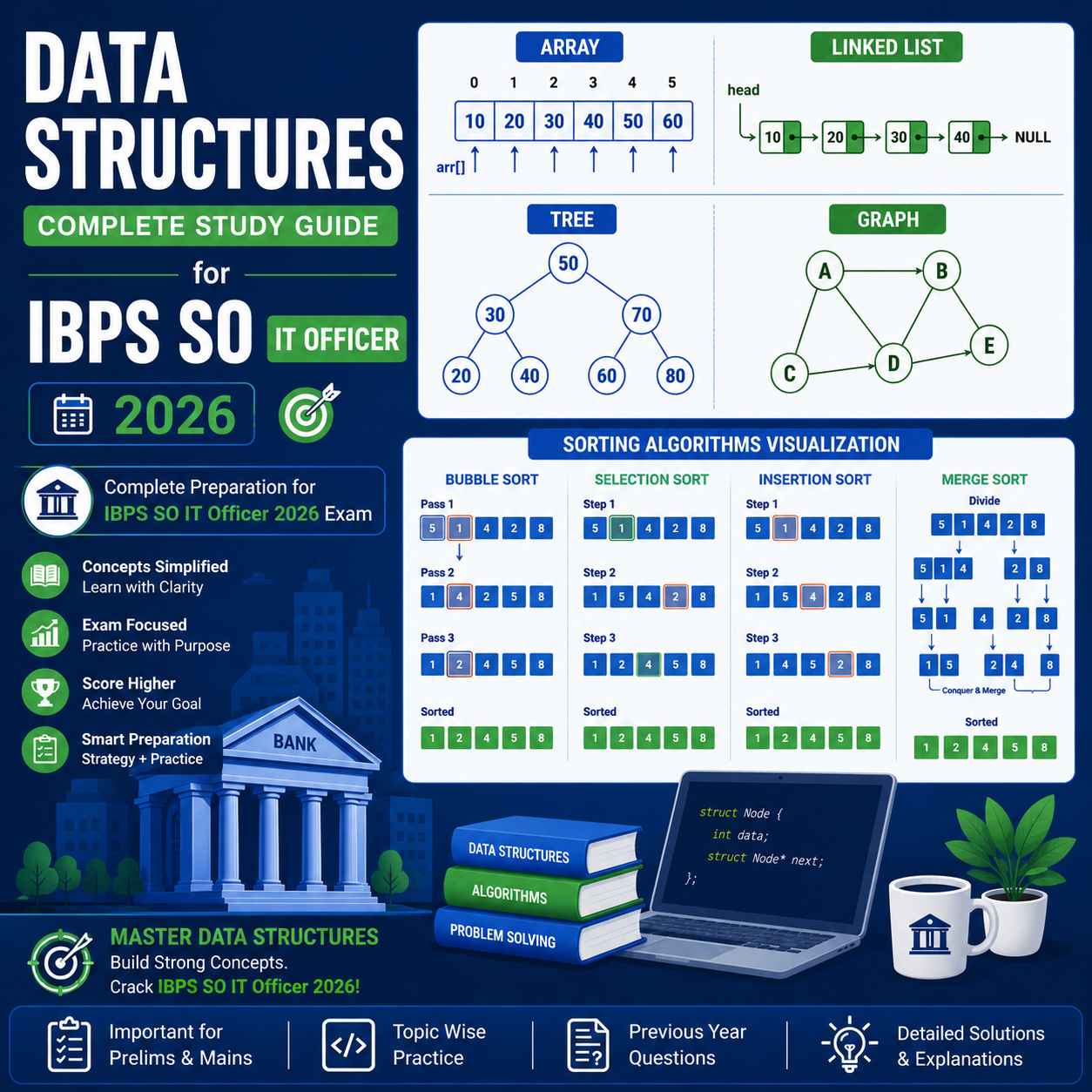
Data Structures MCQ for IBPS SO IT Officer 2026 is an important practice area for the Professional Knowledge section because data structures questions test both theory and logic.
Data Structures is not only useful for coding interviews. It is also important for IT Officer exams because topics like arrays, stacks, queues, linked lists, trees, graphs, hashing, searching and sorting are commonly asked in technical exams. The good thing is that many questions are direct if your basic definitions and operations are clear.
This article gives you 50 important Data Structures MCQs with answers for IBPS SO IT Officer preparation. You can use this as a quick revision set before the exam. For complete Professional Knowledge revision, also read our IBPS SO IT Officer Professional Knowledge Notes.
For official recruitment and exam updates, always check the IBPS official website. For extra conceptual understanding, you can also refer to the GeeksforGeeks Data Structures tutorial.
Why Data Structures Is Important for IBPS SO IT Officer
Data Structure is a way of organizing and storing data so that it can be accessed and modified efficiently.
Simple meaning:
Data Structure = Organized way to store and use dataIn banking IT systems, data structures are used in transaction processing, searching records, managing queues, storing hierarchical information, indexing, routing, and optimizing software performance.
For IBPS SO IT Officer, questions usually come from:
Arrays
Stacks
Queues
Linked Lists
Trees
Graphs
Hashing
Searching
Sorting
Time Complexity
Basic Algorithms
Data Structures MCQ for IBPS SO IT Officer 2026 should be practiced after revising short notes. If you directly solve questions without revising stack, queue, tree and graph basics, many options will look similar.
If you want full theory revision, read our detailed article on Data Structures for IBPS SO IT Officer 2026.
Important Data Structures Topics for IBPS SO
| Topic | Priority |
|---|---|
| Array | Very High |
| Stack | Very High |
| Queue | Very High |
| Linked List | High |
| Tree | High |
| Binary Tree | High |
| Binary Search Tree | High |
| Graph | Medium |
| Hashing | Medium |
| Sorting | High |
| Searching | High |
| Time Complexity | Medium |
If you have less time, focus on array, stack, queue, linked list, tree, searching and sorting first.
You should also revise DBMS and OS side by side because they are high-scoring Professional Knowledge subjects. Read DBMS for IBPS SO IT Officer 2026 and Operating System for IBPS SO IT Officer 2026 for subject-wise preparation.
Quick Revision Notes Before MCQs
Before solving Data Structures MCQ for IBPS SO IT Officer 2026, revise these short points.
Linear vs Non-Linear Data Structure
| Linear Data Structure | Non-Linear Data Structure |
|---|---|
| Data stored sequentially | Data stored hierarchically or connected |
| Easy traversal | Traversal may be complex |
| Array, Stack, Queue, Linked List | Tree, Graph |
Static vs Dynamic Data Structure
| Static | Dynamic |
|---|---|
| Fixed size | Size can change |
| Memory allocated at compile time | Memory allocated at runtime |
| Example: Array | Example: Linked List |
Stack
Stack follows:
LIFO = Last In, First OutMain operations:
push()
pop()
peek()
isEmpty()
Queue
Queue follows:
FIFO = First In, First OutMain operations:
enqueue()
dequeue()
front()
rear()
Searching
| Algorithm | Best Case | Average/Worst Case |
|---|---|---|
| Linear Search | O(1) | O(n) |
| Binary Search | O(1) | O(log n) |
Binary search works only on sorted data.
Sorting
Common sorting algorithms:
Bubble Sort
Selection Sort
Insertion Sort
Merge Sort
Quick Sort
Heap Sort
For algorithm basics, you can also check the Programiz Data Structures and Algorithms guide.
Data Structures MCQ for IBPS SO IT Officer 2026 — 50 Questions with Answers
Q1. Data structure is used to:
A. Store and organize data efficiently
B. Delete operating system
C. Increase monitor brightness
D. Format hard disk only
Answer: A. Store and organize data efficiently
Q2. Which of the following is a linear data structure?
A. Tree
B. Graph
C. Stack
D. Heap tree only
Answer: C. Stack
Q3. Which of the following is a non-linear data structure?
A. Array
B. Queue
C. Linked List
D. Tree
Answer: D. Tree
Q4. Array elements are stored in:
A. Random memory locations only
B. Contiguous memory locations
C. Separate files
D. Network packets
Answer: B. Contiguous memory locations
Q5. Array index usually starts from:
A. 1
B. 0
C. -1
D. 10
Answer: B. 0
Q6. Which data structure follows LIFO?
A. Queue
B. Stack
C. Tree
D. Graph
Answer: B. Stack
Q7. LIFO stands for:
A. Last In First Out
B. Last Input Final Output
C. Long Index First Out
D. Linear Input File Output
Answer: A. Last In First Out
Q8. Which operation inserts an element into stack?
A. enqueue
B. dequeue
C. push
D. pop
Answer: C. push
Q9. Which operation removes an element from stack?
A. push
B. pop
C. insert
D. search
Answer: B. pop
Q10. Stack overflow occurs when:
A. Stack is empty
B. Stack is full and push operation is performed
C. Queue is empty
D. Tree has no node
Answer: B. Stack is full and push operation is performed
Q11. Stack underflow occurs when:
A. Pop operation is performed on empty stack
B. Push operation is performed on full stack
C. Queue is full
D. Array is sorted
Answer: A. Pop operation is performed on empty stack
Q12. Which data structure is used in recursion internally?
A. Queue
B. Stack
C. Graph
D. Hash table
Answer: B. Stack
Q13. Queue follows:
A. LIFO
B. FIFO
C. FILO
D. Random order
Answer: B. FIFO
Q14. FIFO stands for:
A. First In First Out
B. First Input Final Output
C. File In File Out
D. Fast Input Fast Output
Answer: A. First In First Out
Q15. Which operation inserts an element into queue?
A. push
B. pop
C. enqueue
D. peek
Answer: C. enqueue
Linked List and Queue MCQs
Q16. Which operation removes an element from queue?
A. push
B. dequeue
C. pop
D. traverse
Answer: B. dequeue
Q17. A circular queue solves the problem of:
A. Wasted space in simple queue
B. Tree traversal
C. Graph cycle
D. Binary search
Answer: A. Wasted space in simple queue
Q18. Priority queue removes elements based on:
A. Random value
B. Priority
C. Insertion time only
D. Array index only
Answer: B. Priority
Q19. A linked list consists of:
A. Only array indexes
B. Nodes connected by links
C. Only files
D. Only database tables
Answer: B. Nodes connected by links
Q20. Each node in a singly linked list usually contains:
A. Data and next pointer
B. Only previous pointer
C. Only array index
D. Only priority
Answer: A. Data and next pointer
Q21. Advantage of linked list over array is:
A. Fixed size
B. Dynamic size
C. Contiguous memory requirement
D. No insertion possible
Answer: B. Dynamic size
Q22. Disadvantage of linked list is:
A. Easy random access
B. Extra memory for pointer
C. Fixed memory only
D. Cannot store data
Answer: B. Extra memory for pointer
Q23. In doubly linked list, each node contains:
A. Data only
B. Data, previous pointer and next pointer
C. Only next pointer
D. Only index
Answer: B. Data, previous pointer and next pointer
Q24. In circular linked list:
A. Last node points to first node
B. First node points to null only
C. No node is connected
D. Every node has two indexes
Answer: A. Last node points to first node
Q25. Traversing a linked list means:
A. Visiting each node
B. Deleting database
C. Sorting only first node
D. Creating operating system
Answer: A. Visiting each node
Tree and Graph MCQs
Q26. Tree is a:
A. Linear data structure
B. Non-linear data structure
C. File system only
D. Queue type only
Answer: B. Non-linear data structure
Q27. The top node of a tree is called:
A. Leaf
B. Root
C. Edge
D. Degree
Answer: B. Root
Q28. A node with no child is called:
A. Root
B. Parent
C. Leaf
D. Edge
Answer: C. Leaf
Q29. A binary tree node can have maximum:
A. 1 child
B. 2 children
C. 3 children
D. Unlimited children only
Answer: B. 2 children
Q30. In Binary Search Tree, left child is:
A. Greater than root
B. Smaller than root
C. Equal to root always
D. Not allowed
Answer: B. Smaller than root
Q31. In Binary Search Tree, right child is:
A. Smaller than root
B. Greater than root
C. Always null
D. Always equal
Answer: B. Greater than root
Q32. Inorder traversal of BST gives:
A. Random order
B. Descending order always
C. Sorted order
D. Reverse level order
Answer: C. Sorted order
Q33. Graph consists of:
A. Vertices and edges
B. Only arrays
C. Only stacks
D. Only queues
Answer: A. Vertices and edges
Q34. BFS stands for:
A. Binary First Search
B. Breadth First Search
C. Basic File Search
D. Balanced Fast Sorting
Answer: B. Breadth First Search
Q35. DFS stands for:
A. Depth First Search
B. Data File Search
C. Direct Fast Sort
D. Dynamic File System
Answer: A. Depth First Search
Searching, Sorting and Hashing MCQs
Q36. Linear search works on:
A. Only sorted arrays
B. Sorted and unsorted arrays
C. Only trees
D. Only graphs
Answer: B. Sorted and unsorted arrays
Q37. Binary search works only on:
A. Unsorted data
B. Sorted data
C. Stack only
D. Queue only
Answer: B. Sorted data
Q38. Time complexity of linear search in worst case is:
A. O(1)
B. O(log n)
C. O(n)
D. O(n²)
Answer: C. O(n)
Q39. Time complexity of binary search is:
A. O(n)
B. O(log n)
C. O(n²)
D. O(1) always
Answer: B. O(log n)
Q40. Bubble sort compares:
A. Adjacent elements
B. Only first and last elements
C. Only root nodes
D. Only queue elements
Answer: A. Adjacent elements
Q41. Which sorting algorithm uses divide and conquer?
A. Bubble Sort
B. Merge Sort
C. Linear Search
D. Sequential Search
Answer: B. Merge Sort
Q42. Quick Sort uses:
A. Pivot element
B. Root pointer only
C. Queue front only
D. Hash key only
Answer: A. Pivot element
Q43. Hashing is used for:
A. Fast data access
B. Slow searching
C. File deletion only
D. Display brightness
Answer: A. Fast data access
Q44. Collision in hashing occurs when:
A. Two keys produce same hash index
B. Array is empty
C. Stack is full
D. Queue is sorted
Answer: A. Two keys produce same hash index
Q45. Which method can be used to handle collision?
A. Chaining
B. Deleting all records
C. Formatting disk
D. Closing file only
Answer: A. Chaining
Time Complexity and Mixed MCQs
Q46. Big O notation is used to describe:
A. Algorithm complexity
B. File extension
C. Operating system name
D. SQL table
Answer: A. Algorithm complexity
Q47. O(1) means:
A. Constant time
B. Linear time
C. Logarithmic time
D. Quadratic time
Answer: A. Constant time
Q48. O(n) means:
A. Constant time
B. Linear time
C. Logarithmic time
D. No time
Answer: B. Linear time
Q49. Which data structure is best for implementing undo operation?
A. Stack
B. Queue
C. Graph
D. Hash table only
Answer: A. Stack
Q50. Which data structure is best for printer job scheduling?
A. Stack
B. Queue
C. Tree
D. Graph
Answer: B. Queue
Quick Revision Table for Data Structures
| Topic | Must Remember |
|---|---|
| Array | Contiguous memory |
| Stack | LIFO |
| Queue | FIFO |
| Linked List | Dynamic nodes |
| Tree | Hierarchical structure |
| Root | Top node |
| Leaf | Node with no child |
| Binary Tree | Max 2 children |
| BST | Left smaller, right greater |
| Graph | Vertices and edges |
| BFS | Breadth First Search |
| DFS | Depth First Search |
| Linear Search | O(n) |
| Binary Search | O(log n) |
| Hashing | Fast access |
7-Day Data Structures Revision Plan
Use this plan after solving Data Structures MCQ for IBPS SO IT Officer 2026 questions.
| Day | Topic |
|---|---|
| Day 1 | Array and basic data structure types |
| Day 2 | Stack and Queue |
| Day 3 | Linked List |
| Day 4 | Tree and Binary Search Tree |
| Day 5 | Graph, BFS and DFS |
| Day 6 | Searching, Sorting and Hashing |
| Day 7 | Full revision + 100 MCQs |
Daily practice routine:
45 minutes theory revision
45 minutes MCQ practice
20 minutes wrong-question notebook
This routine works because Data Structures has many repeated concepts. If you revise definitions and solve questions regularly, your accuracy will improve.
For complete subject coverage, revise Computer Networks MCQ for IBPS SO IT Officer 2026 and SQL for IBPS SO IT Officer 2026 also.
Common Mistakes Students Make in Data Structures
The first mistake is confusing stack and queue. Remember: stack follows LIFO, queue follows FIFO.
The second mistake is ignoring tree basics. Root, leaf, parent, child, level and height are simple but frequently asked terms.
The third mistake is mixing up BFS and DFS. BFS explores level by level, while DFS goes deep first.
The fourth mistake is forgetting that binary search needs sorted data. If the data is not sorted, binary search cannot be applied directly.
The fifth mistake is solving MCQs without understanding time complexity. At least revise O(1), O(n), O(log n), O(n log n) and O(n²).
The sixth mistake is not maintaining an error notebook. If you repeat the same wrong answer again, it means you did not revise the concept properly.
Frequently Asked Questions
Q1: Is Data Structures important for IBPS SO IT Officer 2026?
Yes, Data Structures is important for IBPS SO IT Officer 2026 because questions from array, stack, queue, linked list, tree, graph, searching and sorting are commonly asked in Professional Knowledge.
Q2: What are the most important Data Structures topics for IBPS SO?
The most important topics are array, stack, queue, linked list, tree, binary search tree, graph, BFS, DFS, searching, sorting, hashing and time complexity.
Q3: How many Data Structures MCQs should I solve before the exam?
You should solve at least 200–300 Data Structures MCQs before the exam. Focus more on wrong questions and revise those topics again.
Q4: What is the difference between stack and queue?
Stack follows LIFO, which means Last In First Out. Queue follows FIFO, which means First In First Out.
Q5: Is binary search important for IBPS SO IT Officer?
Yes, binary search is important. Remember that binary search works only on sorted data and its time complexity is O(log n).
Q6: Are trees and graphs asked in IBPS SO IT Officer?
Yes, basic questions from trees and graphs can be asked. Revise root, leaf, binary tree, BST, BFS, DFS, vertices and edges.
Q7: Which data structure is used in recursion?
Stack is used internally in recursion because function calls are stored and handled in stack order.
Q8: How should I revise Data Structures quickly?
Revise short notes, make difference tables, solve topic-wise MCQs, and maintain a wrong-question notebook. Repeat the wrong questions regularly.