
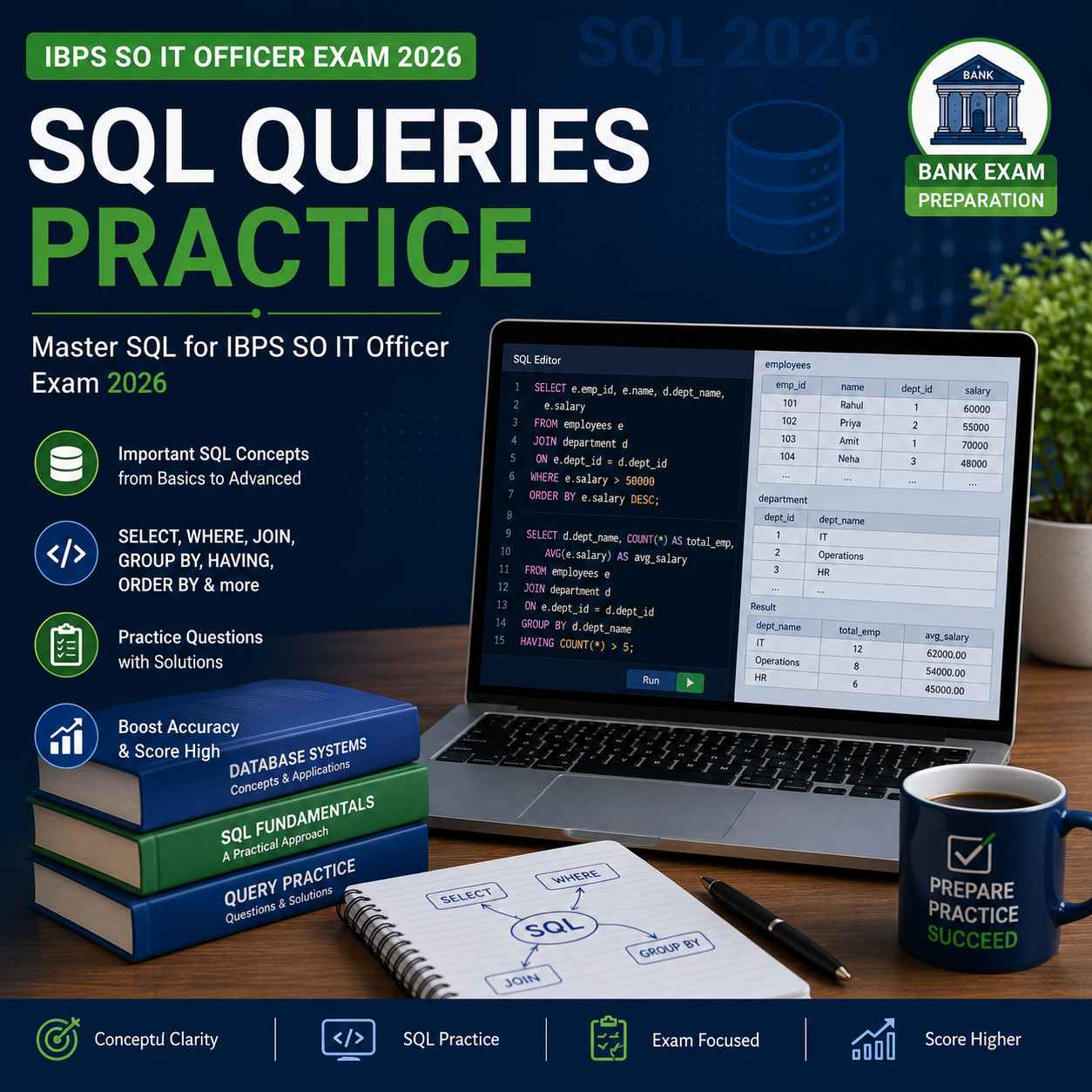
Master SQL for IBPS SO IT Officer 2026 with our complete guide featuring top 50 practice questions, real exam patterns, and proven strategies. SQL is one of the highest-scoring topics in the IBPS SO IT Officer Professional Knowledge section, contributing nearly 8-12 marks every year. With smart preparation, you can score 100% in this section and significantly boost your overall rank.
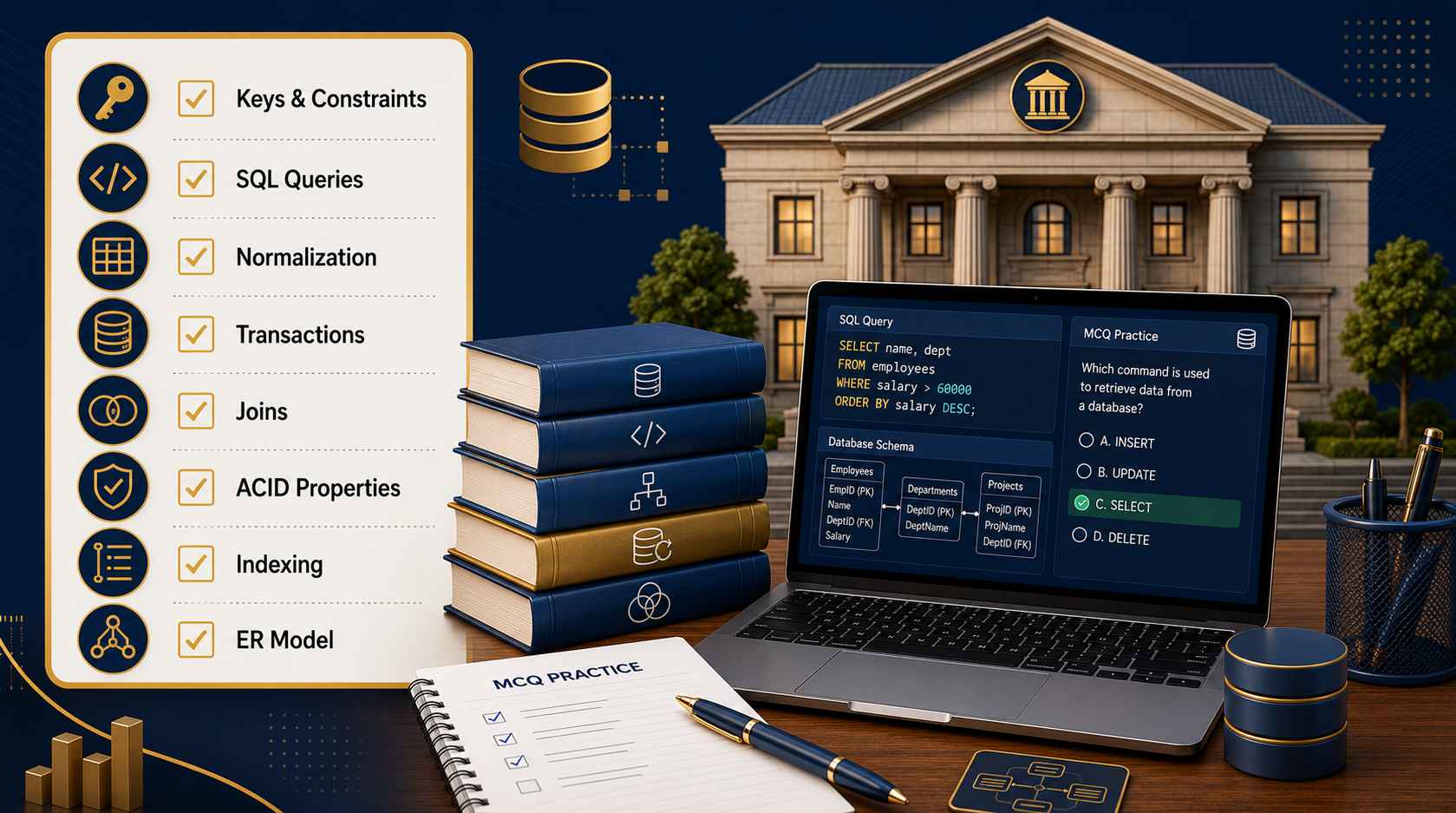
In this comprehensive guide, we’ll cover all SQL concepts, command categories (DDL, DML, DCL, TCL), joins, subqueries, aggregate functions, and the most frequently asked questions in previous years’ papers. Whether you’re a beginner or revising before exam, this SQL for IBPS SO IT Officer 2026 guide is everything you need to crack the SQL section confidently.
Why SQL is Important for IBPS SO IT Officer 2026 Exam
SQL (Structured Query Language) holds significant importance in the IBPS SO IT Officer 2026 exam. Here’s why mastering SQL is critical for your success:
- Direct Questions: 6-10 SQL questions appear in Professional Knowledge section every year.
- Highest Scoring: SQL questions are logical and direct, easier than theory topics.
- Job Relevance: As a bank IT officer, you’ll write SQL queries daily for database operations.
- Common Across Exams: Same SQL syllabus appears in CIL MT, SBI SO, RBI Grade B exams.
- Practical Skills: SQL knowledge helps in interview rounds and on-job tasks.
Complete SQL Syllabus for IBPS SO IT Officer 2026
Understanding the complete syllabus helps you focus on high-yield topics. Here’s the detailed SQL for IBPS SO IT Officer 2026 syllabus breakdown with expected weightage:
| Topic | Sub-Topics | Expected Questions | Difficulty |
|---|---|---|---|
| SQL Basics | Introduction, Datatypes, Syntax | 1-2 | Easy |
| DDL Commands | CREATE, ALTER, DROP, TRUNCATE | 1-2 | Easy |
| DML Commands | SELECT, INSERT, UPDATE, DELETE | 2-3 | Easy-Medium |
| DCL & TCL | GRANT, REVOKE, COMMIT, ROLLBACK | 1 | Easy |
| Joins | INNER, LEFT, RIGHT, FULL, CROSS | 2-3 | Medium |
| Aggregate Functions | COUNT, SUM, AVG, MAX, MIN | 1-2 | Easy-Medium |
| Subqueries | Nested queries, Correlated | 1-2 | Medium-Hard |
| Constraints | NOT NULL, UNIQUE, PRIMARY, FOREIGN | 1-2 | Medium |
SQL Command Categories — Most Asked in IBPS SO IT Officer
SQL commands are categorized into 5 main types. This is a guaranteed question in the SQL for IBPS SO IT Officer 2026 exam. Memorize these categories with examples:
1. DDL (Data Definition Language)
Used to define database structure. These commands affect the schema:
-- CREATE: Creates new table
CREATE TABLE Employee (
    emp_id INT PRIMARY KEY,
    name VARCHAR(50),
    salary DECIMAL(10,2)
);

-- ALTER: Modifies existing table
ALTER TABLE Employee ADD COLUMN department VARCHAR(30);

-- DROP: Deletes table permanently
DROP TABLE Employee;

-- TRUNCATE: Removes all data but keeps structure
TRUNCATE TABLE Employee;

-- RENAME: Renames table
RENAME TABLE Employee TO Staff;
2. DML (Data Manipulation Language)
Used to manipulate data within tables:
-- SELECT: Retrieve data
SELECT * FROM Employee WHERE salary > 50000;

-- INSERT: Add new records
INSERT INTO Employee VALUES (1, 'Rahul', 75000);

-- UPDATE: Modify existing records
UPDATE Employee SET salary = 80000 WHERE emp_id = 1;

-- DELETE: Remove specific records
DELETE FROM Employee WHERE emp_id = 1;
3. DCL (Data Control Language)
Used to control access permissions:
-- GRANT: Give permissions
GRANT SELECT, INSERT ON Employee TO user1;

-- REVOKE: Remove permissions
REVOKE INSERT ON Employee FROM user1;
4. TCL (Transaction Control Language)
Used to manage transactions:
-- COMMIT: Save all changes
COMMIT;

-- ROLLBACK: Undo changes
ROLLBACK;

-- SAVEPOINT: Set checkpoint
SAVEPOINT before_update;
5. DQL (Data Query Language)
Used for querying data — primarily SELECT statement (sometimes considered part of DML).
SQL Joins — Critical Topic for IBPS SO 2026
SQL Joins are tested every year in IBPS SO IT Officer exam. Master all 5 types of joins with clear understanding:
| Join Type | Description | Result |
|---|---|---|
| INNER JOIN | Returns matching rows from both tables | Only matching records |
| LEFT JOIN | Returns all rows from left + matching from right | Left table all + matched right |
| RIGHT JOIN | Returns all rows from right + matching from left | Right table all + matched left |
| FULL OUTER JOIN | Returns all rows from both tables | All records, NULL for non-matches |
| CROSS JOIN | Cartesian product of both tables | Every row combined with every row |
Join Examples for IBPS SO Exam:
-- INNER JOIN Example
SELECT e.name, d.dept_name
FROM Employee e
INNER JOIN Department d ON e.dept_id = d.dept_id;

-- LEFT JOIN Example
SELECT e.name, d.dept_name
FROM Employee e
LEFT JOIN Department d ON e.dept_id = d.dept_id;

-- Multiple table join
SELECT e.name, d.dept_name, p.project_name
FROM Employee e
INNER JOIN Department d ON e.dept_id = d.dept_id
INNER JOIN Project p ON e.emp_id = p.emp_id;
Aggregate Functions — Quick Score Topics for SQL IBPS SO
Aggregate functions are easy-to-score topics in SQL for IBPS SO IT Officer 2026. Expect 1-2 direct questions every year:
- COUNT(): Counts number of rows. Example:
SELECT COUNT(*) FROM Employee; - SUM(): Sums numerical column. Example:
SELECT SUM(salary) FROM Employee; - AVG(): Calculates average. Example:
SELECT AVG(salary) FROM Employee; - MAX(): Returns maximum value. Example:
SELECT MAX(salary) FROM Employee; - MIN(): Returns minimum value. Example:
SELECT MIN(salary) FROM Employee;
GROUP BY and HAVING Clauses:
-- GROUP BY: Groups rows by column
SELECT dept_id, COUNT(*), AVG(salary)
FROM Employee
GROUP BY dept_id;

-- HAVING: Filters grouped results
SELECT dept_id, AVG(salary)
FROM Employee
GROUP BY dept_id
HAVING AVG(salary) > 60000;

-- Difference: WHERE filters rows; HAVING filters groups
Top 50 SQL Queries for IBPS SO IT Officer 2026 Practice
Here are the most important SQL queries you must practice for SQL for IBPS SO IT Officer 2026. These are based on previous year patterns and high-probability questions:
Basic SELECT Queries (Q1-Q10):
-- Q1: Select all employees
SELECT * FROM Employee;

-- Q2: Select specific columns
SELECT name, salary FROM Employee;

-- Q3: Filter with WHERE
SELECT * FROM Employee WHERE salary > 50000;

-- Q4: Sort results
SELECT * FROM Employee ORDER BY salary DESC;

-- Q5: Limit results
SELECT * FROM Employee LIMIT 10;

-- Q6: Distinct values
SELECT DISTINCT department FROM Employee;

-- Q7: Multiple conditions
SELECT * FROM Employee
WHERE salary > 50000 AND department = 'IT';

-- Q8: Pattern matching
SELECT * FROM Employee WHERE name LIKE 'R%';

-- Q9: BETWEEN clause
SELECT * FROM Employee
WHERE salary BETWEEN 40000 AND 80000;

-- Q10: IN operator
SELECT * FROM Employee
WHERE department IN ('IT', 'HR', 'Sales');
Aggregate & GROUP BY Queries (Q11-Q20):
-- Q11: Count employees
SELECT COUNT(*) FROM Employee;

-- Q12: Sum of salaries
SELECT SUM(salary) FROM Employee;

-- Q13: Average salary
SELECT AVG(salary) FROM Employee;

-- Q14: Maximum salary
SELECT MAX(salary) FROM Employee;

-- Q15: Group by department
SELECT department, COUNT(*)
FROM Employee GROUP BY department;

-- Q16: Average salary per department
SELECT department, AVG(salary)
FROM Employee GROUP BY department;

-- Q17: Departments with avg salary > 60000
SELECT department, AVG(salary)
FROM Employee
GROUP BY department
HAVING AVG(salary) > 60000;

-- Q18: Count non-null values
SELECT COUNT(department) FROM Employee;

-- Q19: Min and Max together
SELECT MIN(salary), MAX(salary) FROM Employee;

-- Q20: Total departments
SELECT COUNT(DISTINCT department) FROM Employee;
JOIN Queries (Q21-Q30):
-- Q21: Inner join
SELECT e.name, d.dept_name
FROM Employee e
INNER JOIN Department d ON e.dept_id = d.id;

-- Q22: Left join
SELECT e.name, d.dept_name
FROM Employee e
LEFT JOIN Department d ON e.dept_id = d.id;

-- Q23: Right join
SELECT e.name, d.dept_name
FROM Employee e
RIGHT JOIN Department d ON e.dept_id = d.id;

-- Q24: Full outer join
SELECT e.name, d.dept_name
FROM Employee e
FULL OUTER JOIN Department d ON e.dept_id = d.id;

-- Q25: Self join (find managers)
SELECT e1.name AS Employee, e2.name AS Manager
FROM Employee e1
INNER JOIN Employee e2 ON e1.manager_id = e2.emp_id;

-- Q26: Multiple joins
SELECT e.name, d.dept_name, p.project_name
FROM Employee e
JOIN Department d ON e.dept_id = d.id
JOIN Project p ON e.emp_id = p.emp_id;

-- Q27: Join with WHERE
SELECT e.name, d.dept_name
FROM Employee e
INNER JOIN Department d ON e.dept_id = d.id
WHERE e.salary > 60000;

-- Q28: Join with GROUP BY
SELECT d.dept_name, COUNT(e.emp_id)
FROM Department d
LEFT JOIN Employee e ON d.id = e.dept_id
GROUP BY d.dept_name;

-- Q29: Cross join
SELECT * FROM Employee CROSS JOIN Department;

-- Q30: Natural join
SELECT * FROM Employee NATURAL JOIN Department;
Subquery Questions (Q31-Q40):
-- Q31: Employees above average salary
SELECT * FROM Employee
WHERE salary > (SELECT AVG(salary) FROM Employee);

-- Q32: Second highest salary
SELECT MAX(salary) FROM Employee
WHERE salary < (SELECT MAX(salary) FROM Employee);

-- Q33: Nth highest salary
SELECT salary FROM Employee
ORDER BY salary DESC LIMIT 1 OFFSET 2;

-- Q34: Employees in departments with >5 people
SELECT * FROM Employee
WHERE dept_id IN (
    SELECT dept_id FROM Employee
    GROUP BY dept_id HAVING COUNT(*) > 5
);

-- Q35: Highest paid in each department
SELECT * FROM Employee e1
WHERE salary = (
    SELECT MAX(salary) FROM Employee e2
    WHERE e1.dept_id = e2.dept_id
);

-- Q36: Departments with no employees
SELECT * FROM Department
WHERE id NOT IN (SELECT dept_id FROM Employee);

-- Q37: Employees earning more than manager
SELECT e.name FROM Employee e
WHERE e.salary > (
    SELECT salary FROM Employee
    WHERE emp_id = e.manager_id
);

-- Q38: EXISTS clause
SELECT * FROM Department d
WHERE EXISTS (
    SELECT 1 FROM Employee e
    WHERE e.dept_id = d.id
);

-- Q39: ALL operator
SELECT * FROM Employee
WHERE salary > ALL (
    SELECT salary FROM Employee WHERE dept_id = 1
);

-- Q40: ANY operator
SELECT * FROM Employee
WHERE salary > ANY (
    SELECT salary FROM Employee WHERE dept_id = 1
);
Advanced & Modification Queries (Q41-Q50):
-- Q41: Insert single row
INSERT INTO Employee VALUES (101, 'Amit', 65000, 1);

-- Q42: Insert multiple rows
INSERT INTO Employee VALUES
(102, 'Priya', 70000, 2),
(103, 'Rohit', 75000, 1);

-- Q43: Update salary
UPDATE Employee SET salary = salary * 1.10
WHERE department = 'IT';

-- Q44: Delete with condition
DELETE FROM Employee WHERE salary < 30000;

-- Q45: Create table with constraints
CREATE TABLE Student (
    id INT PRIMARY KEY,
    name VARCHAR(50) NOT NULL,
    email VARCHAR(100) UNIQUE,
    age INT CHECK (age >= 18)
);

-- Q46: Add column to existing table
ALTER TABLE Employee ADD COLUMN email VARCHAR(100);

-- Q47: Modify column type
ALTER TABLE Employee MODIFY salary DECIMAL(12,2);

-- Q48: Drop column
ALTER TABLE Employee DROP COLUMN email;

-- Q49: Create index
CREATE INDEX idx_salary ON Employee(salary);

-- Q50: Create view
CREATE VIEW HighEarners AS
SELECT * FROM Employee WHERE salary > 80000;
Most Asked SQL MCQs in IBPS SO IT Officer Previous Years
These multiple-choice questions are based on actual SQL for IBPS SO IT Officer 2026 previous year papers. Practice these for guaranteed marks:
- Which is a DDL command? Answer: CREATE (others: ALTER, DROP, TRUNCATE)
- Which command removes all rows but keeps table? Answer: TRUNCATE
- What does ACID stand for? Answer: Atomicity, Consistency, Isolation, Durability
- Which JOIN returns only matching rows? Answer: INNER JOIN
- Difference between DELETE and TRUNCATE? Answer: DELETE uses WHERE, TRUNCATE doesn’t; TRUNCATE is faster
- Which clause filters groups? Answer: HAVING
- Default sorting order in ORDER BY? Answer: ASC (Ascending)
- Which is NOT an aggregate function? Answer: ROUND (others: SUM, AVG, COUNT are aggregates)
- Symbol for wildcard in LIKE? Answer: % (for any characters), _ (for single character)
- Which command saves transaction permanently? Answer: COMMIT
- Which JOIN gives Cartesian product? Answer: CROSS JOIN
- NULL value in SQL means? Answer: Unknown/missing value, not zero or empty string
- Which DCL command gives access? Answer: GRANT
- What is a view in SQL? Answer: Virtual table based on SELECT query
- How to find duplicate rows? Answer: Using GROUP BY and HAVING COUNT(*) > 1
SQL Tips & Tricks to Score 100% in IBPS SO IT Officer 2026
Follow these proven strategies to ace the SQL section in your bank IT officer exam:
- Practice Daily: Write 5-10 SQL queries daily. Practice makes you fast and accurate.
- Memorize Syntax: Each command’s exact syntax — small mistakes cost marks.
- Understand JOIN Logic: Draw Venn diagrams to visualize join types.
- Master Subqueries: These appear in tricky questions worth 2 marks each.
- Learn Constraints: PRIMARY KEY, FOREIGN KEY, NOT NULL, UNIQUE, CHECK.
- Use Online SQL Editor: Practice on db-fiddle.com or sqliteonline.com.
- Solve Previous Papers: Last 5 years cover 80% of patterns repeated.
- Time Yourself: Maximum 45 seconds per SQL MCQ in actual exam.
- Mock Tests: Take weekly mock tests focused on SQL section.
- Make Flashcards: For SQL functions, JOIN types, and command categories.
Common SQL Mistakes to Avoid in IBPS SO IT Officer Exam
- ❌ Confusing WHERE and HAVING clauses — WHERE filters rows, HAVING filters groups.
- ❌ Forgetting GROUP BY when using aggregate functions with other columns.
- ❌ Using = with NULL instead of IS NULL.
- ❌ Mixing up TRUNCATE (no WHERE) and DELETE (with WHERE).
- ❌ Wrong JOIN direction confusion — LEFT vs RIGHT.
- ❌ Not understanding the difference between UNION and UNION ALL.
- ❌ Missing semicolons in multi-statement queries.
- ❌ Using string comparison without quotes in WHERE clause.
30-Day SQL Study Plan for IBPS SO IT Officer 2026
Here’s a structured 30-day plan to master SQL for IBPS SO IT Officer 2026:
📅 Week 1: SQL Basics (Days 1-7)
- Day 1-2: SQL introduction, datatypes, basic syntax
- Day 3-4: DDL commands (CREATE, ALTER, DROP)
- Day 5-6: DML commands (SELECT, INSERT, UPDATE, DELETE)
- Day 7: Practice + 25 MCQs
📅 Week 2: Advanced Queries (Days 8-14)
- Day 8-9: WHERE, ORDER BY, LIMIT, DISTINCT
- Day 10-11: Aggregate functions, GROUP BY, HAVING
- Day 12-13: Constraints (PRIMARY, FOREIGN, UNIQUE)
- Day 14: Practice + 35 MCQs
📅 Week 3: Joins & Subqueries (Days 15-21)
- Day 15-16: INNER, LEFT, RIGHT, FULL joins
- Day 17-18: Self join, cross join, natural join
- Day 19-20: Subqueries (correlated and nested)
- Day 21: Practice + 50 MCQs
📅 Week 4: Mastery & Mock Tests (Days 22-30)
- Day 22-24: Views, indexes, transactions (TCL)
- Day 25-27: Previous year SQL questions practice
- Day 28-29: Full-length mock tests
- Day 30: Final revision + weak topics
Best Online Resources for SQL Practice
These free resources will help you practice SQL queries online:
- W3Schools SQL: Best beginner-friendly SQL tutorial with try-it-yourself editor
- SQLZoo: Interactive SQL exercises with feedback
- HackerRank SQL: Practice problems graded by difficulty
- LeetCode Database: Real interview-style SQL questions
- DB-Fiddle: Online SQL editor to test queries
- SQLite Online: Free browser-based SQL practice environment
SQL for IBPS SO vs Other Bank IT Exams
Good news! SQL syllabus is almost identical across major bank IT exams. Here’s how SQL for IBPS SO IT Officer 2026 compares with other exams:
| Exam | SQL Questions | Difficulty | Focus Areas |
|---|---|---|---|
| IBPS SO IT Officer | 6-10 | Medium | Joins, DDL, Aggregates |
| CIL MT Systems | 8-12 | Medium-Hard | Subqueries, Complex joins |
| SBI SO Systems | 6-8 | Medium | DML, Constraints |
| RBI Grade B | 4-6 | Easy-Medium | Basics, Aggregates |
One thorough SQL preparation will help you crack all these exams! For complete DBMS preparation, also check our DBMS for IBPS SO IT Officer 2026 Complete Study Guide.
Quick SQL Revision Cheat Sheet — Last 24 Hours Before Exam
Use this cheat sheet for last-minute revision before your IBPS SO IT Officer exam:
- ✅ All 5 command categories: DDL, DML, DCL, TCL, DQL
- ✅ Difference between DELETE, TRUNCATE, and DROP
- ✅ All 5 JOIN types with use cases
- ✅ Aggregate functions: COUNT, SUM, AVG, MAX, MIN
- ✅ GROUP BY vs HAVING vs WHERE
- ✅ Subquery types and EXISTS, IN, ANY, ALL
- ✅ Constraints: PRIMARY, FOREIGN, UNIQUE, NOT NULL, CHECK
- ✅ Wildcards: % and _ with LIKE operator
- ✅ UNION vs UNION ALL difference
- ✅ Views and Indexes basic concepts
Also Read – Complete IBPS SO IT Officer 2026 Study Series
- 📖 DBMS for IBPS SO IT Officer 2026 — Complete Study Guide
- 📖 Software Engineer Salary in India 2026 — Complete Guide
- 📖 Python vs JavaScript 2026 — Which is Better for Beginners?
- 📖 Top 10 Best AI Tools 2026 — For Smart Exam Prep
Final Thoughts on SQL for IBPS SO IT Officer 2026
Mastering SQL for IBPS SO IT Officer 2026 is absolutely achievable with consistent practice and the right strategy. SQL is the most scoring topic in the Professional Knowledge section because questions are direct, logical, and based on standard syntax. Focus on writing queries yourself rather than just reading them — practical practice is the key to success.
Start with basics, gradually move to joins and subqueries, and practice at least 5 queries daily for 30 days. With this disciplined approach using our comprehensive guide, you can confidently solve 100% of SQL questions in the actual exam and significantly improve your overall score. Remember, SQL knowledge is not just for the exam — it’s a lifelong skill you’ll use as a bank IT officer.
Ready to ace the SQL section? Bookmark CodeLearning.in for daily free study material on IBPS SO IT Officer, CIL MT, SBI SO, and other bank IT exams. Practice the 50 SQL queries listed above and drop your queries in comments — we respond within 24 hours! Stay tuned for tomorrow’s article on Computer Networks for IBPS SO IT Officer 2026! 🎯
Keep practicing SQL for IBPS SO IT Officer 2026 daily! Our SQL for IBPS SO IT Officer 2026 guide is updated regularly with new questions and tips. Share this SQL for IBPS SO IT Officer 2026 study material with fellow aspirants. With consistent practice using our SQL for IBPS SO IT Officer 2026 resources, your success in bank IT officer exam is guaranteed!
Disclaimer: The SQL questions and patterns provided in this guide are based on previous year IBPS SO IT Officer exam papers and standard SQL curriculum. Exam syllabus and question patterns may vary year to year. Always refer to the official IBPS notification at www.ibps.in for the latest exam updates and syllabus changes.

4 comments on “SQL for IBPS SO IT Officer 2026 – Best 50 Practice Questions”