
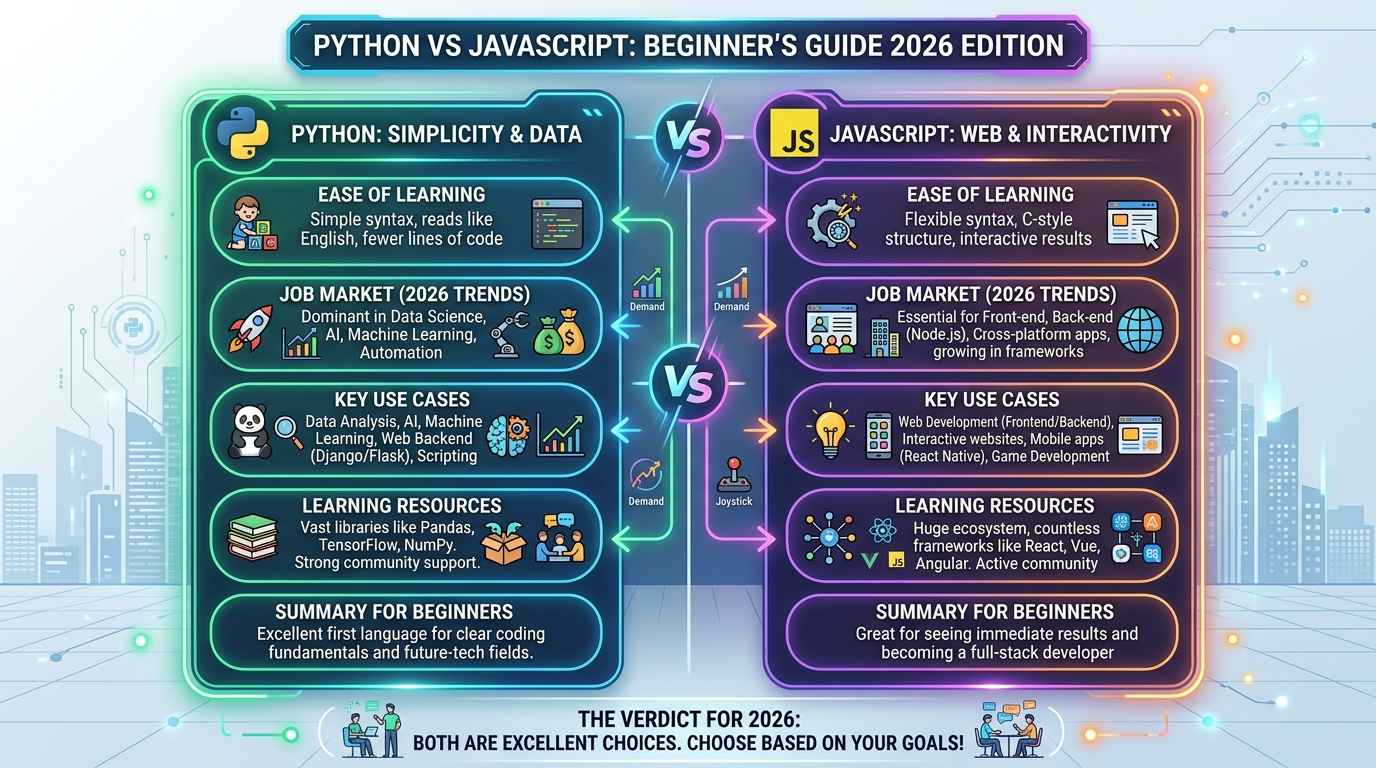
Python vs JavaScript 2026 — this is the biggest question every coding beginner asks today. With both languages dominating the tech industry in 2026, choosing the right one for your career can feel overwhelming. Should you start with Python’s clean syntax or JavaScript’s web superpowers? In this complete guide, we’ll compare Python and JavaScript across every important factor — from job opportunities to salary, ease of learning to real-world applications. By the end, you’ll know exactly which language to pick for your goals.
Whether you want to build websites, dive into AI and data science, automate boring tasks, or land a high-paying tech job, this comparison will help you make the right choice. Let’s settle the Python vs JavaScript 2026 debate once and for all.
Quick Comparison: Python vs JavaScript 2026 at a Glance
Before we deep-dive into details, here’s a quick side-by-side comparison of both languages to help you understand their core differences:
| Feature | Python 🐍 | JavaScript ⚡ |
|---|---|---|
| Released | 1991 | 1995 |
| Primary Use | AI, Data Science, Backend, Automation | Web Development, Frontend, Mobile, Backend |
| Learning Curve | Very Easy ⭐⭐⭐⭐⭐ | Moderate ⭐⭐⭐⭐ |
| Syntax | Clean, English-like | C-style, curly braces |
| Performance | Slower (Interpreted) | Faster (V8 Engine) |
| Average Salary (India) | ₹6-15 LPA | ₹5-14 LPA |
| Average Salary (US) | $95,000 – $140,000 | $90,000 – $135,000 |
| Job Demand 2026 | Very High 🔥 | Very High 🔥 |
| Best For | AI, ML, Data Analysis, Scripting | Websites, Apps, Real-time Features |
| Top Companies Using | Google, Netflix, Instagram, NASA | Facebook, PayPal, Uber, Microsoft |
What is Python? — The King of AI & Data Science
Python is a high-level, general-purpose programming language created by Guido van Rossum in 1991. Known for its simple, readable syntax, Python has become the #1 choice for beginners and the most popular language for artificial intelligence, machine learning, and data science in 2026.
Python’s philosophy is “readability counts” — which means code looks almost like plain English. This makes it incredibly easy for beginners to pick up, even if they have zero programming experience.
Simple Python Code Example:
# Hello World in Python
print("Hello, World!")

# Variables and basic math
name = "CodeLearning"
year = 2026
print(f"Welcome to {name} in {year}!")

# A simple function
def greet(user):
    return f"Hello, {user}! Happy coding!"

print(greet("Developer"))
What is JavaScript? — The Language of the Web
JavaScript is the programming language that powers the modern web. Created by Brendan Eich in 1995 in just 10 days, JavaScript runs in every web browser on Earth — making it impossible to avoid if you want to build interactive websites or web applications in 2026.
Beyond browsers, JavaScript now powers servers (Node.js), mobile apps (React Native), desktop applications (Electron), and even AI projects (TensorFlow.js). It’s truly a full-stack language.
Simple JavaScript Code Example:
// Hello World in JavaScript
console.log("Hello, World!");

// Variables and template literals
const name = "CodeLearning";
const year = 2026;
console.log(`Welcome to ${name} in ${year}!`);

// A simple function
function greet(user) {
    return `Hello, ${user}! Happy coding!`;
}

console.log(greet("Developer"));
Python vs JavaScript 2026: Which is Easier to Learn?
For absolute beginners, Python wins hands down when it comes to learning curve. Here’s why:
Why Python is Easier:
- Clean Syntax: No semicolons, no curly braces — uses indentation for code blocks.
- English-like Code: Reads almost like plain English sentences.
- Fewer Concepts: Beginners can write useful programs within days.
- Interactive Mode: Test code line-by-line in Python REPL.
- Less Boilerplate: Shorter code to achieve the same task.
Why JavaScript is a Bit Harder:
- Quirky Behavior: Type coercion can confuse beginners (e.g.,
"5" + 3 = "53"). - Async Programming: Promises, async/await are tough for newcomers.
- Multiple Ways: Many ways to do the same thing (var/let/const, function/arrow).
- Browser Quirks: Different browsers may behave slightly differently.
Verdict: Start with Python if you want to learn programming concepts. Move to JavaScript if you specifically want to build websites.
Job Opportunities: Python vs JavaScript 2026
Both languages have massive job demand in 2026, but they serve different career paths. According to the latest industry reports, here’s what the job market looks like:
Python Job Roles 2026:
- Data Scientist — ₹8-25 LPA (India) / $100K-$160K (US)
- Machine Learning Engineer — ₹10-30 LPA / $110K-$180K
- AI Engineer — ₹12-35 LPA / $120K-$200K
- Python Backend Developer — ₹6-18 LPA / $90K-$140K
- Data Analyst — ₹5-12 LPA / $70K-$110K
- DevOps Engineer — ₹8-22 LPA / $100K-$150K
JavaScript Job Roles 2026:
- Frontend Developer — ₹5-15 LPA / $85K-$130K
- Full Stack Developer — ₹8-22 LPA / $100K-$160K
- React Developer — ₹6-18 LPA / $95K-$140K
- Node.js Backend Developer — ₹7-20 LPA / $95K-$145K
- Mobile App Developer (React Native) — ₹6-16 LPA / $90K-$135K
- JavaScript Software Engineer — ₹8-25 LPA / $100K-$160K
Python vs JavaScript: Real-World Applications 2026
Both languages dominate different areas of technology. Here’s where each one shines:
Where Python Dominates 🐍
- Artificial Intelligence: ChatGPT, Claude, Gemini — all built primarily with Python.
- Machine Learning: TensorFlow, PyTorch, Scikit-learn ecosystems.
- Data Science: Pandas, NumPy, Matplotlib for data analysis.
- Web Backend: Django and Flask for server-side development.
- Automation: Scripts to automate repetitive tasks at work.
- Scientific Computing: Used by NASA, CERN for research.
- Game Development: Pygame for 2D games.
Where JavaScript Dominates ⚡
- Frontend Web: Every modern website uses JavaScript.
- React, Vue, Angular: Most popular frontend frameworks.
- Backend Development: Node.js for scalable servers.
- Mobile Apps: React Native (Instagram, Discord, Pinterest).
- Desktop Apps: Electron (VS Code, Slack, Discord).
- Real-time Apps: Chat apps, live notifications, gaming.
- Browser Extensions: Chrome, Firefox extensions.
Performance Comparison: Python vs JavaScript 2026
When comparing **python vs javascript 2026** for **raw performance**, JavaScript generally wins thanks to Google’s V8 engine that powers Chrome and Node.js. However, Python’s slower speed rarely matters for most real-world applications.
Speed Benchmarks:
- JavaScript: 2-10x faster than Python for most computations.
- Python: Slower but more readable; speed boosted via NumPy, Cython.
- Web Requests: Node.js handles concurrent requests better than Python.
- AI/ML Tasks: Python actually wins here due to optimized libraries.
Reality Check: For 99% of beginner projects, performance difference doesn’t matter. Focus on learning, not benchmarks.
Pros and Cons: Python vs JavaScript 2026
✅ Python Pros
- Easiest language to learn for beginners.
- Dominant in AI, ML, and data science.
- Massive library ecosystem (PyPI has 500,000+ packages).
- Used in scientific research and academia.
- Great for automation and scripting.
- Highest paying jobs in AI/ML.
❌ Python Cons
- Slower execution speed.
- Not used for frontend web development.
- Mobile app development is limited.
- Global Interpreter Lock (GIL) limits multi-threading.
✅ JavaScript Pros
- Only language that runs in web browsers natively.
- Full-stack capability (frontend + backend + mobile).
- Huge community and npm package ecosystem.
- Fast execution with V8 engine.
- Strong demand from startups and tech giants.
- Easy to see results visually (in browser).
❌ JavaScript Cons
- Confusing for absolute beginners (type coercion, async).
- Rapidly changing ecosystem (new frameworks every year).
- Not ideal for data science or AI.
- Browser compatibility issues occasionally.
Which Should You Learn First in 2026?
Here’s our honest recommendation based on your goals:
🎯 Learn Python First If You Want To:
- Build a career in AI, Machine Learning, or Data Science.
- Work as a Data Analyst or Scientist.
- Get into research, finance, or scientific computing.
- Automate tasks at your job or daily life.
- Learn programming with the easiest possible syntax.
- Eventually work with cutting-edge AI tools.
🎯 Learn JavaScript First If You Want To:
- Build websites and web applications.
- Work as a Frontend or Full Stack Developer.
- Create mobile apps (with React Native).
- See visual results quickly in your browser.
- Work in startups and product companies.
- Build a freelancing career with web projects.
Can You Learn Both Python and JavaScript?
Absolutely yes! In fact, in the python vs javascript 2026 landscape, top developers know both languages. Many companies prefer hiring developers who can switch between Python (for data/AI work) and JavaScript (for web work).
Our recommendation: Start with one, master the basics, then learn the other. Don’t try to learn both simultaneously as a beginner — it’ll confuse you.
If you’re interested in AI tools and how they’re built, check out our detailed guide on the Top 10 Best AI Tools in 2026 That Will Blow Your Mind. Also, if you’re a developer choosing between AI coding assistants, read our comparison of GitHub Copilot vs Cursor AI to boost your productivity.
Best Resources to Learn Python and JavaScript 2026
📚 Python Resources:
- Official: Python.org — Official documentation and tutorials.
- Free Course: Python for Everybody (Coursera).
- YouTube: freeCodeCamp’s 4-hour Python course.
- Practice: HackerRank, LeetCode, Codewars.
📚 JavaScript Resources:
- Official: MDN Web Docs — Best JavaScript reference.
- Free Course: JavaScript30 by Wes Bos.
- YouTube: Traversy Media’s JavaScript Crash Course.
- Practice: Frontend Mentor, JavaScript.info exercises.
Also Read
- 📖 Top 10 Best AI Tools in 2026 That Will Blow Your Mind
- 📖 GitHub Copilot vs Cursor AI — Which is the Best AI Coding Tool in 2026?
Final Verdict: Python vs JavaScript 2026
The Python vs JavaScript 2026 debate doesn’t have a single winner — both are amazing languages with bright futures. Your choice should depend on your career goals, not popularity contests.
TL;DR Decision Guide:
- 👉 Want AI/Data Science career? Choose Python.
- 👉 Want Web Development career? Choose JavaScript.
- 👉 Total beginner with no clear goal? Start with Python (easier).
- 👉 Want fastest path to a job? Choose JavaScript (more entry-level openings).
- 👉 Want to maximize career options? Learn both eventually.
The best language is the one you’ll actually stick with and master. Pick one, start building projects, and you’ll thank yourself a year from now. Whether you choose Python or JavaScript, both will open incredible career opportunities in 2026 and beyond.
Ready to start coding? Bookmark CodeLearning.in for daily programming tutorials, AI tools reviews, and tech career tips. Drop a comment below — which language are you choosing in 2026 and why? We’d love to hear your story! 🚀

8 comments on “Python vs JavaScript 2026 — Which is Better for Beginners?”