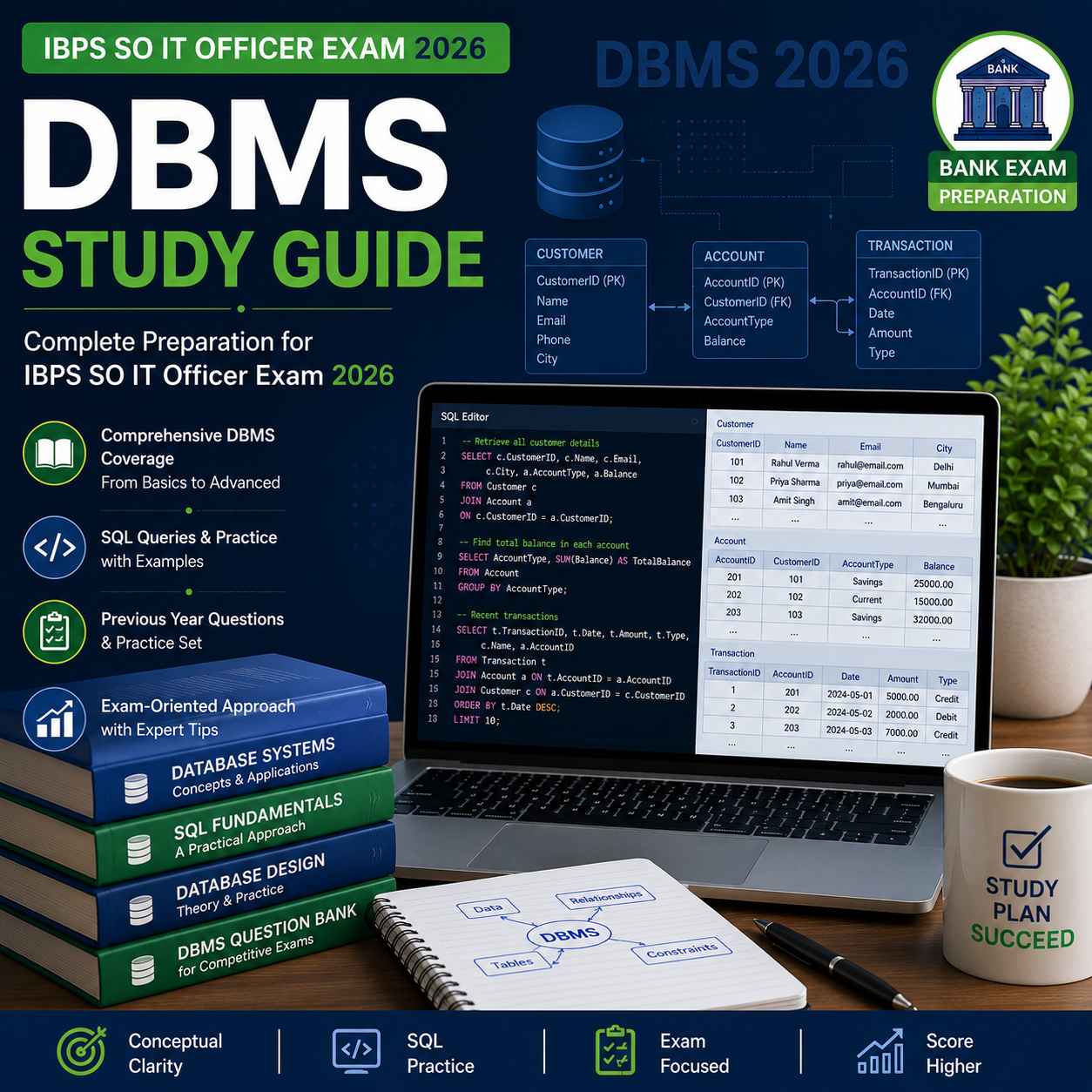
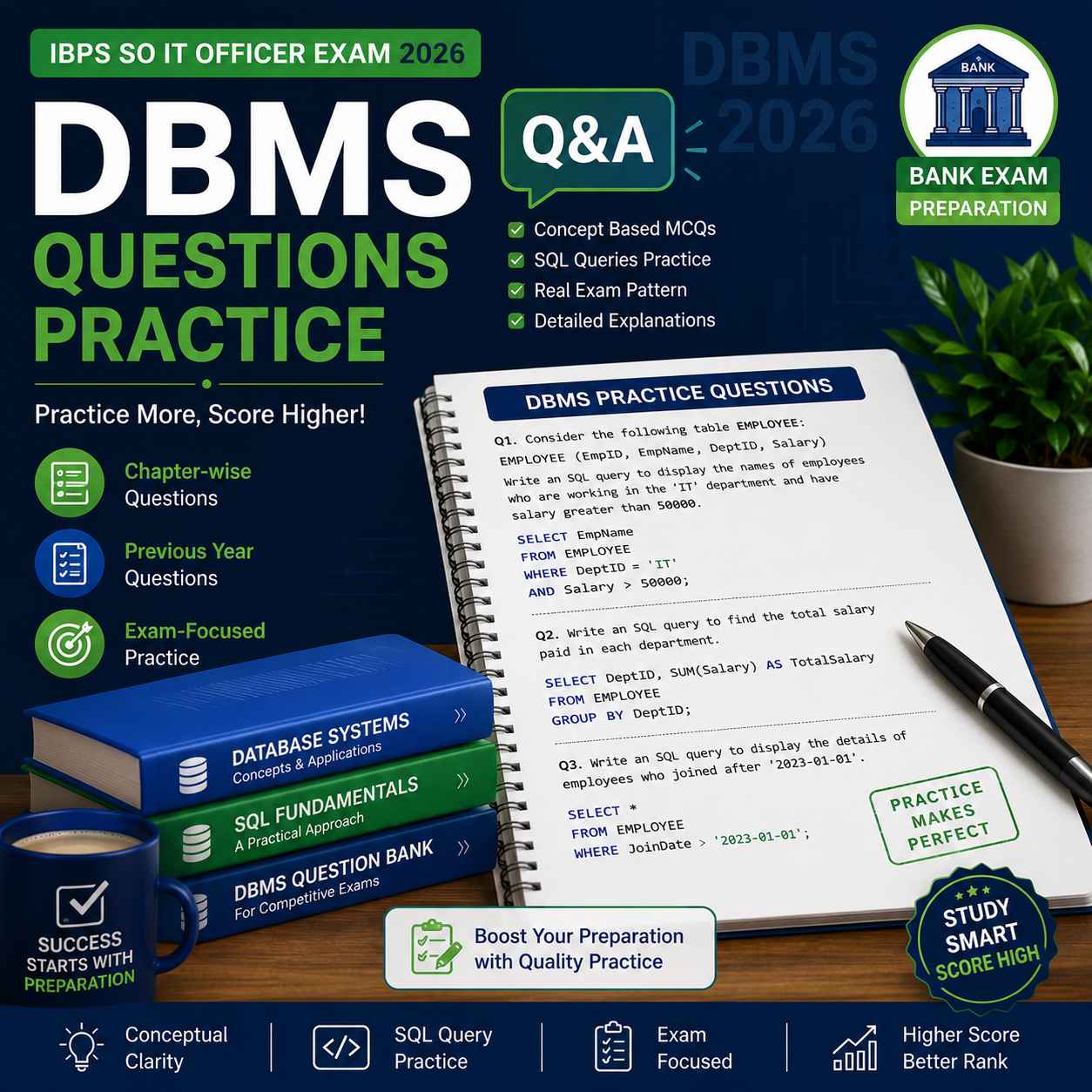
Looking for the best DBMS important questions for IBPS SO 2026? You’ve landed at the perfect place! Database Management System is one of the highest-scoring topics in the IBPS SO IT Officer Professional Knowledge section, with 15-20 marks contribution every year. Practicing the right set of important questions can be the difference between selection and rejection in this competitive exam.
In this comprehensive guide, we’ve compiled the top DBMS important questions for IBPS SO 2026 based on previous year papers, expected patterns, and frequently asked topics. Whether you’re starting your preparation or doing last-minute revision, these handpicked questions with detailed answers will help you score maximum marks in the DBMS section of bank IT officer exam.
Why DBMS Important Questions for IBPS SO 2026 Matter
Practicing DBMS important questions for IBPS SO 2026 is critical for several reasons:
- Exam Pattern Recognition: Same patterns repeat every year — practicing helps you identify them quickly.
- Time Management: Practice helps you solve questions in 30-45 seconds each.
- Concept Reinforcement: Questions reveal which concepts need more revision.
- Confidence Building: Familiarity reduces exam anxiety on D-day.
- Score Maximization: DBMS is scoring section — practice ensures 90%+ accuracy.
- Multiple Exams: Same questions appear in CIL MT, SBI SO, RBI Grade B exams.
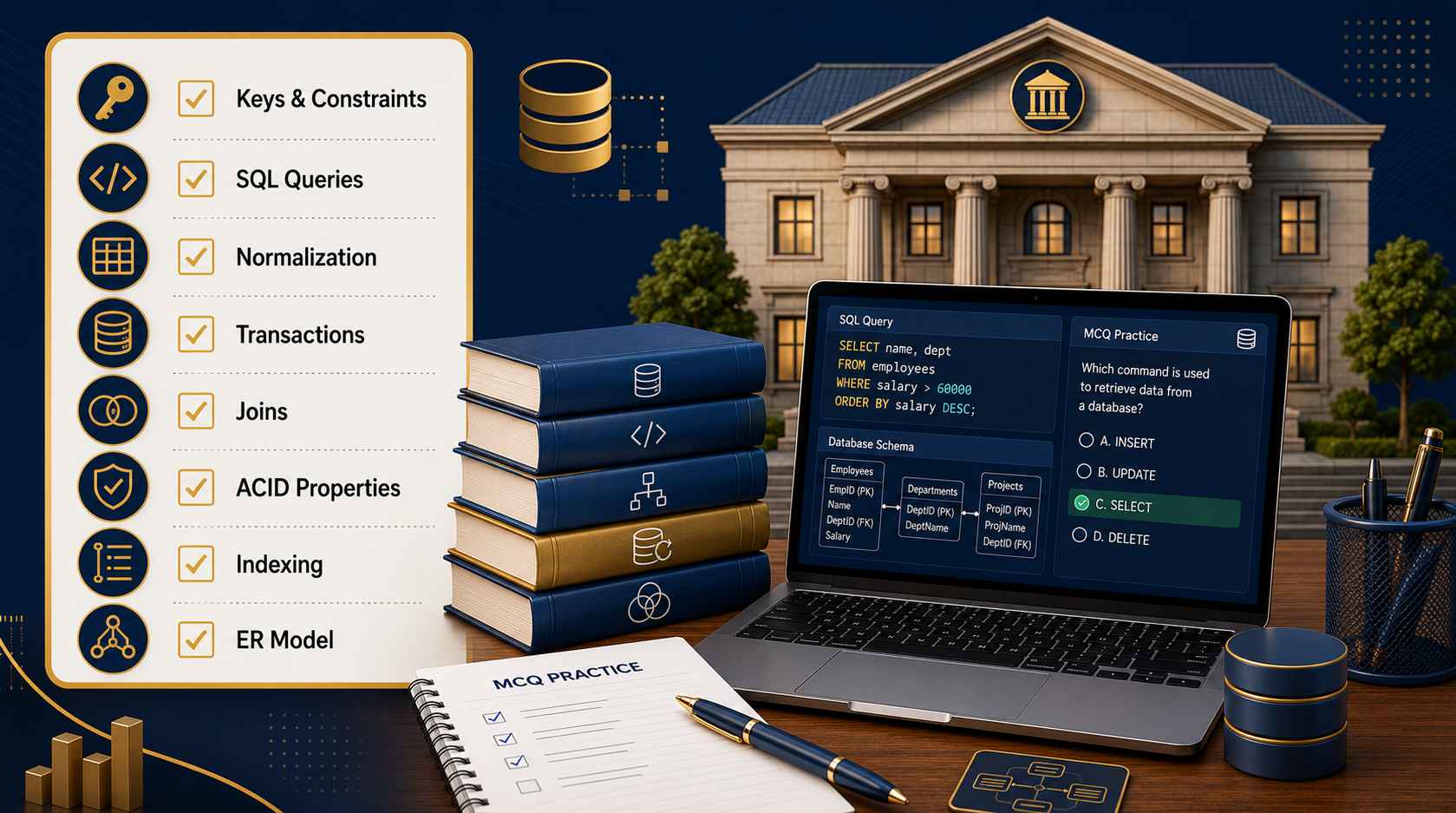
DBMS Important Questions for IBPS SO 2026 – Topic-Wise Distribution
Before diving into questions, understand which topics carry maximum weightage in the DBMS important questions for IBPS SO 2026 section:
| Topic | Questions Frequency | Difficulty | Priority |
|---|---|---|---|
| Keys (Primary, Foreign, etc.) | 2-3 every year | Easy | ⭐⭐⭐ High |
| Normalization (1NF-BCNF) | 2-3 every year | Medium | ⭐⭐⭐ High |
| SQL Queries | 3-5 every year | Medium | ⭐⭐⭐ High |
| ACID Properties | 1-2 every year | Easy | ⭐⭐ Medium |
| ER Model | 1-2 every year | Medium | ⭐⭐ Medium |
| Joins | 2-3 every year | Medium | ⭐⭐⭐ High |
| Indexing | 1 every year | Hard | ⭐⭐ Medium |
| Transactions | 1-2 every year | Medium | ⭐⭐ Medium |
Top 25 DBMS Important Questions for IBPS SO 2026 – With Answers
Here are the most frequently asked DBMS important questions for IBPS SO 2026 based on previous year papers. Master these to ensure maximum scores:
Section 1: Database Basics (Q1-Q5)
Q1. What is DBMS?
Answer: DBMS (Database Management System) is software that manages databases by providing interfaces to create, retrieve, update, and delete data. Examples include MySQL, Oracle, PostgreSQL, SQL Server, MongoDB.
Q2. What is the difference between DBMS and RDBMS?
Answer: DBMS stores data as files without relationships, while RDBMS stores data in tables (rows and columns) with relationships between them. RDBMS follows Codd’s 12 rules; examples include MySQL, Oracle, PostgreSQL.
Q3. Who is known as the father of DBMS?
Answer: Edgar F. Codd is known as the father of relational database management systems (RDBMS). He proposed the relational model in 1970.
Q4. What are the advantages of DBMS over file system?
Answer: Key advantages include: reduced data redundancy, data consistency, better security, concurrent access support, backup and recovery, data integrity, and improved data sharing.
Q5. What is a database schema?
Answer: A database schema is the logical structure of the database that defines how data is organized, including tables, columns, data types, relationships, and constraints. It’s the blueprint of the database.
Section 2: Keys and Constraints (Q6-Q10)
Q6. What is a Primary Key?
Answer: A Primary Key is a column (or set of columns) that uniquely identifies each row in a table. It must be UNIQUE and NOT NULL. Each table can have only one primary key.
Q7. What is the difference between Primary Key and Unique Key?
Answer: Primary Key: unique + not null + only one per table. Unique Key: unique values but can be null + multiple unique keys allowed per table.
Q8. What is a Foreign Key?
Answer: A Foreign Key is a column in one table that references the Primary Key of another table. It establishes relationships and maintains referential integrity between tables.
Q9. What is a Candidate Key?
Answer: A Candidate Key is any column or combination of columns that can uniquely identify rows in a table. From candidate keys, one is selected as Primary Key; others become Alternate Keys.
Q10. What is a Composite Key?
Answer: A Composite Key is a Primary Key made of two or more columns combined to uniquely identify rows. Used when single column cannot ensure uniqueness, e.g., (Student_ID + Course_ID) in enrollment table.
Section 3: Normalization (Q11-Q15)
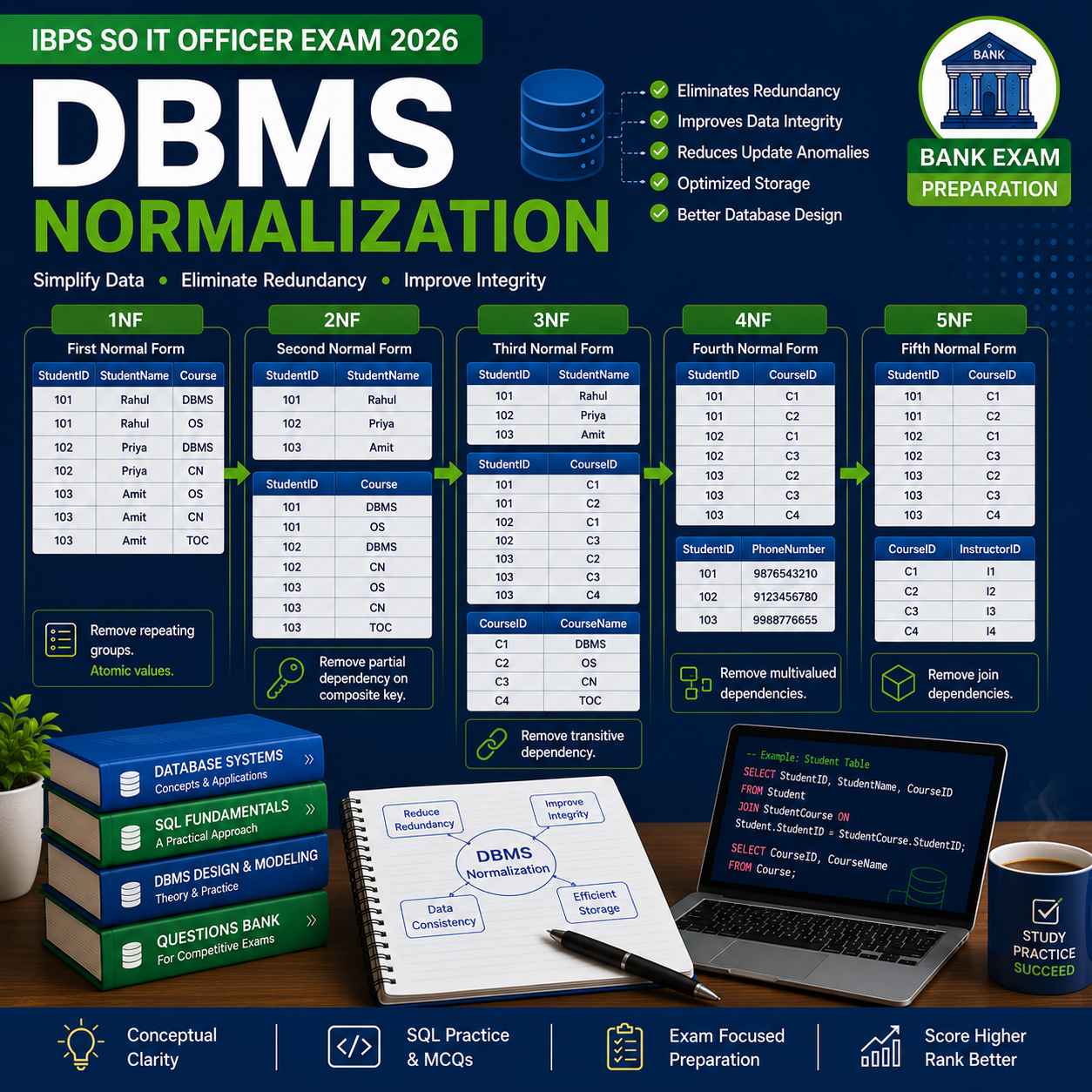
Q11. What is Normalization?
Answer: Normalization is the process of organizing database tables to reduce data redundancy and improve data integrity by dividing larger tables into smaller related tables following specific rules (Normal Forms).
Q12. What is 1NF (First Normal Form)?
Answer: A table is in 1NF when: all columns contain atomic (indivisible) values, each column has unique name, all entries in a column are of the same type, and no repeating groups exist.
Q13. What is 2NF (Second Normal Form)?
Answer: A table is in 2NF when: it’s in 1NF AND no partial dependency exists (all non-key attributes must depend on the entire primary key, not just part of it).
Q14. What is 3NF (Third Normal Form)?
Answer: A table is in 3NF when: it’s in 2NF AND no transitive dependency exists (non-key attributes should depend only on primary key, not on other non-key attributes).
Q15. What is BCNF (Boyce-Codd Normal Form)?
Answer: BCNF is a stricter version of 3NF. A table is in BCNF when: it’s in 3NF AND every determinant must be a candidate key. It eliminates all anomalies that 3NF couldn’t address.
Section 4: SQL Queries (Q16-Q20)
Q16. What are the categories of SQL commands?
Answer: SQL commands are divided into 5 categories: DDL (CREATE, ALTER, DROP), DML (SELECT, INSERT, UPDATE, DELETE), DCL (GRANT, REVOKE), TCL (COMMIT, ROLLBACK, SAVEPOINT), and DQL (SELECT).
Q17. What is the difference between DELETE, TRUNCATE, and DROP?
Answer: DELETE removes specific rows with WHERE clause (DML, can rollback). TRUNCATE removes all rows but keeps structure (DDL, faster). DROP removes entire table including structure (DDL, permanent).
Q18. What is a JOIN in SQL?
Answer: JOIN combines rows from two or more tables based on a related column. Types: INNER JOIN (matching rows), LEFT JOIN (all left + matching right), RIGHT JOIN (all right + matching left), FULL OUTER JOIN (all rows from both).
Q19. What is the difference between WHERE and HAVING clauses?
Answer: WHERE filters rows before grouping (works on individual rows). HAVING filters groups after GROUP BY (works on aggregated results). WHERE cannot use aggregate functions; HAVING can.
Q20. What are aggregate functions in SQL?
Answer: Aggregate functions perform calculations on multiple rows and return single value. Common ones: COUNT(), SUM(), AVG(), MAX(), MIN(). Used with GROUP BY for grouped calculations.
Section 5: Transactions & Advanced (Q21-Q25)
Q21. What are ACID properties?
Answer: ACID stands for: Atomicity (all-or-nothing), Consistency (database remains valid), Isolation (concurrent transactions don’t interfere), Durability (changes persist after commit). These ensure reliable transaction processing.
Q22. What is a transaction in DBMS?
Answer: A transaction is a sequence of one or more SQL operations executed as a single unit. It either completes fully (COMMIT) or rolls back entirely (ROLLBACK) to maintain database consistency.
Q23. What is indexing in DBMS?
Answer: Indexing is a data structure technique to speed up data retrieval from database. Like a book index, it creates pointers to data locations. Types: B-Tree, B+ Tree, Hash Index, Bitmap Index.
Q24. What is a view in SQL?
Answer: A view is a virtual table based on the result of a SQL query. It doesn’t store data physically; it provides a customized presentation of data from one or more tables. Used for security and simplification.
Q25. What is a stored procedure?
Answer: A stored procedure is a pre-compiled set of SQL statements stored in the database that can be executed by calling its name. Benefits: better performance, reusability, security, reduced network traffic.
Top 30 MCQs – DBMS Important Questions for IBPS SO 2026
Practice these multiple-choice DBMS important questions for IBPS SO 2026 with answers. These are based on actual exam patterns:
- Which command removes all rows from a table but keeps the structure?
Answer: TRUNCATE - Which is NOT a property of ACID?
Answer: Availability (correct ones: Atomicity, Consistency, Isolation, Durability) - Which key can have NULL values?
Answer: Foreign Key (Primary Key cannot have NULL) - Which normal form eliminates partial dependency?
Answer: 2NF (Second Normal Form) - Which SQL command is used to give permissions to users?
Answer: GRANT (DCL command) - What does DDL stand for?
Answer: Data Definition Language - Which JOIN returns matching rows from both tables only?
Answer: INNER JOIN - Which is NOT an aggregate function?
Answer: ROUND (others like SUM, AVG, COUNT are aggregates) - What is the maximum number of primary keys in a table?
Answer: One (1) - Which language is used to query database?
Answer: SQL (Structured Query Language) - What does ER stand for in ER Model?
Answer: Entity-Relationship - Which command is used to undo a transaction?
Answer: ROLLBACK - Which is faster – DELETE or TRUNCATE?
Answer: TRUNCATE (DDL, no logging per row) - What is the symbol for “any character” in LIKE clause?
Answer: _ (underscore) for single character, % for multiple - Which clause is used to group data?
Answer: GROUP BY - What does BCNF stand for?
Answer: Boyce-Codd Normal Form - Which JOIN returns all rows from left table?
Answer: LEFT JOIN (or LEFT OUTER JOIN) - Which SQL function returns number of rows?
Answer: COUNT() - What is the default sorting order in ORDER BY?
Answer: ASC (Ascending) - Which is used to remove a column from table?
Answer: ALTER TABLE table_name DROP COLUMN column_name - What is a tuple in DBMS?
Answer: A row in a relational table - Which property ensures permanent storage after commit?
Answer: Durability - What is degree of a relation?
Answer: Number of columns/attributes - What is cardinality of a relation?
Answer: Number of rows/tuples - Which operator is used for pattern matching?
Answer: LIKE - What is the full form of DML?
Answer: Data Manipulation Language - Which is NOT a DDL command?
Answer: SELECT (SELECT is DML/DQL) - What does CRUD stand for?
Answer: Create, Read, Update, Delete - Which key uniquely identifies a row but is not Primary Key?
Answer: Alternate Key - What is the minimum value of a column without NOT NULL constraint?
Answer: NULL
Tricky DBMS Important Questions for IBPS SO 2026
These advanced DBMS important questions for IBPS SO 2026 test conceptual understanding. Master these for the tough section:
Q1. Can a foreign key reference its own table?
Answer: Yes, this is called Self-Referential Foreign Key. Example: Employee table where manager_id references emp_id of same table (manager is also an employee).
Q2. What is a deadlock in DBMS? How to prevent it?
Answer: Deadlock occurs when two or more transactions are waiting for each other to release locks indefinitely. Prevention methods: Wait-Die scheme, Wound-Wait scheme, Timeout mechanism, Deadlock detection with rollback.
Q3. What is the difference between Clustered and Non-Clustered Index?
Answer: Clustered Index physically reorders table rows (only 1 per table, usually on Primary Key). Non-Clustered Index creates separate structure with pointers (multiple allowed per table).
Q4. What is the difference between UNION and UNION ALL?
Answer: UNION combines results from two queries and removes duplicates (slower due to sorting). UNION ALL combines results including all duplicates (faster, no sorting required).
Q5. What are the disadvantages of denormalization?
Answer: Disadvantages include: data redundancy increases, more storage required, update anomalies, harder to maintain consistency, requires more careful design. Used only when read performance is critical.
SQL Query Based DBMS Important Questions for IBPS SO 2026
These SQL query questions test practical knowledge. Memorize these patterns for the DBMS important questions for IBPS SO 2026 exam:
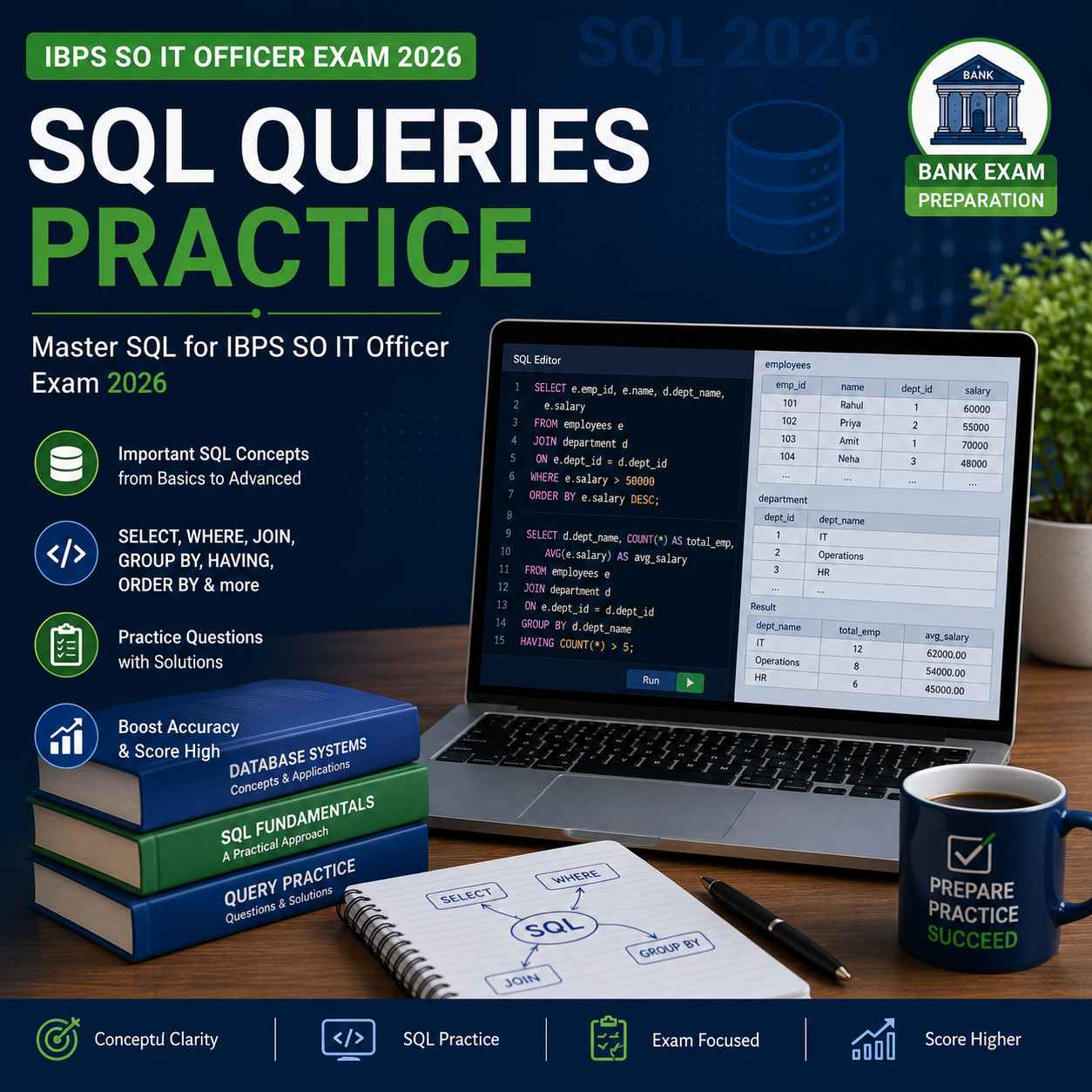
Q1. Write SQL query to find second highest salary from Employee table.
SELECT MAX(salary) FROM Employee
WHERE salary < (SELECT MAX(salary) FROM Employee);
Q2. Write SQL query to find duplicate records in a table.
SELECT column_name, COUNT(*) FROM table_name
GROUP BY column_name
HAVING COUNT(*) > 1;
Q3. Write SQL to find employees having same salary.
SELECT e1.name, e2.name, e1.salary
FROM Employee e1, Employee e2
WHERE e1.salary = e2.salary
AND e1.emp_id < e2.emp_id;
Q4. Write SQL to count employees in each department.
SELECT dept_id, COUNT(*) AS total_employees
FROM Employee
GROUP BY dept_id;
Q5. Write SQL to find top 3 highest paid employees.
SELECT * FROM Employee
ORDER BY salary DESC
LIMIT 3;
Smart Tips to Solve DBMS Important Questions for IBPS SO 2026
Follow these proven strategies to maximize your score with DBMS important questions for IBPS SO 2026:
- Read Question Carefully: 70% mistakes happen due to misreading. Read twice before answering.
- Elimination Method: Rule out obviously wrong options first to improve chances.
- Time Per Question: Spend max 45-60 seconds per DBMS MCQ.
- Concept Over Cramming: Understand concepts; questions vary but concepts are same.
- Practice Daily: Solve at least 25-30 questions daily for 30 days.
- Mock Tests: Take full-length mocks under timed conditions.
- Revise Mistakes: Maintain error log; revise weak topics weekly.
- Group Similar Questions: Recognize patterns to solve faster.
- Skip Strategy: Mark difficult questions, return later if time permits.
- Negative Marking: Attempt only if 60%+ confident to avoid losing marks.
Common Mistakes While Solving DBMS Questions
Avoid these costly errors when attempting DBMS important questions for IBPS SO 2026:
- ❌ Confusing Primary Key vs Unique Key vs Candidate Key.
- ❌ Mixing DELETE, TRUNCATE, and DROP commands.
- ❌ Wrong understanding of JOIN direction (LEFT vs RIGHT).
- ❌ Forgetting NULL behavior in comparisons (use IS NULL, not = NULL).
- ❌ Mistaking 2NF and 3NF normalization differences.
- ❌ Confusing WHERE and HAVING clauses.
- ❌ Wrong sequence of ACID property meanings.
- ❌ Using aggregate functions in WHERE clause (use HAVING).
- ❌ Missing GROUP BY when using aggregates with other columns.
- ❌ Misjudging time and getting stuck on tough questions.
Last Week Strategy – DBMS Important Questions for IBPS SO 2026
If your exam is within a week, follow this intense revision plan:
📅 Day 1-2: Quick Concept Revision
- Revise all 6 types of keys with examples
- Memorize ACID properties with bank example
- Review all 5 normal forms (1NF to BCNF)
- Refresh SQL command categories
📅 Day 3-4: Question Practice
- Solve top 100 DBMS questions
- Focus on previous year papers
- Time each question (45 seconds max)
📅 Day 5-6: Mock Tests
- Take 2 full-length mock tests
- Analyze mistakes thoroughly
- Revise weak topics
📅 Day 7: Final Revision
- Quick formula/concept revision
- No new topics
- Light practice (50 questions)
- Sleep well before exam
DBMS Important Questions for CIL MT & SBI SO Comparison
The good news? DBMS important questions for IBPS SO 2026 are almost identical to other bank IT exams:
| Exam | DBMS Questions | Common Topics |
|---|---|---|
| IBPS SO IT Officer | 12-15 | Keys, Normalization, SQL |
| CIL MT Systems | 15-20 | Same + Advanced concepts |
| SBI SO Systems | 10-15 | Same patterns |
| RBI Grade B (DEPR) | 8-12 | Basic DBMS focus |
One strong DBMS preparation cracks all four exams! For complete DBMS theory, refer to our DBMS for IBPS SO IT Officer 2026 Complete Study Guide. Also practice SQL for IBPS SO IT Officer 2026 — Best 50 Practice Questions to master query writing.
Free Resources to Practice More DBMS Questions
Beyond this guide, use these resources to practice more DBMS important questions for IBPS SO 2026:
- GeeksforGeeks DBMS Quiz: Topic-wise MCQs with explanations
- Studytonight DBMS Tests: Free practice tests online
- JavaTpoint DBMS Section: Concept + questions combined
- Sanfoundry DBMS MCQs: 1000+ questions categorized
- IndiaBix DBMS Quiz: Aptitude-style practice tests
- PreviousPapers.in: Actual IBPS SO previous year papers
Also Read – Complete IBPS SO IT Officer 2026 Study Series
- 📖 DBMS for IBPS SO IT Officer 2026 – Complete Study Guide
- 📖 SQL for IBPS SO IT Officer 2026 – Best 50 Practice Questions
- 📖 Software Engineer Salary in India 2026 Complete Guide
- 📖 Python vs JavaScript 2026 – Which is Better for Beginners?
Final Words on DBMS Important Questions for IBPS SO 2026
Mastering DBMS important questions for IBPS SO 2026 is your fastest path to scoring high in the Professional Knowledge section. Questions repeat in pattern; concepts remain same — focus on understanding rather than memorizing. With 30 days of consistent practice using this guide, you can confidently solve 90%+ DBMS questions in the actual exam.
Remember that DBMS is one of the most scoring sections in bank IT officer exams, and these handpicked questions cover all important topics. Practice the 25 detailed Q&A, 30 MCQs, and 5 SQL query questions provided above multiple times. Time yourself, identify weak areas, and revise regularly for guaranteed success.
Ready to crack the DBMS section? Bookmark CodeLearning.in for daily DBMS practice questions, complete study guides, and free resources for IBPS SO IT Officer, CIL MT Systems, SBI SO, and other bank IT exams. Drop your questions in comments — our team responds within 24 hours. Stay tuned for tomorrow’s article on Computer Networks for IBPS SO IT Officer 2026! 🎯
Disclaimer: The DBMS questions provided in this guide are based on previous year IBPS SO IT Officer exam papers and standard database curriculum. Exam patterns and questions may vary year to year. Always refer to the official IBPS notification at www.ibps.in for latest exam updates and official syllabus.