
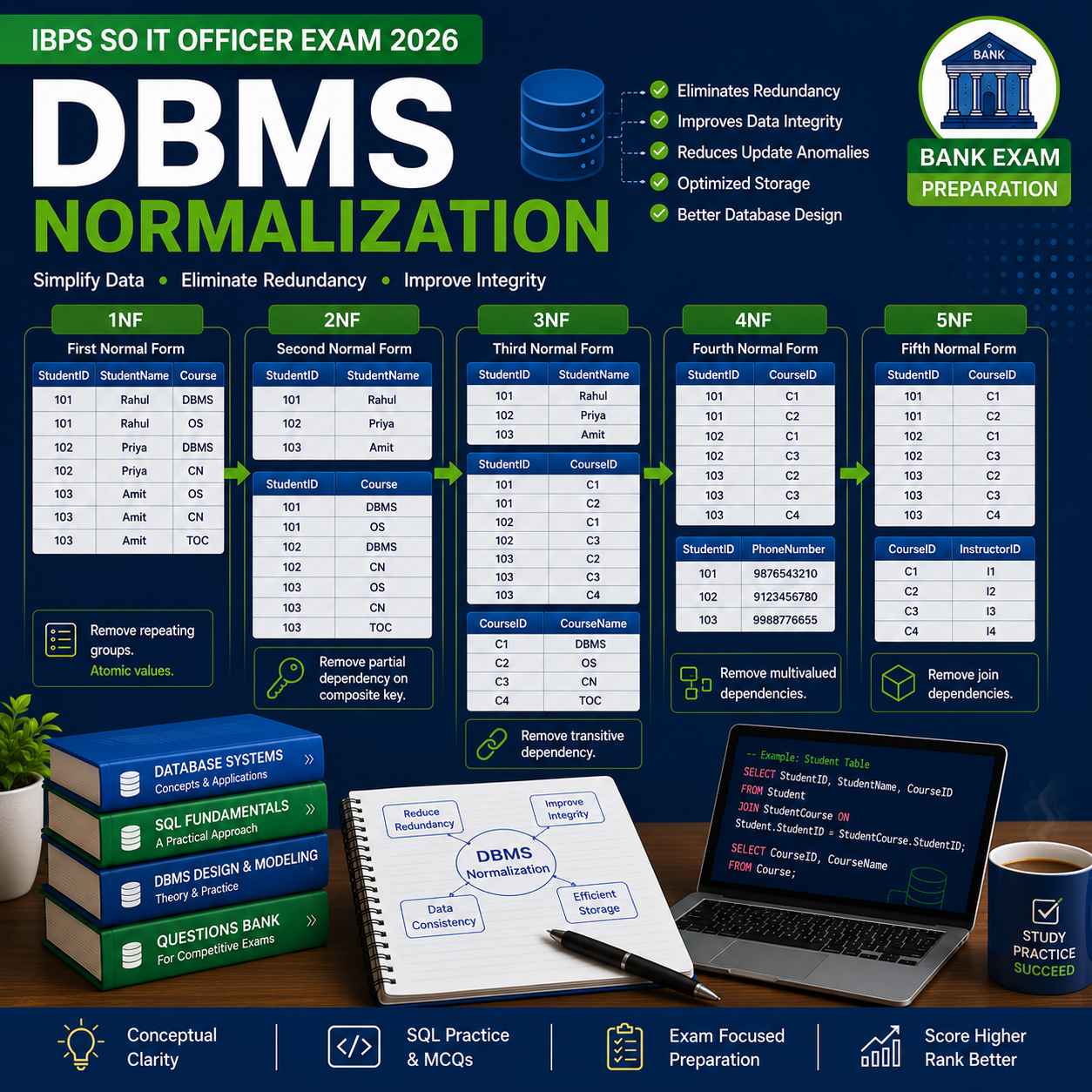
Master DBMS Normalization for IBPS SO IT Officer from basics to advanced with our complete guide covering 1NF to 5NF. Normalization is one of the most asked topics in the IBPS SO IT Officer Professional Knowledge section, contributing 3-5 marks every year. With proper understanding, you can score 100% in normalization questions and confidently solve any related problem in the exam.
In this comprehensive guide on DBMS Normalization for IBPS SO IT Officer, we’ll cover all normal forms with real-world examples, conversion steps, previous year questions, memory tricks, and common pitfalls. Whether you’re a beginner struggling with normalization concepts or a serious aspirant doing final revision, this article will make you a normalization expert in just 2 hours of study.
What is Normalization in DBMS?
Normalization is the process of organizing data in a database to reduce data redundancy and improve data integrity. It involves dividing larger tables into smaller related tables and defining relationships between them. The DBMS Normalization for IBPS SO IT Officer syllabus tests both theoretical understanding and practical application.
Why Normalization is Important?
- Eliminates Data Redundancy: Removes duplicate data across tables.
- Prevents Anomalies: Avoids insert, update, and delete anomalies.
- Improves Data Integrity: Ensures data accuracy and consistency.
- Better Database Design: Creates efficient and scalable database structure.
- Storage Optimization: Reduces storage space requirements.
- Easier Maintenance: Simplifies database updates and modifications.
Anomalies in DBMS – Why We Need Normalization
Before diving into normal forms, understand the 3 anomalies that normalization solves. This concept is frequently asked in DBMS Normalization for IBPS SO IT Officer exam:
1. Insertion Anomaly
Occurs when we can’t insert data due to absence of other data. Example: Can’t add a new department without an employee.
2. Update Anomaly
Occurs when we have to update same data in multiple places, risking inconsistency. Example: Department name change requires updating in 100 employee records.
3. Deletion Anomaly
Occurs when deleting data unintentionally removes other valuable information. Example: Deleting last employee of a department also deletes department info.
Functional Dependencies – Foundation of DBMS Normalization
Functional Dependencies (FDs) are the foundation of DBMS Normalization for IBPS SO IT Officer. You must understand these before tackling normal forms.
Types of Functional Dependencies:
| Type | Definition | Example |
|---|---|---|
| Full Functional Dependency | Non-key attribute depends on entire primary key | (StudentID, CourseID) → Grade |
| Partial Dependency | Non-key depends on part of composite key | (StudentID, CourseID) → StudentName |
| Transitive Dependency | A → B and B → C, so A → C | EmpID → DeptID → DeptName |
| Multi-Valued Dependency | One attribute determines multiple values | StudentID → → Hobby |
| Trivial Dependency | Right side is subset of left side | (A, B) → A |
1NF (First Normal Form) – DBMS Normalization for IBPS SO IT Officer
Definition: A relation is in First Normal Form (1NF) if it satisfies these rules:
- All columns must contain atomic (indivisible) values.
- Each column must have a unique name.
- All entries in a column must be of the same data type.
- The order of rows and columns is not significant.
- No repeating groups of columns.
Example: Converting to 1NF
❌ NOT in 1NF (Multi-valued attribute):
| StudentID | Name | Subjects |
|---|---|---|
| 101 | Rahul | Math, Physics, Chemistry |
| 102 | Priya | Biology, Chemistry |
✅ In 1NF (Atomic values):
| StudentID | Name | Subject |
|---|---|---|
| 101 | Rahul | Math |
| 101 | Rahul | Physics |
| 101 | Rahul | Chemistry |
| 102 | Priya | Biology |
| 102 | Priya | Chemistry |
2NF (Second Normal Form) – DBMS Normalization for IBPS SO IT Officer
Definition: A relation is in Second Normal Form (2NF) if:
- It is already in 1NF.
- There is no partial dependency (every non-prime attribute is fully functionally dependent on the primary key).
Example: Converting to 2NF
❌ NOT in 2NF (Partial Dependency exists):
Table: Student_Course with composite key (StudentID, CourseID)
| StudentID | CourseID | StudentName | CourseName | Grade |
|---|---|---|---|---|
| 101 | C01 | Rahul | DBMS | A |
| 101 | C02 | Rahul | Networks | B |
Problem: StudentName depends only on StudentID (partial dependency).
✅ In 2NF (Split into 3 tables):
- Student: StudentID, StudentName
- Course: CourseID, CourseName
- Enrollment: StudentID, CourseID, Grade
3NF (Third Normal Form) – DBMS Normalization for IBPS SO IT Officer
Definition: A relation is in Third Normal Form (3NF) if:
- It is already in 2NF.
- There is no transitive dependency (no non-key attribute depends on another non-key attribute).
Example: Converting to 3NF
❌ NOT in 3NF (Transitive Dependency):
| EmpID | EmpName | DeptID | DeptName | DeptLocation |
|---|---|---|---|---|
| 1 | Amit | D01 | IT | Mumbai |
| 2 | Priya | D02 | HR | Delhi |
Problem: EmpID → DeptID → DeptName, DeptLocation (transitive dependency)
✅ In 3NF (Split into 2 tables):
- Employee: EmpID, EmpName, DeptID
- Department: DeptID, DeptName, DeptLocation
BCNF (Boyce-Codd Normal Form) – DBMS Normalization for IBPS SO IT Officer
Definition: A relation is in BCNF if:
- It is already in 3NF.
- For every functional dependency A → B, A must be a candidate key (superkey).
BCNF is a stricter version of 3NF. Every BCNF table is automatically in 3NF, but not vice versa. The DBMS Normalization for IBPS SO IT Officer exam often tests the difference between 3NF and BCNF.
Example: Converting to BCNF
❌ In 3NF but NOT in BCNF:
Table: Student_Course_Professor (StudentID, CourseID, ProfessorID)
Constraints:
- Each course is taught by only one professor
- Each professor teaches only one course
- A student can take multiple courses from different professors
Functional Dependencies: ProfessorID → CourseID (ProfessorID is not a candidate key, but determines CourseID)
✅ In BCNF (Decomposed):
- Course_Professor: ProfessorID, CourseID
- Student_Professor: StudentID, ProfessorID
4NF (Fourth Normal Form) – DBMS Normalization for IBPS SO IT Officer
Definition: A relation is in Fourth Normal Form (4NF) if:
- It is already in BCNF.
- It has no multi-valued dependencies.
Example: Converting to 4NF
❌ NOT in 4NF (Multi-valued dependency):
| StudentID | Hobby | Language |
|---|---|---|
| 101 | Cricket | English |
| 101 | Cricket | Hindi |
| 101 | Reading | English |
| 101 | Reading | Hindi |
Problem: Student has multiple hobbies AND multiple languages (independent multi-valued attributes).
✅ In 4NF (Split into 2 tables):
- Student_Hobby: StudentID, Hobby
- Student_Language: StudentID, Language
5NF (Fifth Normal Form / PJNF) – DBMS Normalization for IBPS SO IT Officer
Definition: A relation is in Fifth Normal Form (5NF), also called Project-Join Normal Form (PJNF), if:
- It is already in 4NF.
- Every join dependency is implied by candidate keys.
- The table cannot be further decomposed without loss of data.
5NF deals with cases where a table can be reconstructed from three or more smaller tables. It’s rarely encountered in real-world databases but appears in advanced DBMS Normalization for IBPS SO IT Officer questions.
5NF Example:
Table: Salesperson_Product_Customer
Where: A salesperson sells certain products to certain customers, and these relationships are independent.
✅ In 5NF (Decomposed into 3 tables):
- Salesperson_Product: SalespersonID, ProductID
- Product_Customer: ProductID, CustomerID
- Salesperson_Customer: SalespersonID, CustomerID
Quick Comparison Table – All Normal Forms for IBPS SO 2026
Here’s a complete reference table for DBMS Normalization for IBPS SO IT Officer exam. Memorize this for quick revision:
| Normal Form | Rule | Removes | Year Proposed |
|---|---|---|---|
| 1NF | Atomic values, no repeating groups | Multi-valued attributes | 1970 (Codd) |
| 2NF | 1NF + No partial dependency | Partial dependencies | 1971 (Codd) |
| 3NF | 2NF + No transitive dependency | Transitive dependencies | 1971 (Codd) |
| BCNF | 3NF + Every determinant is candidate key | Anomalies from non-candidate determinants | 1974 (Boyce-Codd) |
| 4NF | BCNF + No multi-valued dependencies | Multi-valued dependencies | 1977 (Fagin) |
| 5NF | 4NF + No join dependencies | Join dependencies | 1979 (Fagin) |
Memory Tricks for DBMS Normalization – IBPS SO IT Officer 2026
These memory tricks help you remember DBMS Normalization for IBPS SO IT Officer concepts quickly:
Trick 1: Sequential Building
Each normal form builds on previous: 1NF → 2NF → 3NF → BCNF → 4NF → 5NF. To be in higher form, must satisfy lower forms first.
Trick 2: Remember the “PTM” Rule
- Partial → Remove in 2NF
- Transitive → Remove in 3NF
- Multi-valued → Remove in 4NF
Trick 3: BCNF Mnemonic
“BCNF = Every determinant is a candidate key” — If you find non-candidate key determining something, decompose!
Trick 4: “Father of Forms”
Remember inventors: Codd (1NF, 2NF, 3NF), Boyce-Codd (BCNF), Fagin (4NF, 5NF).
Trick 5: Anomaly Check
If table has insertion, update, or deletion anomaly — it needs further normalization!
Top 15 DBMS Normalization Questions for IBPS SO IT Officer 2026
Practice these previous year DBMS Normalization for IBPS SO IT Officer questions:
- Q. Which normal form removes partial dependency?
Answer: 2NF (Second Normal Form) - Q. Which is the highest normal form?
Answer: 6NF (technically, but 5NF/PJNF is highest commonly used) - Q. What does BCNF stand for?
Answer: Boyce-Codd Normal Form - Q. Who proposed the relational model?
Answer: Edgar F. Codd in 1970 - Q. Which normal form removes transitive dependency?
Answer: 3NF (Third Normal Form) - Q. What is the prerequisite for 2NF?
Answer: Must be in 1NF first - Q. Multi-valued dependency is removed in which form?
Answer: 4NF (Fourth Normal Form) - Q. Which form is also called PJNF?
Answer: 5NF (Project-Join Normal Form) - Q. What is denormalization?
Answer: Reverse of normalization — combining tables to improve query performance - Q. Which anomaly occurs when we can’t insert new data?
Answer: Insertion Anomaly - Q. BCNF is stricter version of which form?
Answer: 3NF (Third Normal Form) - Q. Can a relation be in 3NF but not in BCNF?
Answer: Yes, if a non-candidate key determinant exists - Q. What is a determinant?
Answer: An attribute (or set) on which another attribute is functionally dependent - Q. Which normal form has atomic values rule?
Answer: 1NF (First Normal Form) - Q. What is the main goal of normalization?
Answer: To eliminate data redundancy and prevent anomalies
Practical Normalization Example – Step by Step
Let’s normalize a real database table step-by-step for DBMS Normalization for IBPS SO IT Officer understanding:
Original Unnormalized Table:
| OrderID | Products | CustomerID | CustomerName | City | State |
|---|---|---|---|---|---|
| O1 | Laptop, Mouse | C01 | Rahul | Mumbai | MH |
| O2 | Phone | C02 | Priya | Delhi | DL |
Step 1: Apply 1NF (Atomic Values)
| OrderID | Product | CustomerID | CustomerName | City | State |
|---|---|---|---|---|---|
| O1 | Laptop | C01 | Rahul | Mumbai | MH |
| O1 | Mouse | C01 | Rahul | Mumbai | MH |
| O2 | Phone | C02 | Priya | Delhi | DL |
Step 2: Apply 2NF (Remove Partial Dependency)
Split into 2 tables:
- Orders: OrderID, Product, CustomerID
- Customers: CustomerID, CustomerName, City, State
Step 3: Apply 3NF (Remove Transitive Dependency)
Notice: City → State (transitive dependency in Customers table). Split further:
- Orders: OrderID, Product, CustomerID
- Customers: CustomerID, CustomerName, City
- Locations: City, State
Now the database is in 3NF, free of all major anomalies!
Common Mistakes in DBMS Normalization for IBPS SO IT Officer Exam
Avoid these errors when solving normalization questions:
- ❌ Confusing partial and transitive dependencies.
- ❌ Skipping the 1NF check before applying 2NF.
- ❌ Not identifying composite primary keys correctly.
- ❌ Misunderstanding the difference between 3NF and BCNF.
- ❌ Forgetting that every higher NF satisfies all lower NFs.
- ❌ Confusing multi-valued and join dependencies.
- ❌ Not recognizing functional dependencies in given problems.
- ❌ Assuming all candidate keys are obvious without analysis.
Denormalization – The Reverse of Normalization
While DBMS Normalization for IBPS SO IT Officer reduces redundancy, sometimes we deliberately add redundancy back — this is called denormalization.
When to Denormalize?
- When query performance is more critical than storage.
- For reporting and analytics databases (OLAP).
- When joins are too expensive computationally.
- Data warehouses with read-heavy operations.
Trade-offs:
| Aspect | Normalization | Denormalization |
|---|---|---|
| Redundancy | Minimal | Higher |
| Query Speed | Slower (more joins) | Faster (fewer joins) |
| Storage | Less storage | More storage |
| Update Speed | Faster | Slower (multiple places) |
| Use Case | OLTP (Transactional) | OLAP (Analytics) |
Last-Minute Revision Notes for DBMS Normalization IBPS SO 2026
Use this quick revision before your exam:
- ✅ 1NF: Atomic values, no repeating groups, no multi-valued attributes
- ✅ 2NF: 1NF + No partial dependency on composite primary key
- ✅ 3NF: 2NF + No transitive dependency between non-key attributes
- ✅ BCNF: 3NF + Every determinant is a candidate key (superkey)
- ✅ 4NF: BCNF + No multi-valued dependencies
- ✅ 5NF (PJNF): 4NF + No join dependencies
- ✅ Goal: Eliminate Insertion, Update, and Deletion anomalies
- ✅ Sequential: Each NF requires previous NFs to be satisfied
- ✅ Inventors: Codd (1NF-3NF), Boyce-Codd (BCNF), Fagin (4NF-5NF)
Smart Tips to Solve Normalization Questions Fast
- Identify Primary Key First: Find the key (single or composite) before checking dependencies.
- List All Functional Dependencies: Write down all FDs given in the problem.
- Apply Sequentially: Start from 1NF, move up step by step.
- Check Each Rule: Verify all conditions of each normal form.
- Practice Decomposition: Learn to split tables correctly without data loss.
- Memorize Key Differences: Especially between 3NF vs BCNF, 4NF vs 5NF.
- Use Examples: Relate to real-world tables (Student, Employee, Order).
- Time Yourself: Max 1 minute per normalization MCQ.
30-Day Study Plan – DBMS Normalization for IBPS SO IT Officer
📅 Week 1: Foundations (Days 1-7)
- Day 1-2: Anomalies and functional dependencies
- Day 3-4: 1NF and 2NF with examples
- Day 5-6: 3NF with practice problems
- Day 7: 25 MCQs practice
📅 Week 2: Advanced Forms (Days 8-14)
- Day 8-9: BCNF in depth
- Day 10-11: 4NF and multi-valued dependencies
- Day 12-13: 5NF and join dependencies
- Day 14: 40 MCQs practice
📅 Week 3: Practice (Days 15-21)
- Day 15-17: Decomposition problems
- Day 18-19: Previous year questions
- Day 20-21: Mock tests
📅 Week 4: Mastery (Days 22-30)
- Day 22-25: Full-length practice tests
- Day 26-28: Weak area focus
- Day 29-30: Final revision + memory tricks
DBMS Normalization Comparison – IBPS SO vs Other Bank IT Exams
Good news! DBMS Normalization for IBPS SO IT Officer syllabus matches other bank IT exams:
| Exam | Normalization Questions | Difficulty | Focus Forms |
|---|---|---|---|
| IBPS SO IT Officer | 3-5 | Medium | 1NF to BCNF |
| CIL MT Systems | 4-6 | Medium-Hard | All forms 1NF to 5NF |
| SBI SO Systems | 2-4 | Easy-Medium | 1NF, 2NF, 3NF |
| RBI Grade B | 1-2 | Easy | Basic forms only |
One thorough normalization preparation helps in all bank IT exams! For complete DBMS theory, check our DBMS for IBPS SO IT Officer 2026 Complete Study Guide and practice more questions in our DBMS Important Questions for IBPS SO 2026 article.
Also Read – Complete IBPS SO IT Officer 2026 Study Series
- 📖 DBMS for IBPS SO IT Officer 2026 – Complete Study Guide
- 📖 SQL for IBPS SO IT Officer 2026 – Best 50 Practice Questions
- 📖 DBMS Important Questions for IBPS SO 2026 – Top 60 MCQs
- 📖 Software Engineer Salary in India 2026 – Complete Guide
Final Words on DBMS Normalization for IBPS SO IT Officer 2026
Mastering DBMS Normalization for IBPS SO IT Officer from 1NF to 5NF is achievable with the systematic approach outlined in this guide. Focus on understanding the logic behind each normal form rather than memorizing rules. Practice decomposition problems regularly, and you’ll be able to solve any normalization question in under 45 seconds during the actual exam.
Remember that normalization is not just an exam topic — it’s a fundamental database design skill you’ll use throughout your career as a bank IT officer. The 6 normal forms covered in this guide (1NF, 2NF, 3NF, BCNF, 4NF, 5NF) provide a complete framework for designing efficient databases. With 30 days of focused practice using this guide, you can confidently solve all normalization questions and score full marks in this section.
Ready to master normalization? Bookmark CodeLearning.in for daily DBMS practice questions, complete study guides, and free resources for IBPS SO IT Officer, CIL MT Systems, SBI SO, and other bank IT exams. Drop your queries in comments — our experts respond within 24 hours. Stay tuned for tomorrow’s article on ER Diagram for IBPS SO IT Officer 2026! 🎯
Disclaimer: The normalization concepts and examples provided are based on standard DBMS curriculum and previous year IBPS SO IT Officer exam patterns. Exam questions may vary year to year. Always refer to the official IBPS notification at www.ibps.in for latest updates and official syllabus details.











3 comments on “DBMS Normalization for IBPS SO IT Officer – 1NF to 5NF”