
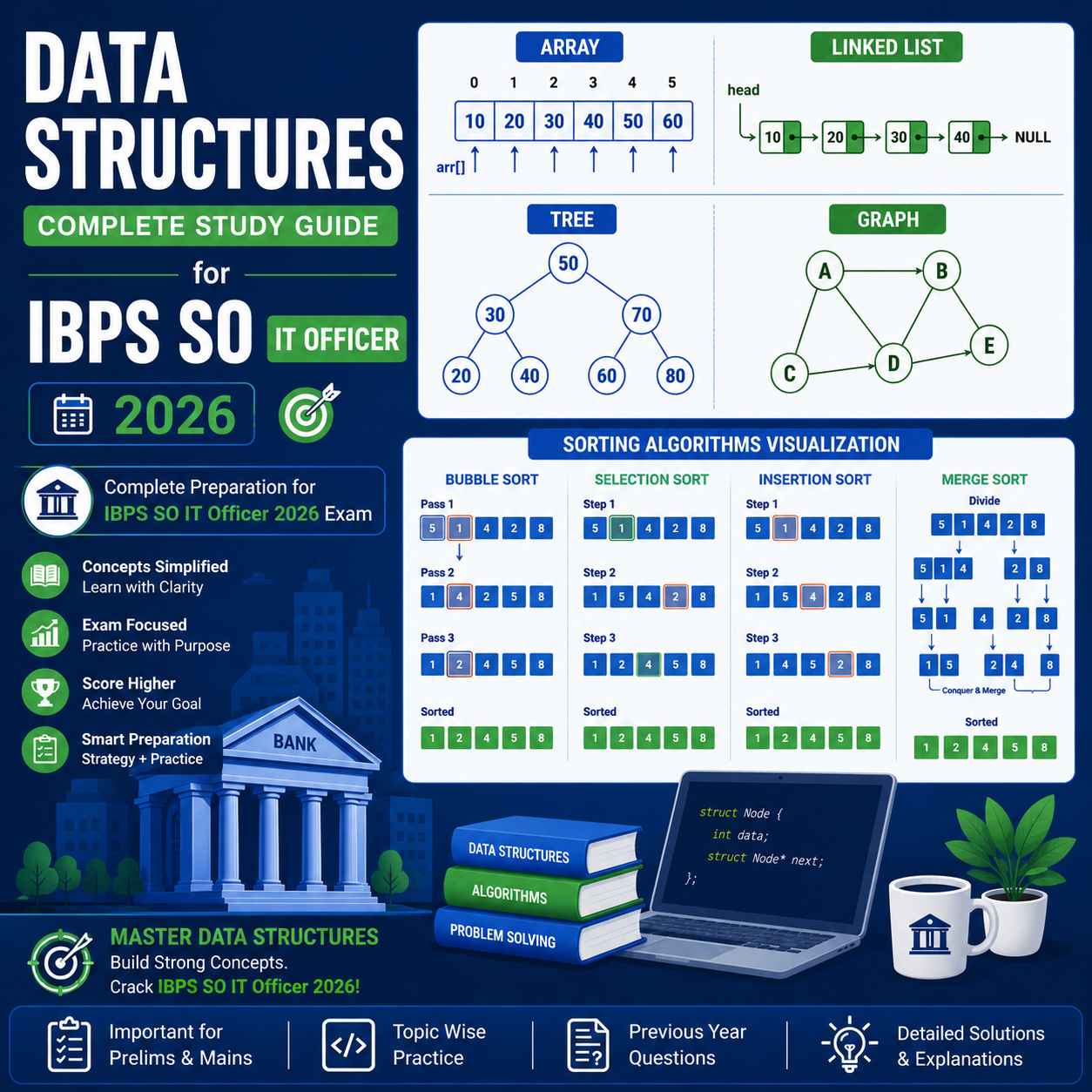
Master Data Structures for IBPS SO IT Officer 2026 with our complete study guide covering arrays, linked lists, stacks, queues, trees, graphs, and sorting algorithms. Data Structures is one of the most important topics in the IBPS SO IT Officer Professional Knowledge section, contributing 6-8 marks every year. With proper preparation using this guide, you can score full marks in this section and significantly improve your final selection chances.
In this comprehensive guide on Data Structures for IBPS SO IT Officer 2026, we’ll cover the complete syllabus, important concepts with examples, time complexity analysis, sorting and searching algorithms, top MCQs, and proven preparation strategies. Whether you’re starting fresh or doing last-minute revision, this article gives you everything needed to crack the data structures section of bank IT officer exam.
Why Data Structures is Important for IBPS SO IT Officer 2026
Data Structures holds significant weightage in the Data Structures for IBPS SO IT Officer 2026 exam. Here’s why mastering this section is crucial:
- Consistent Weightage: 6-8 questions appear from Data Structures every year.
- Logical Questions: Most questions test understanding, easier than memorization topics.
- Job Foundation: Banking software development requires strong DS knowledge.
- Common Topic: Same syllabus in CIL MT, SBI SO, NIELIT, GATE CSE exams.
- Interview Critical: Data structures questions are common in interview rounds.
- Programming Base: Foundation for advanced programming concepts.
Complete Syllabus – Data Structures for IBPS SO IT Officer 2026
Understanding the complete syllabus helps focus on high-yield topics. Here’s the detailed Data Structures for IBPS SO IT Officer 2026 breakdown:
| Topic | Sub-Topics | Expected Questions | Difficulty |
|---|---|---|---|
| Arrays | 1D, 2D, Operations, Memory | 1-2 | Easy |
| Linked Lists | Singly, Doubly, Circular | 1-2 | Medium |
| Stack | Operations, Applications | 1 | Easy-Medium |
| Queue | Linear, Circular, Priority | 1 | Easy-Medium |
| Trees | BST, AVL, B-Tree, Traversal | 2-3 | Medium-Hard |
| Graphs | Types, BFS, DFS | 1-2 | Medium-Hard |
| Sorting | Bubble, Merge, Quick, Heap | 1-2 | Medium |
| Searching | Linear, Binary, Hash | 1 | Easy |
Arrays – Foundation of Data Structures for IBPS SO 2026
Arrays are the simplest and most asked data structure in Data Structures for IBPS SO IT Officer 2026. Master these concepts:
Array Basics:
- Definition: Collection of elements of same data type stored in contiguous memory.
- Index: Starts from 0 in most languages (C, C++, Java, Python).
- Size: Fixed at declaration time (static arrays).
- Access: O(1) time using index.
- Memory Formula: Address = Base + (Index × Size of element).
Array Operations and Time Complexity:
| Operation | Time Complexity | Description |
|---|---|---|
| Access | O(1) | Direct access using index |
| Search | O(n) | Linear search worst case |
| Insertion | O(n) | Shifting required |
| Deletion | O(n) | Shifting required |
Linked Lists – Data Structures for IBPS SO IT Officer 2026
Linked Lists are dynamic data structures and frequently asked in Data Structures for IBPS SO IT Officer 2026. Master all three types:
Types of Linked Lists:
1. Singly Linked List
- Each node has data + pointer to next node
- Last node points to NULL
- Can traverse only in one direction
- Memory efficient compared to others
2. Doubly Linked List
- Each node has data + prev pointer + next pointer
- Can traverse in both directions
- Uses more memory than singly
- Easier deletion (no need to track previous)
3. Circular Linked List
- Last node points back to first node (no NULL)
- Can be singly or doubly circular
- Useful for round-robin scheduling
Array vs Linked List Comparison:
| Feature | Array | Linked List |
|---|---|---|
| Memory | Contiguous | Non-contiguous |
| Size | Fixed | Dynamic |
| Access | O(1) random | O(n) sequential |
| Insertion | O(n) | O(1) at head |
| Deletion | O(n) | O(1) at head |
| Memory Usage | Less (no pointers) | More (pointers needed) |
Stack – Data Structures for IBPS SO IT Officer 2026
Stack follows LIFO (Last In First Out) principle. It’s a guaranteed question in Data Structures for IBPS SO IT Officer 2026:
Stack Operations:
- Push: Add element to top — O(1)
- Pop: Remove element from top — O(1)
- Peek/Top: View top element without removing — O(1)
- isEmpty: Check if stack is empty — O(1)
- isFull: Check if stack is full — O(1)
Stack Applications (Frequently Asked):
- Function call management (call stack)
- Expression evaluation (Postfix, Prefix)
- Undo/Redo operations in editors
- Browser back button history
- Balanced parenthesis checking
- Recursion implementation
- Depth First Search (DFS)
Queue – Data Structures for IBPS SO IT Officer 2026
Queue follows FIFO (First In First Out) principle. Important topic in Data Structures for IBPS SO IT Officer 2026:
Types of Queues:
1. Simple Queue (Linear)
- Front and rear pointers
- Enqueue at rear, dequeue at front
- Drawback: Wasted space
2. Circular Queue
- Rear connects back to front
- Better memory utilization
- Used in CPU scheduling
3. Priority Queue
- Elements have priorities
- Higher priority dequeued first
- Implemented using heap
4. Double-Ended Queue (Deque)
- Insert and delete from both ends
- Used in scheduling algorithms
Queue Applications:
- CPU scheduling in OS
- Printer queue management
- Breadth First Search (BFS)
- Handling interrupts in real-time systems
- Call center customer waiting
- Network packet management
Trees – Most Important Data Structure for IBPS SO IT Officer 2026
Trees are hierarchical data structures and carry maximum marks in Data Structures for IBPS SO IT Officer 2026. Master these:
Tree Terminology:
- Root: Topmost node of tree
- Parent: Node having children
- Child: Node connected below parent
- Leaf: Node with no children
- Sibling: Nodes with same parent
- Depth: Distance from root to node
- Height: Longest path from node to leaf
- Degree: Number of children of a node
Types of Trees:
| Tree Type | Description | Use Case |
|---|---|---|
| Binary Tree | Each node has max 2 children | General hierarchical data |
| BST (Binary Search Tree) | Left < Root < Right | Searching and sorting |
| AVL Tree | Self-balancing BST | Maintaining balance |
| Red-Black Tree | Self-balancing with colors | STL, Java TreeMap |
| B-Tree | Multi-way tree | Database indexing |
| B+ Tree | Modified B-Tree | File systems, databases |
| Heap | Complete binary tree with order | Priority queue |
| Trie | Prefix tree | Dictionary, autocomplete |
Binary Search Tree (BST) Properties:
- Left subtree contains values less than parent
- Right subtree contains values greater than parent
- Search: O(log n) average, O(n) worst case
- Insertion and deletion: O(log n) average
- Inorder traversal gives sorted output
Tree Traversal Methods – Data Structures for IBPS SO 2026
Tree traversal questions are common in Data Structures for IBPS SO IT Officer 2026. Master these 4 types:
1. Inorder Traversal (Left → Root → Right)
Used in BST to get sorted output.
2. Preorder Traversal (Root → Left → Right)
Used to create copy of tree or get prefix expression.
3. Postorder Traversal (Left → Right → Root)
Used to delete tree or get postfix expression.
4. Level Order Traversal (BFS)
Visit nodes level by level from top to bottom. Uses queue.
Memory Trick:
Position of “Root” in name tells when to visit it:
Inorder = Root in middle (Left, Root, Right)
Preorder = Root first (Root, Left, Right)
Postorder = Root last (Left, Right, Root)
Graphs – Data Structures for IBPS SO IT Officer 2026
Graphs are advanced data structures. Important topics in Data Structures for IBPS SO IT Officer 2026:
Graph Terminology:
- Vertex (Node): Entity in graph
- Edge: Connection between vertices
- Degree: Number of edges connected to vertex
- Path: Sequence of vertices connected by edges
- Cycle: Path that starts and ends at same vertex
- Connected Graph: Path exists between every pair
Types of Graphs:
| Graph Type | Description |
|---|---|
| Directed Graph | Edges have direction (arrows) |
| Undirected Graph | Edges have no direction |
| Weighted Graph | Edges have weights/costs |
| Cyclic Graph | Contains at least one cycle |
| Acyclic Graph | No cycles (DAG if directed) |
| Complete Graph | Every pair of vertices connected |
Graph Traversal Algorithms:
BFS (Breadth First Search)
- Uses Queue data structure
- Visits level by level
- Time complexity: O(V + E)
- Used to find shortest path in unweighted graph
DFS (Depth First Search)
- Uses Stack (or recursion)
- Goes deep before backtracking
- Time complexity: O(V + E)
- Used to detect cycles, find paths
Sorting Algorithms – Data Structures for IBPS SO 2026
Sorting algorithms are tested every year in Data Structures for IBPS SO IT Officer 2026. Master time complexities:
| Algorithm | Best Case | Average Case | Worst Case | Space | Stable |
|---|---|---|---|---|---|
| Bubble Sort | O(n) | O(n²) | O(n²) | O(1) | Yes |
| Selection Sort | O(n²) | O(n²) | O(n²) | O(1) | No |
| Insertion Sort | O(n) | O(n²) | O(n²) | O(1) | Yes |
| Merge Sort | O(n log n) | O(n log n) | O(n log n) | O(n) | Yes |
| Quick Sort | O(n log n) | O(n log n) | O(n²) | O(log n) | No |
| Heap Sort | O(n log n) | O(n log n) | O(n log n) | O(1) | No |
| Counting Sort | O(n+k) | O(n+k) | O(n+k) | O(k) | Yes |
| Radix Sort | O(nk) | O(nk) | O(nk) | O(n+k) | Yes |
Key Points About Sorting:
- Best: Merge Sort, Heap Sort (consistent O(n log n))
- Fastest in Practice: Quick Sort (despite O(n²) worst case)
- Stable: Bubble, Insertion, Merge, Counting, Radix
- In-Place: Bubble, Selection, Insertion, Heap, Quick
- External Sorting: Used when data doesn’t fit in memory
Searching Algorithms – Data Structures for IBPS SO 2026
Searching is a fundamental topic in Data Structures for IBPS SO IT Officer 2026:
1. Linear Search
- Time Complexity: O(n)
- Works on sorted and unsorted arrays
- Simple but slow for large data
2. Binary Search
- Time Complexity: O(log n)
- Only works on sorted arrays
- Divides array in half each iteration
- Much faster than linear search
3. Hash Search
- Time Complexity: O(1) average
- Uses hash function for direct access
- Used in databases and caches
Top 20 Data Structures Questions for IBPS SO IT Officer 2026
Practice these previous year Data Structures for IBPS SO IT Officer 2026 questions:
- Q. Which data structure uses LIFO principle?
Answer: Stack - Q. Which data structure uses FIFO principle?
Answer: Queue - Q. Time complexity of binary search?
Answer: O(log n) - Q. Best case time complexity of Quick Sort?
Answer: O(n log n) - Q. Worst case time complexity of Quick Sort?
Answer: O(n²) - Q. Which traversal gives sorted output in BST?
Answer: Inorder Traversal - Q. Which data structure is used in BFS?
Answer: Queue - Q. Which data structure is used in DFS?
Answer: Stack - Q. Maximum number of nodes in binary tree of height h?
Answer: 2^(h+1) – 1 - Q. Time complexity to access array element?
Answer: O(1) - Q. Which sorting algorithm is stable?
Answer: Merge Sort, Bubble Sort, Insertion Sort - Q. Time complexity of merge sort?
Answer: O(n log n) in all cases - Q. Which data structure has dynamic size?
Answer: Linked List - Q. Postfix expression evaluation uses which DS?
Answer: Stack - Q. Which tree is used in database indexing?
Answer: B-Tree / B+ Tree - Q. Hash table average search time?
Answer: O(1) - Q. How many child nodes in binary tree max?
Answer: 2 - Q. Priority queue is implemented using?
Answer: Heap - Q. Which sort is fastest in practice?
Answer: Quick Sort - Q. Recursion uses which data structure internally?
Answer: Stack (Call Stack)
Time Complexity Summary – Quick Reference
Memorize this table for Data Structures for IBPS SO IT Officer 2026:
| Data Structure | Access | Search | Insert | Delete |
|---|---|---|---|---|
| Array | O(1) | O(n) | O(n) | O(n) |
| Stack | O(n) | O(n) | O(1) | O(1) |
| Queue | O(n) | O(n) | O(1) | O(1) |
| Linked List | O(n) | O(n) | O(1) | O(1) |
| Hash Table | N/A | O(1) | O(1) | O(1) |
| BST (avg) | O(log n) | O(log n) | O(log n) | O(log n) |
| AVL Tree | O(log n) | O(log n) | O(log n) | O(log n) |
Memory Tricks – Data Structures for IBPS SO 2026
Use these tricks to remember important Data Structures for IBPS SO IT Officer 2026 concepts:
Trick 1: LIFO vs FIFO
- Stack = LIFO (Last In First Out) = Plate Stack
- Queue = FIFO (First In First Out) = Line at counter
Trick 2: Sorting Algorithm Speeds
Remember: “Bad Selections Insert Merge Quick Heap”
Bubble, Selection, Insertion = O(n²) — Slow
Merge, Quick, Heap = O(n log n) — Fast
Trick 3: BST Traversal
Position of “root” in name = when to visit root:
Inorder = Middle, Preorder = First, Postorder = Last
Trick 4: BFS vs DFS
- BFS = uses Queue (alphabetical match)
- DFS = uses Stack (D before S in tree, S in Stack)
Common Mistakes – Data Structures for IBPS SO IT Officer Exam
- ❌ Confusing best, average, and worst case complexities.
- ❌ Forgetting which traversal gives sorted BST output (Inorder).
- ❌ Mixing up Stack and Queue applications.
- ❌ Not knowing stable vs unstable sorting algorithms.
- ❌ Confusing BFS (Queue) and DFS (Stack) implementations.
- ❌ Memorizing complexities without understanding.
- ❌ Skipping tree traversal practice problems.
- ❌ Not relating data structures to real-world examples.
- ❌ Ignoring hash table collision handling techniques.
- ❌ Wrong understanding of recursion using stack.
30-Day Study Plan – Data Structures for IBPS SO IT Officer 2026
📅 Week 1: Basics (Days 1-7)
- Day 1-2: Arrays (1D, 2D, operations)
- Day 3-4: Linked Lists (all 3 types)
- Day 5-6: Stack and Queue
- Day 7: 25 MCQs practice
📅 Week 2: Trees (Days 8-14)
- Day 8-9: Binary Tree and BST
- Day 10-11: AVL, Red-Black, B-Tree
- Day 12-13: Tree traversals (all 4 types)
- Day 14: 35 MCQs practice
📅 Week 3: Graphs and Algorithms (Days 15-21)
- Day 15-16: Graph types and representations
- Day 17-18: BFS and DFS
- Day 19-20: Sorting algorithms
- Day 21: 40 MCQs practice
📅 Week 4: Mastery (Days 22-30)
- Day 22-23: Searching algorithms and hashing
- Day 24-25: Time complexity analysis
- Day 26-27: Previous year papers
- Day 28-29: Mock tests
- Day 30: Final revision + weak topics
Best Books for Data Structures IBPS SO IT Officer 2026
- Data Structures Through C by Yashavant Kanetkar
- Data Structures and Algorithms in Java by Robert Lafore
- Introduction to Algorithms by Cormen (CLRS)
- Data Structures and Algorithms Made Easy by Narasimha Karumanchi
- IBPS SO IT Officer Professional Knowledge by Arihant Publications
- GATE CSE Data Structures by Made Easy
Last 24 Hours Cheat Sheet – Data Structures for IBPS SO 2026
Quick revision points before exam:
- ✅ Stack: LIFO, used in recursion, DFS
- ✅ Queue: FIFO, used in BFS, scheduling
- ✅ Array Access: O(1), Search: O(n)
- ✅ Linked List: Dynamic size, sequential access
- ✅ BST Inorder: Gives sorted output
- ✅ Binary Search: O(log n) on sorted array
- ✅ Quick Sort: Best in practice, O(n log n) average
- ✅ Merge Sort: Stable, O(n log n) all cases
- ✅ Heap: Priority queue implementation
- ✅ B-Tree: Used in databases
- ✅ Hash Table: O(1) average operations
- ✅ AVL Tree: Self-balancing BST
Data Structures for Other Bank IT Exams Comparison
Same syllabus works for multiple exams:
| Exam | DS Questions | Focus Areas |
|---|---|---|
| IBPS SO IT Officer | 6-8 | Trees, Sorting, Time Complexity |
| CIL MT Systems | 8-10 | Advanced trees, graphs |
| SBI SO Systems | 5-7 | Basic DS concepts |
| GATE CSE | 15-20 | All topics in depth |
For complete preparation, check our IBPS SO IT Officer Syllabus 2026 Complete Guide and master DBMS for IBPS SO IT Officer 2026 for highest weightage section.
Free Resources to Practice Data Structures for IBPS SO 2026
- GeeksforGeeks: Data Structures tutorials with code
- HackerRank: Data Structures practice problems
- LeetCode: Interview-style DS questions
- Visualgo.net: Visualize sorting and DS
- Sanfoundry: 1000+ MCQs on DS
- YouTube: Abdul Bari, Gate Smashers channels
Also Read – Complete IBPS SO IT Officer 2026 Study Series
- 📖 IBPS SO IT Officer Syllabus 2026 – Complete Guide
- 📖 DBMS for IBPS SO IT Officer 2026 – Study Guide
- 📖 SQL for IBPS SO IT Officer 2026 – 50 Questions
- 📖 DBMS Normalization for IBPS SO – 1NF to 5NF
- 📖 Computer Networks for IBPS SO IT Officer 2026
Final Thoughts on Data Structures for IBPS SO IT Officer 2026
Mastering Data Structures for IBPS SO IT Officer 2026 is essential for success in bank IT officer exam. Focus on Trees, Sorting algorithms, Time complexity, and Stack/Queue concepts — these cover 70% of data structures questions. Use the memory tricks provided, practice regularly, and revise time complexity tables frequently.
Remember that data structures form the foundation of computer science. As a future bank IT officer, you’ll work with various data structures in banking software daily. With 30 days of focused study using this guide, you can confidently solve all data structures questions and significantly boost your overall score.
Ready to crack the Data Structures section? Bookmark CodeLearning.in for daily DS practice questions, complete study guides, and free resources for IBPS SO IT Officer, CIL MT, SBI SO, and other bank IT exams. Drop your questions in comments — our team responds within 24 hours. Stay tuned for our next article! 🎯
Disclaimer: The data structures concepts and questions provided are based on standard computer science curriculum and previous year IBPS SO IT Officer exam patterns. Exam patterns may vary year to year. Always refer to the official IBPS notification at www.ibps.in for latest exam updates and syllabus.





5 comments on “Data Structures for IBPS SO IT Officer 2026 — Best Notes, MCQs & Tricks”