

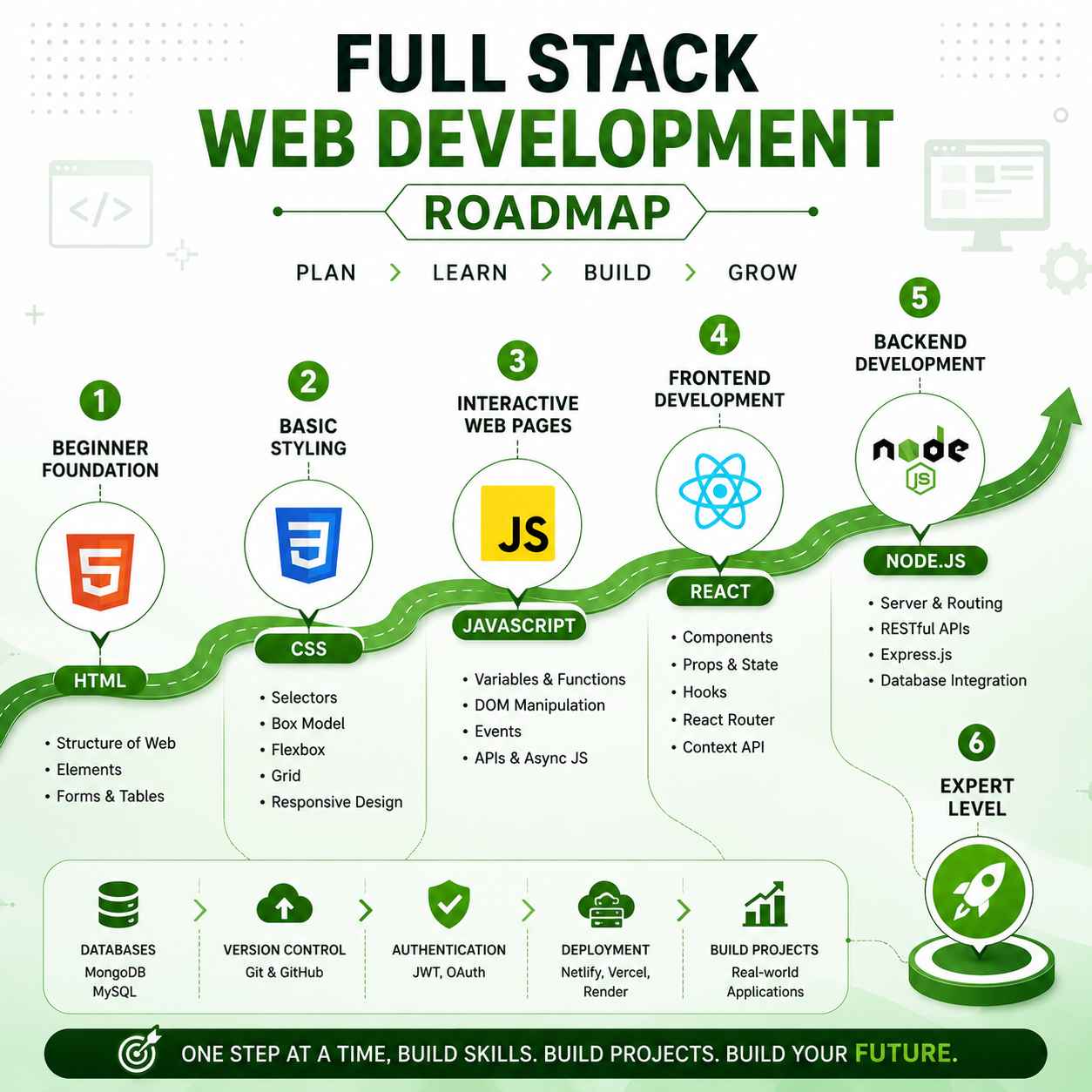
Want to become a successful web developer? Following the right Full Stack Web Development Roadmap 2026 can transform you from beginner to industry-ready developer in just 6-12 months. As a B.Tech qualified Full Stack Developer with 6+ years of professional experience, I’ve created this step-by-step roadmap based on real industry requirements, current hiring trends, and the exact path that helped me land high-paying tech jobs.
This Full Stack Web Development Roadmap 2026 covers every essential skill — from HTML basics to modern frameworks like React and Node.js. Whether you’re a complete beginner or a developer looking to upgrade your skills, this guide gives you a clear, actionable path to build production-ready web applications and start your career in tech.
What is Full Stack Web Development in 2026?
Full Stack Web Development means building both the frontend (what users see) and backend (server-side logic) of web applications. A Full Stack Developer can work on databases, APIs, user interfaces, and deployment — making them highly valuable in the job market with salaries ranging from ₹6 LPA to ₹40+ LPA in India.
Why Follow Full Stack Web Development Roadmap 2026?
- High Demand: 70% of tech jobs need Full Stack skills
- Better Salaries: 30-40% more than specialists
- Career Flexibility: Work in startups or enterprises
- Freelance Opportunities: Earn $20-100/hr globally
- Job Security: Multiple skills = better stability
Step 1: Master HTML, CSS, and JavaScript Fundamentals
The first step in any Full Stack Web Development Roadmap 2026 is building strong fundamentals. Don’t skip these basics — they are the foundation of everything!
HTML (1-2 weeks):
- HTML5 semantic tags
- Forms and input elements
- Tables, lists, and links
- Accessibility (ARIA basics)
- SEO-friendly markup
CSS (2-3 weeks):
- Selectors, properties, values
- Flexbox and Grid layouts
- Responsive design (mobile-first)
- CSS animations
- Tailwind CSS framework (industry standard now)
JavaScript (4-6 weeks):
- Variables, data types, operators
- Functions and arrow functions
- Arrays and objects
- ES6+ features (let, const, destructuring)
- Async JavaScript (Promises, async/await)
- DOM manipulation
- Fetch API for HTTP requests
Master JavaScript deeply — it’s the most important language in web development.
Step 2: Learn a Frontend Framework — React.js
After mastering JavaScript, the next phase of your Full Stack Web Development Roadmap 2026 is learning a modern frontend framework. React.js is the clear winner with 60%+ market share.
React.js Essential Topics (4-6 weeks):
- Components and JSX
- Props and state management
- React Hooks (useState, useEffect, useContext)
- React Router for navigation
- Form handling and validation
- API integration with Axios/Fetch
- Context API or Redux Toolkit
Next.js Framework (2-3 weeks):
After React, learn Next.js — the most popular React framework for production applications. It offers server-side rendering, SEO benefits, and better performance.
Step 3: Backend Development with Node.js
The third critical phase of Full Stack Web Development Roadmap 2026 is backend development. Node.js is the most popular choice because you can use the same JavaScript language for both frontend and backend.
Node.js + Express.js (4-6 weeks):
- Node.js basics and npm
- Express.js framework
- RESTful API design
- Routes and middleware
- Authentication (JWT, bcrypt)
- Error handling and logging
- File uploads with Multer
Alternative Backend Options:
- Python (Django/FastAPI): Great for AI integration
- Java (Spring Boot): Enterprise applications
- Go (Golang): Modern, high-performance
For comparing languages, check our Python vs JavaScript Guide.
Step 4: Database Management — MongoDB and PostgreSQL
Every web application needs a database. Your Full Stack Web Development Roadmap 2026 should include both NoSQL and SQL databases.
MongoDB (NoSQL — 2-3 weeks):
- Document-based storage
- CRUD operations
- Mongoose ODM for Node.js
- Aggregation pipelines
- Indexing and performance
PostgreSQL (SQL — 2-3 weeks):
- SQL queries (SELECT, INSERT, UPDATE, DELETE)
- Joins and relationships
- Indexes and optimization
- Prisma ORM (modern, type-safe)
For deep SQL knowledge, refer to our SQL Complete Guide.
Step 5: Version Control — Git and GitHub
Git is non-negotiable for any developer. Every Full Stack Web Development Roadmap 2026 must include Git mastery from day one.
Git Essentials (1 week):
- git init, add, commit, push, pull
- Branching and merging
- Resolving merge conflicts
- GitHub workflow (PRs, issues)
- Collaborating on open source
Pro Tip: Commit code daily and build a strong GitHub profile — recruiters check this!
Step 6: Deployment and DevOps Basics
Building apps isn’t enough — you need to deploy them. The final phase of your Full Stack Web Development Roadmap 2026 covers deployment.
Deployment Platforms (2 weeks):
- Vercel: Best for Next.js and React apps
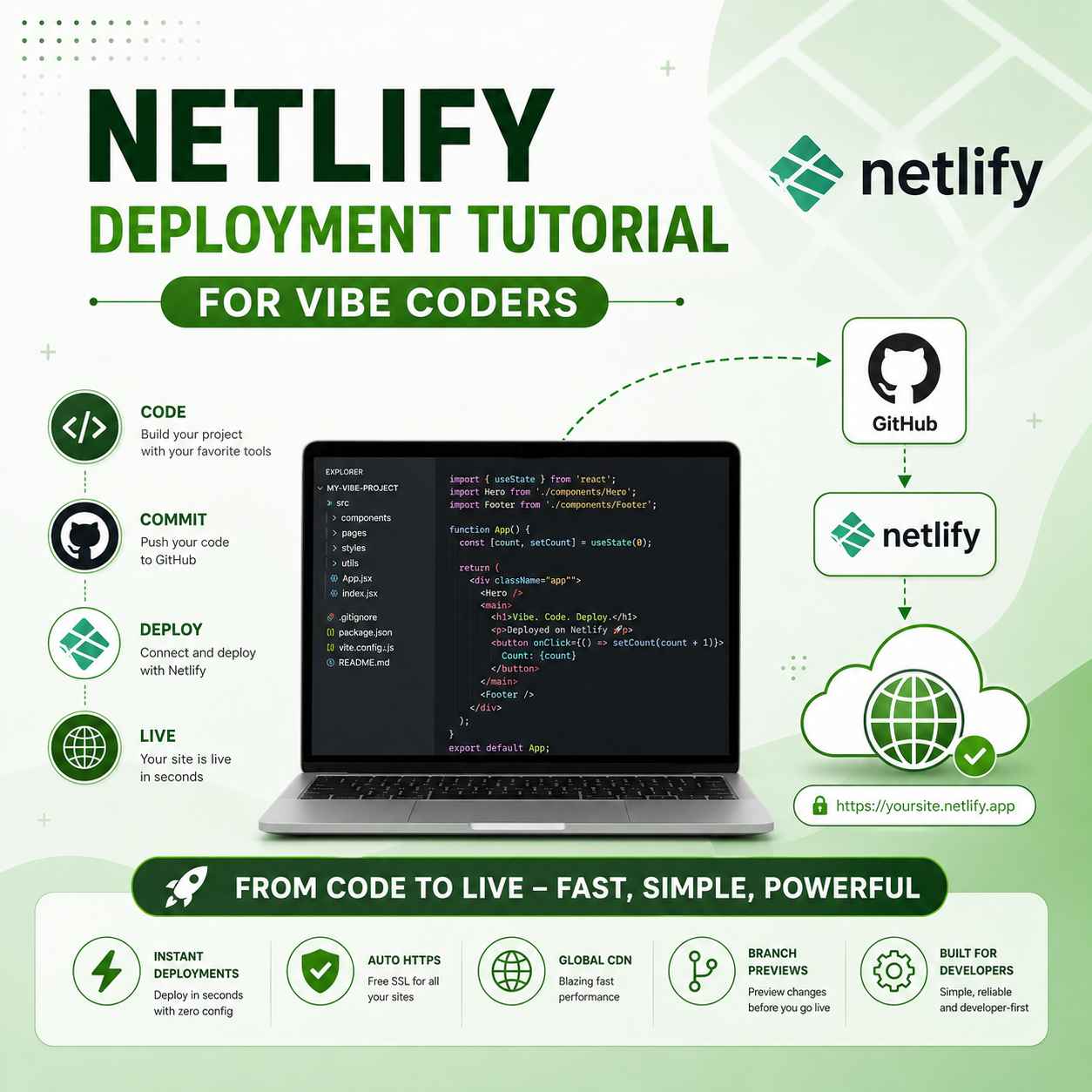
- Netlify: Great for static sites
- Railway/Render: Backend deployment
- AWS basics: EC2, S3, RDS
- Docker: Containerization (advanced)
Additional Skills:
- Environment variables management
- CI/CD with GitHub Actions
- Domain setup and SSL certificates
- Monitoring and error tracking
Full Stack Web Development Roadmap 2026 – Complete Timeline
| Phase | Duration | Skills |
|---|---|---|
| Foundation | 7-11 weeks | HTML, CSS, JavaScript |
| Frontend | 6-9 weeks | React.js, Next.js |
| Backend | 4-6 weeks | Node.js, Express |
| Database | 4-6 weeks | MongoDB, PostgreSQL |
| Version Control | 1 week | Git, GitHub |
| Deployment | 2 weeks | Vercel, AWS basics |
| Total | 6-8 months | Job-ready! |
Build Real Projects — Most Important Step!
Theory alone won’t get you hired. Build these projects following the Full Stack Web Development Roadmap 2026:
- Portfolio Website: Showcase your work
- Todo App: CRUD operations practice
- Blog Platform: Full stack with authentication
- E-commerce Site: Payment integration
- Social Media Clone: Real-time features
Quality projects on GitHub matter more than certificates!
Best Free Resources for Full Stack Web Development Roadmap 2026
- freeCodeCamp: Comprehensive curriculum
- The Odin Project: Project-based learning
- MDN Web Docs: Best documentation
- JavaScript.info: Deep JavaScript guide
- YouTube: Apna College, Web Dev Simplified
- Frontend Mentor: Real-world challenges
Salary Expectations for Full Stack Developers India 2026
| Experience | Salary Range |
|---|---|
| Fresher (0-1 yr) | ₹4-8 LPA |
| Junior (1-3 yrs) | ₹8-15 LPA |
| Mid-Level (3-5 yrs) | ₹15-25 LPA |
| Senior (5-8 yrs) | ₹25-45 LPA |
| Lead (8+ yrs) | ₹45-1 Cr+ LPA |
Check detailed salaries in our Software Engineer Salary Guide India 2026.
Common Mistakes in Full Stack Web Development Roadmap 2026
- ❌ Jumping to React without mastering JavaScript
- ❌ Watching tutorials without building projects
- ❌ Learning too many frameworks superficially
- ❌ Ignoring Git from the start
- ❌ Not deploying projects publicly
- ❌ Skipping database fundamentals
- ❌ Avoiding CSS, jumping straight to Tailwind
Also Read – Career Development Articles
- 📖 Which Language is Best for Software Engineer 2026
- 📖 Python vs JavaScript 2026 Complete Guide
- 📖 Software Engineer Salary in India 2026
- 📖 Top 10 Best AI Tools 2026
Final Thoughts on Full Stack Web Development Roadmap 2026
Following this Full Stack Web Development Roadmap 2026 consistently for 6-8 months will transform you into a job-ready developer. The key is consistency — code daily, build real projects, and never stop learning. Web development is one of the most rewarding tech careers in 2026, with excellent salaries, remote work opportunities, and continuous growth potential.
Remember, this roadmap is a guide, not a strict rule. Customize it based on your goals — whether that’s getting a corporate job, freelancing, or building your own startup. Start today, code every single day, and within 6-8 months, you’ll be applying for your first Full Stack Developer role!
Ready to start your web development journey? Bookmark CodeLearning.in for daily web development tutorials, career tips, and project ideas. Drop your questions in comments — our team responds within 24 hours! 🚀💻
Disclaimer: Salary figures and learning durations are based on industry averages and personal experience as a Full Stack Developer. Individual results may vary based on dedication, prior experience, and consistent practice. Technology trends evolve rapidly — refer to authoritative sources like Stack Overflow Developer Survey for the latest data.


5 comments on “Full Stack Web Development Roadmap 2026 — Complete Beginner’s Guide”