
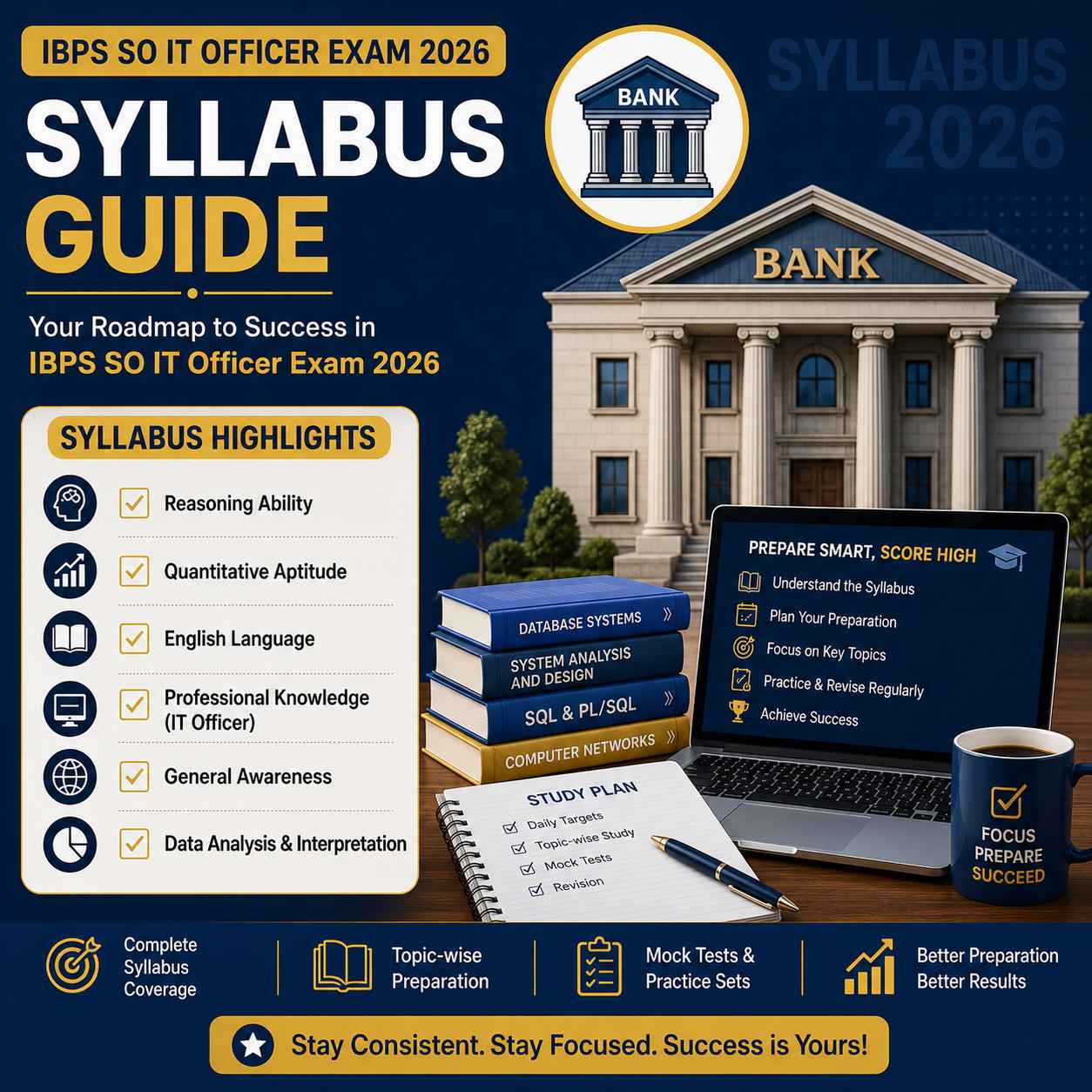
The IBPS SO IT Officer Syllabus 2026 just got its official update — and if you are preparing for CRP SPL-XVI, this is the article you need to read right now. IBPS released the detailed notification on 01 July 2026, and the registration window is already open until 21 July 2026. That is a short window, and the exam itself starts in August 2026.
This guide extracts every important detail directly from the official PDF notification — vacancies, eligibility, exam structure, IBPS SO IT Officer Syllabus 2026 topic-wise breakdown, and a preparation plan that actually works.
Let’s get into it.
IBPS SO IT Officer 2026 — Exam Overview (CRP SPL-XVI)
This recruitment is part of IBPS’s Common Recruitment Process for Specialist Officers in Public Sector Banks. The vacancies are for the financial year 2027-28, and the process runs from online registration all the way through provisional allotment in January 2027.
| Detail | Information |
|---|---|
| Exam Name | CRP SPL-XVI — IT Officer Scale I |
| Conducting Body | IBPS (Institute of Banking Personnel Selection) |
| Post | IT Officer (Scale I) |
| Pay Scale | ₹48,480 – ₹85,920 (Basic) |
| Registration Period | 01 July 2026 to 21 July 2026 |
| Preliminary Exam | August 2026 |
| Main Exam | November 2026 |
| Interview | November/December 2026 |
| Provisional Allotment | January 2027 |
| Official Website | www.ibps.in |
IBPS SO IT Officer 2026 — Vacancy Details (Official CRP SPL-XVI Notification)
Total IT Officer Scale I vacancies as per official notification: 301
| Category | Vacancies |
|---|---|
| SC | 46 |
| ST | 23 |
| OBC | 82 |
| EWS | 28 |
| UR (General) | 122 |
| Total | 301 |
Bank-wise breakdown:
| Bank | SC | ST | OBC | EWS | UR | Total |
|---|---|---|---|---|---|---|
| Bank of India | 16 | 8 | 29 | 11 | 46 | 110 |
| Punjab National Bank | 15 | 8 | 27 | 10 | 40 | 100 |
| Central Bank of India | 8 | 3 | 13 | 5 | 21 | 50 |
| Indian Overseas Bank | 3 | 1 | 6 | 2 | 13 | 25 |
| Punjab & Sind Bank | 4 | 3 | 7 | 0 | 2 | 16 |
| Indian Bank / UCO Bank / Union Bank | NR | NR | NR | NR | NR | NR |
NR = Vacancy Not Reported yet. Final allotment is based on actual vacancies.
Eligibility Criteria
Age (as on 01 July 2026)
Minimum 20 years — Maximum 30 years. Born between 02.07.1996 and 01.07.2006 (both inclusive).
| Category | Age Relaxation |
|---|---|
| SC/ST | 5 years |
| OBC (Non-Creamy Layer) | 3 years |
| PwBD | 10 years |
| Ex-Servicemen | 5 years |
Educational Qualification (as on 21 July 2026)
Any one of the following:
- Option A: 4-year Engineering/Technology Degree in Computer Science / Computer Applications / IT / Electronics / Electronics & Telecommunications / Electronics & Communication / Electronics & Instrumentation
- Option B: Post Graduate Degree in Electronics / Electronics & Tele Communication / Electronics & Communication / Electronics & Instrumentation / Computer Science / IT / Computer Applications
- Option C: Graduate having passed DOEACC ‘B’ level
Result must be declared on or before 21 July 2026. No equivalent qualification accepted.
Application Fee
- SC/ST/PwBD: ₹175 (inclusive of GST)
- All Others: ₹850 (inclusive of GST)
Online payment only, from 01–21 July 2026.
IBPS SO IT Officer 2026 — Exam Pattern
Stage 1: Preliminary Examination
| Subject | Questions | Marks | Duration |
|---|---|---|---|
| English Language | 25 | 25 | 20 minutes |
| Reasoning | 25 | 25 | 20 minutes |
| Quantitative Aptitude | 25 | 25 | 20 minutes |
| Professional Knowledge | 25 | 50 | 20 minutes |
| Total | 100 | 125 | 80 minutes |
- Separate timer for each section
- Negative marking: 0.25 marks per wrong answer
- Must qualify individually in all 4 sections
Stage 2: Main Examination
| Subject | Questions | Marks | Duration |
|---|---|---|---|
| English Language | 30 | 30 | 25 minutes |
| Reasoning | 40 | 40 | 35 minutes |
| Quantitative Aptitude | 30 | 30 | 25 minutes |
| Professional Knowledge (Objective) | 50 | 100 | 40 minutes |
| Total | 150 | 200 | 125 minutes |
Critical point: English, Reasoning, and Quant are only qualifying in Mains. Merit ranking is done entirely on Professional Knowledge marks. This section deserves 70% of your preparation time.
Stage 3: Interview
- Total marks: 100
- Qualifying marks: 40% General/EWS | 35% SC/ST/OBC/PwBD
- Final score = 80% Mains + 20% Interview
IBPS SO IT Officer Syllabus 2026 — Mains Professional Knowledge (Complete Topic-Wise)
This is the section that decides your rank. Study this carefully.
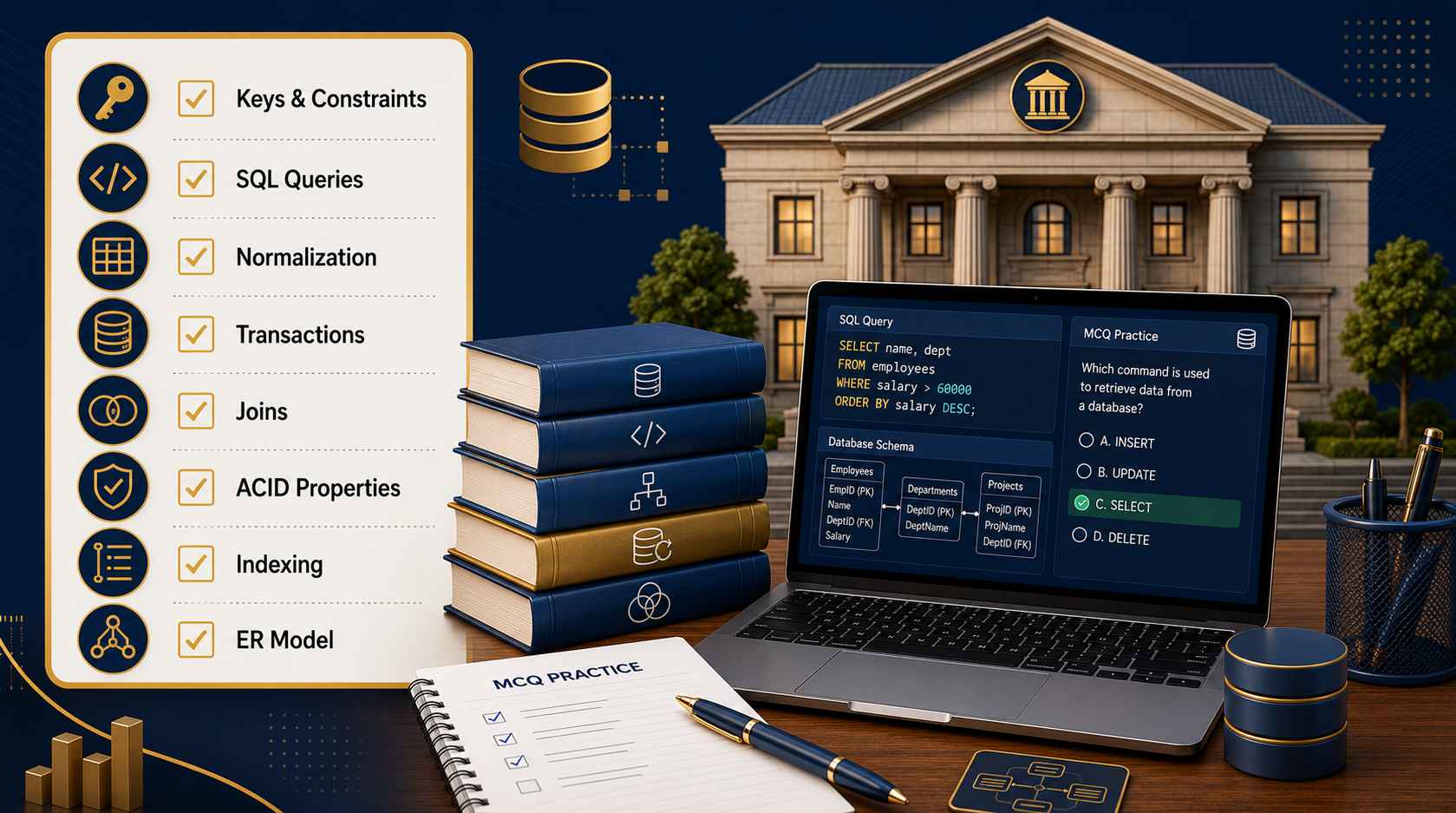
1. Database Management System (DBMS) — 15–20 Marks
Highest weighted topic in the entire IBPS SO IT Officer Syllabus 2026. Cannot be skipped under any circumstance.
- ER Model and ER Diagrams
- Relational Model — Tables, Keys (Primary, Foreign, Candidate, Super)
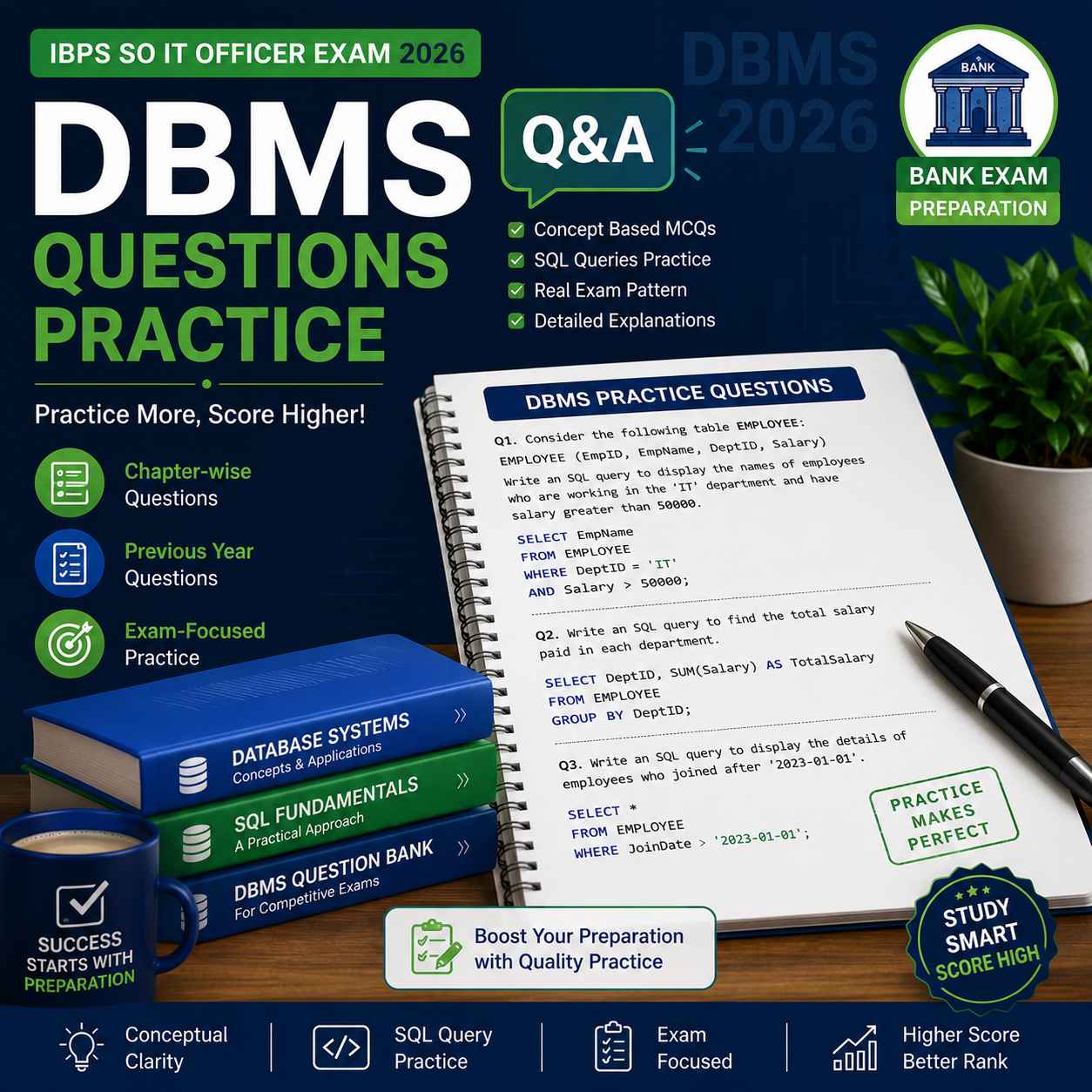
- SQL — DDL, DML, DCL, TCL (SELECT, INSERT, UPDATE, DELETE, JOIN)
- Joins — Inner, Outer, Left, Right, Cross, Self
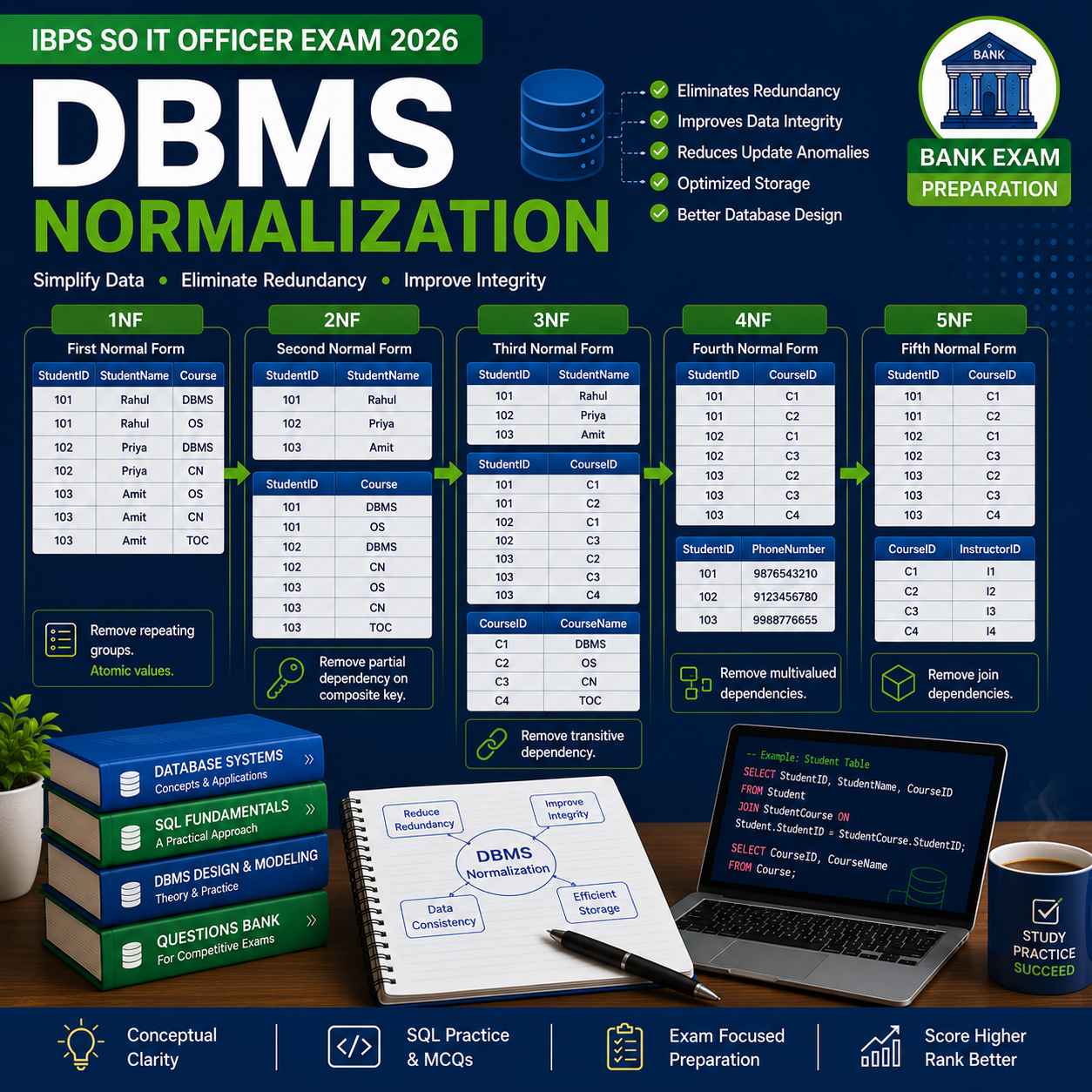
- Normalization — 1NF, 2NF, 3NF, BCNF
- Transactions — ACID Properties
- Concurrency Control — Lock-based, Timestamp-based protocols
- Recovery techniques — Checkpoint, Log-based
- Indexing and Hashing
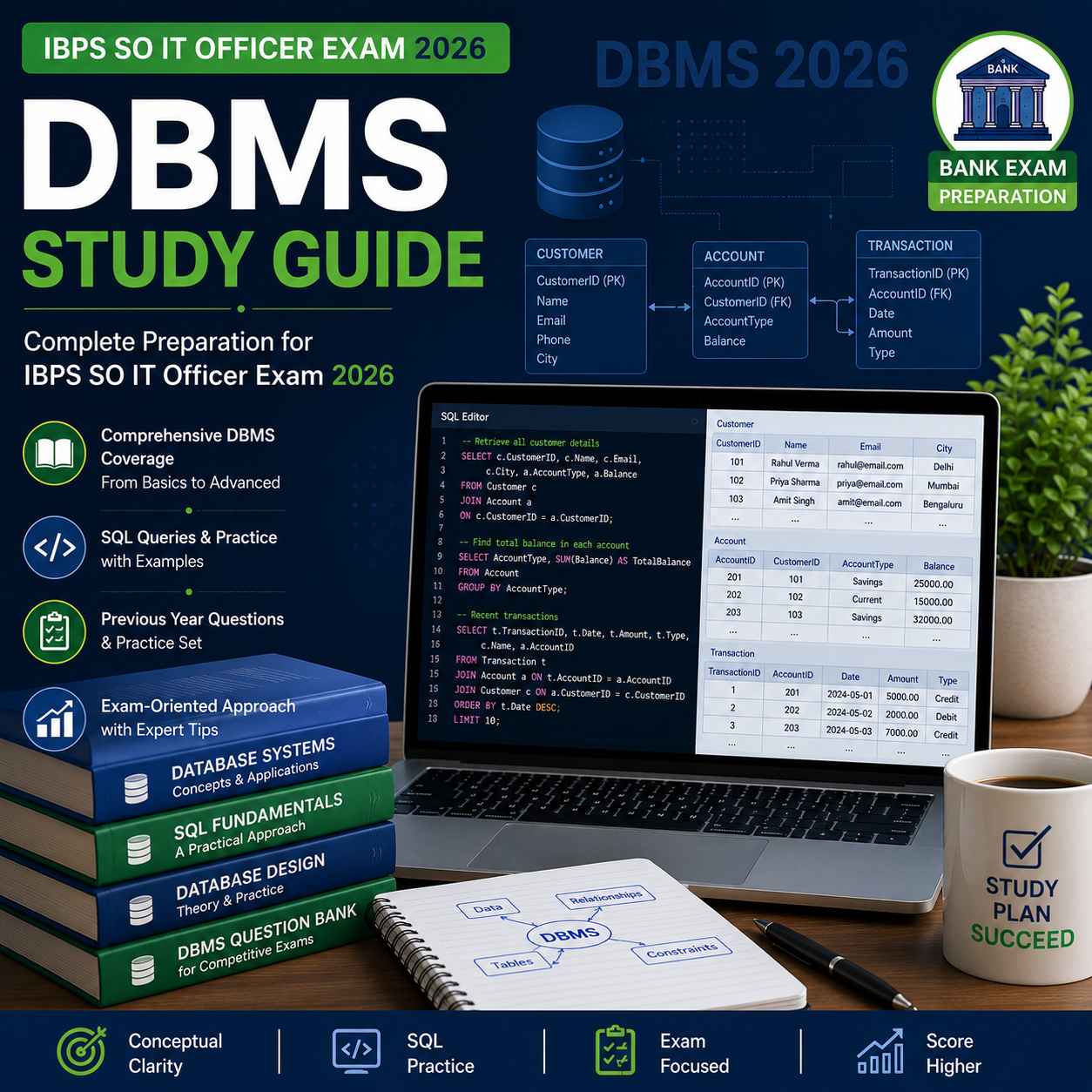
For deep preparation on this topic, read our complete guide: DBMS for IBPS SO IT Officer 2026.
Normalization especially (1NF to BCNF) is a consistent exam question — master it separately: DBMS Normalization for IBPS SO IT Officer.
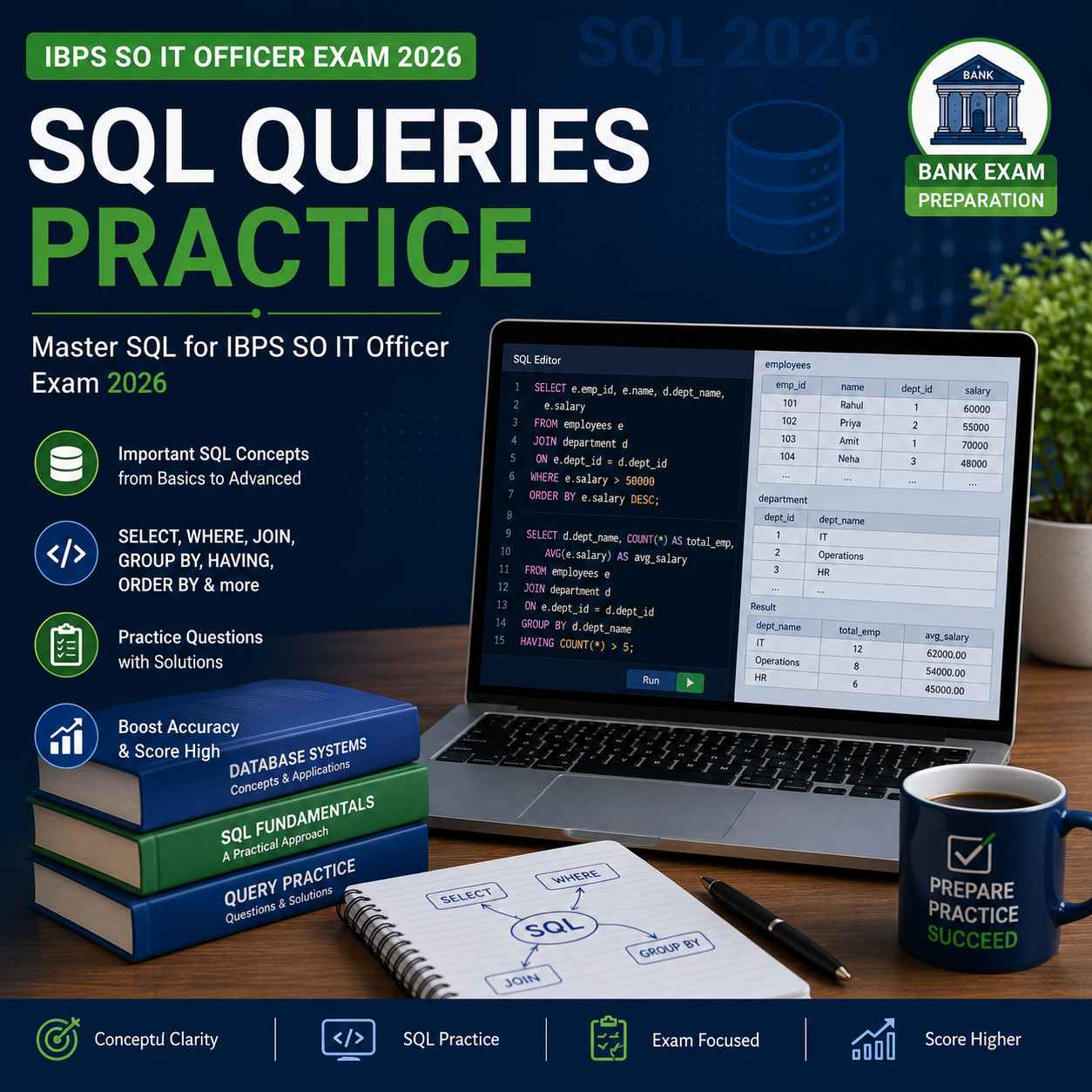
For SQL practice and query-based questions: SQL for IBPS SO IT Officer 2026.
And for the most-repeated questions from previous papers: DBMS Important Questions for IBPS SO 2026.
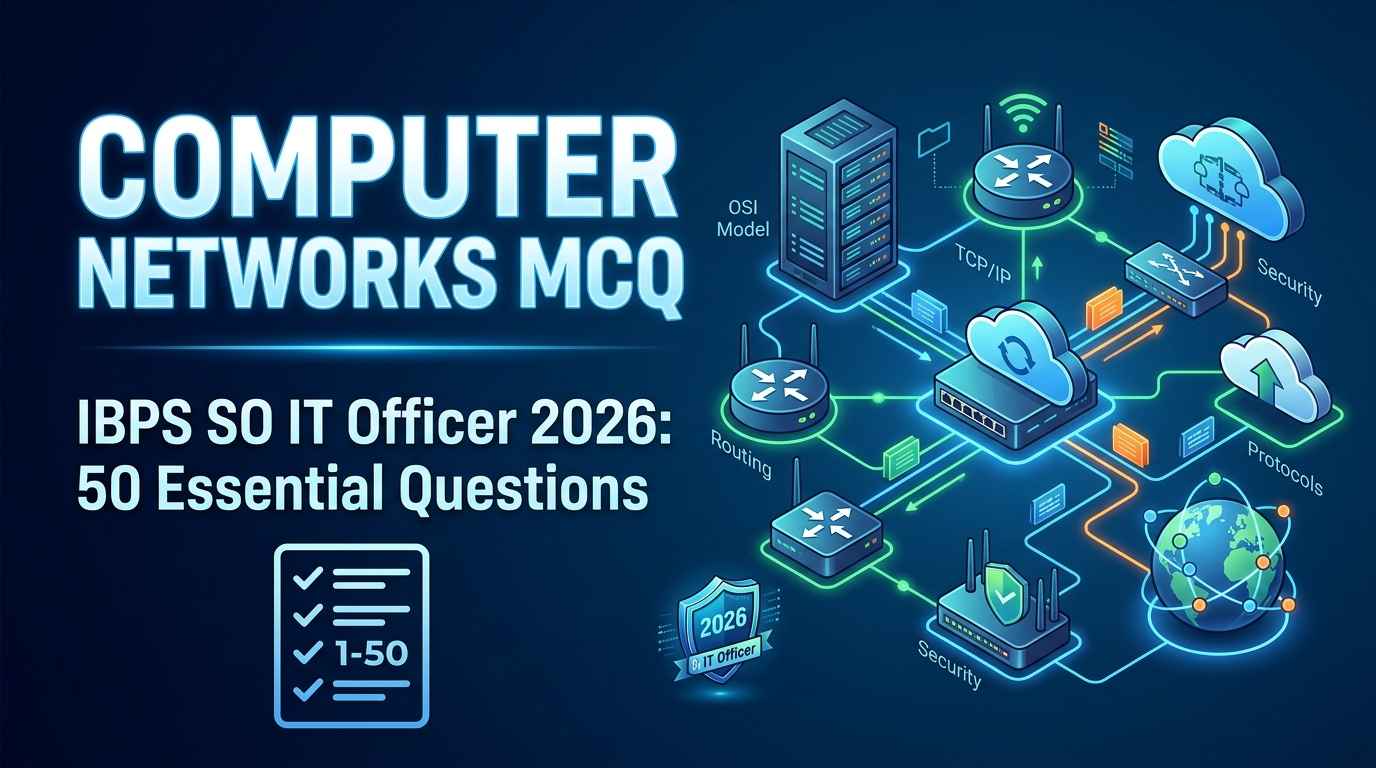
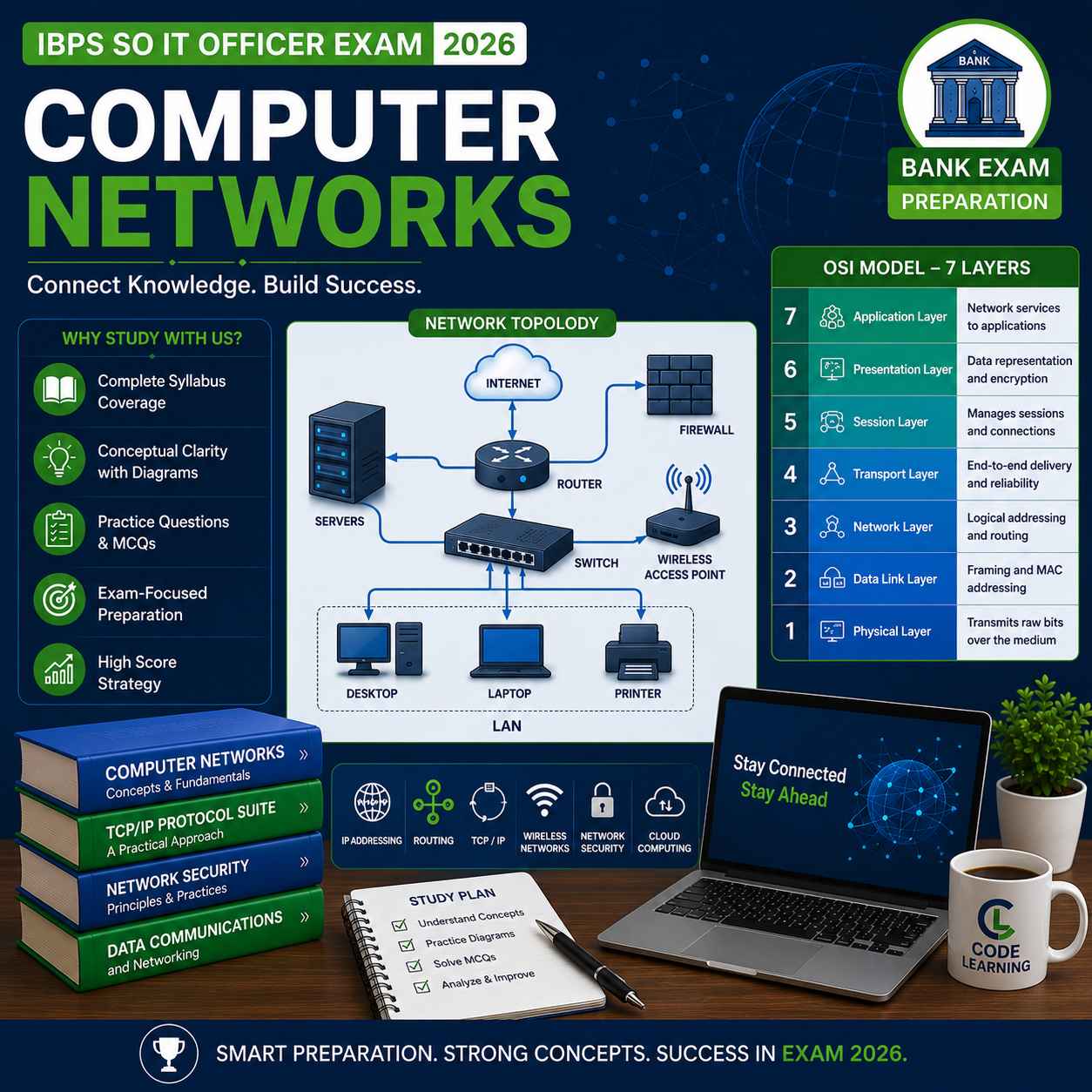
2. Computer Networks — 8–12 Marks
- OSI Model — all 7 layers with functions (very frequently asked)
- TCP/IP Model — differences from OSI
- IP Addressing — IPv4, IPv6, Subnetting, CIDR notation
- Routing Protocols — RIP, OSPF, BGP
- TCP vs UDP — differences, use cases
- Protocols — DNS, DHCP, HTTP/HTTPS, FTP, SMTP, POP3
- Network topologies — Bus, Star, Ring, Mesh, Hybrid
- Switching — Circuit, Packet, Message
- Firewalls, VPN, Proxy Servers
- Wireless — Wi-Fi standards (802.11), Bluetooth, 4G/5G basics
Complete preparation guide: Computer Networks for IBPS SO IT Officer 2026.
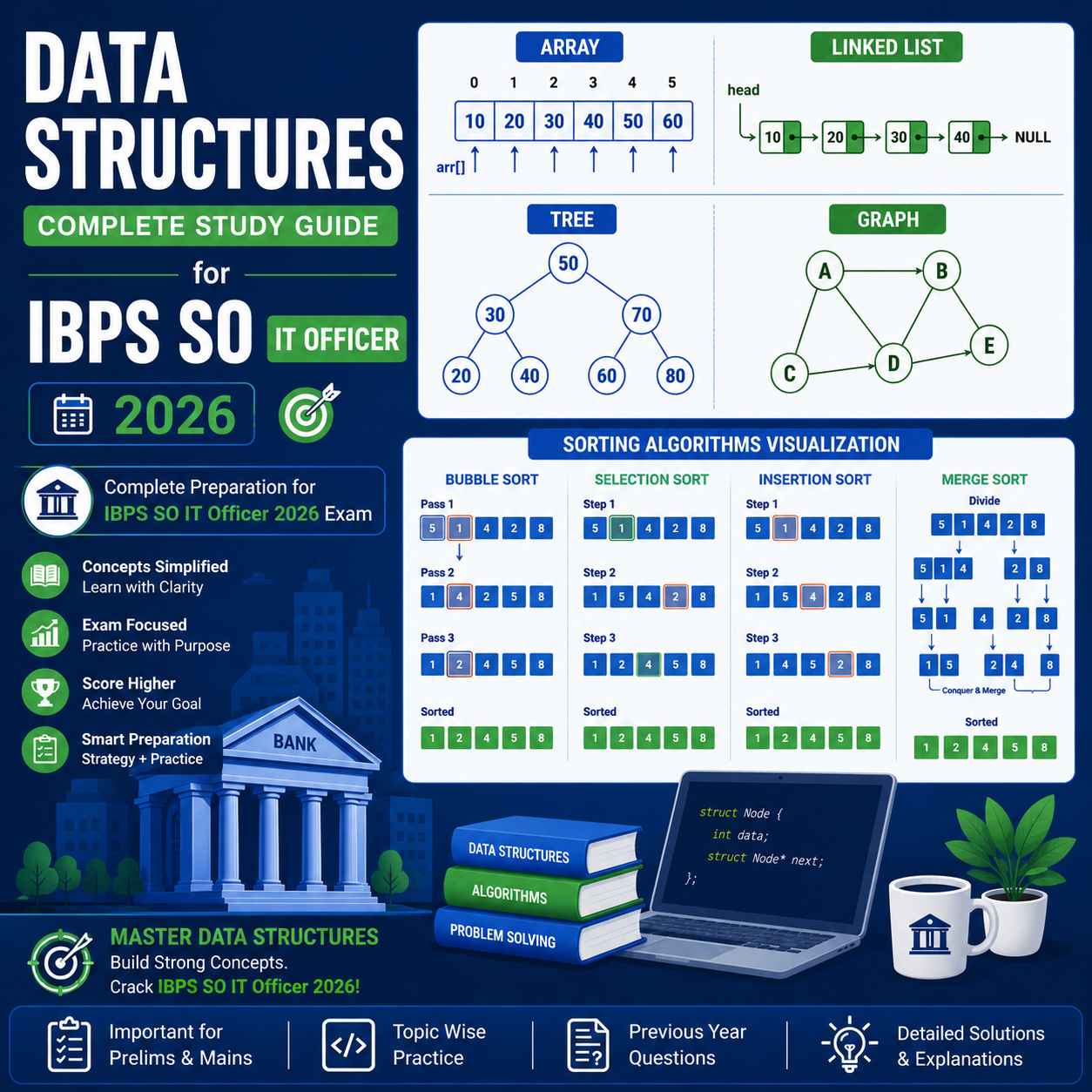
3. Data Structures & Algorithms — 6–8 Marks
- Arrays and Strings — operations, searching
- Linked Lists — Singly, Doubly, Circular
- Stacks and Queues — operations, applications (infix/postfix)
- Trees — Binary Tree, BST, AVL Tree, Heap, B-Tree
- Graphs — BFS, DFS, Dijkstra’s, Kruskal’s, Prim’s
- Sorting Algorithms — Bubble, Insertion, Selection, Merge, Quick, Heap Sort
- Searching — Linear, Binary
- Time and Space Complexity — Big-O notation
- Hashing — Hash functions, Collision resolution
Full topic guide: Data Structures for IBPS SO IT Officer 2026.
Not sure which language to use for DSA practice? Read: Which Language is Best for DSA.
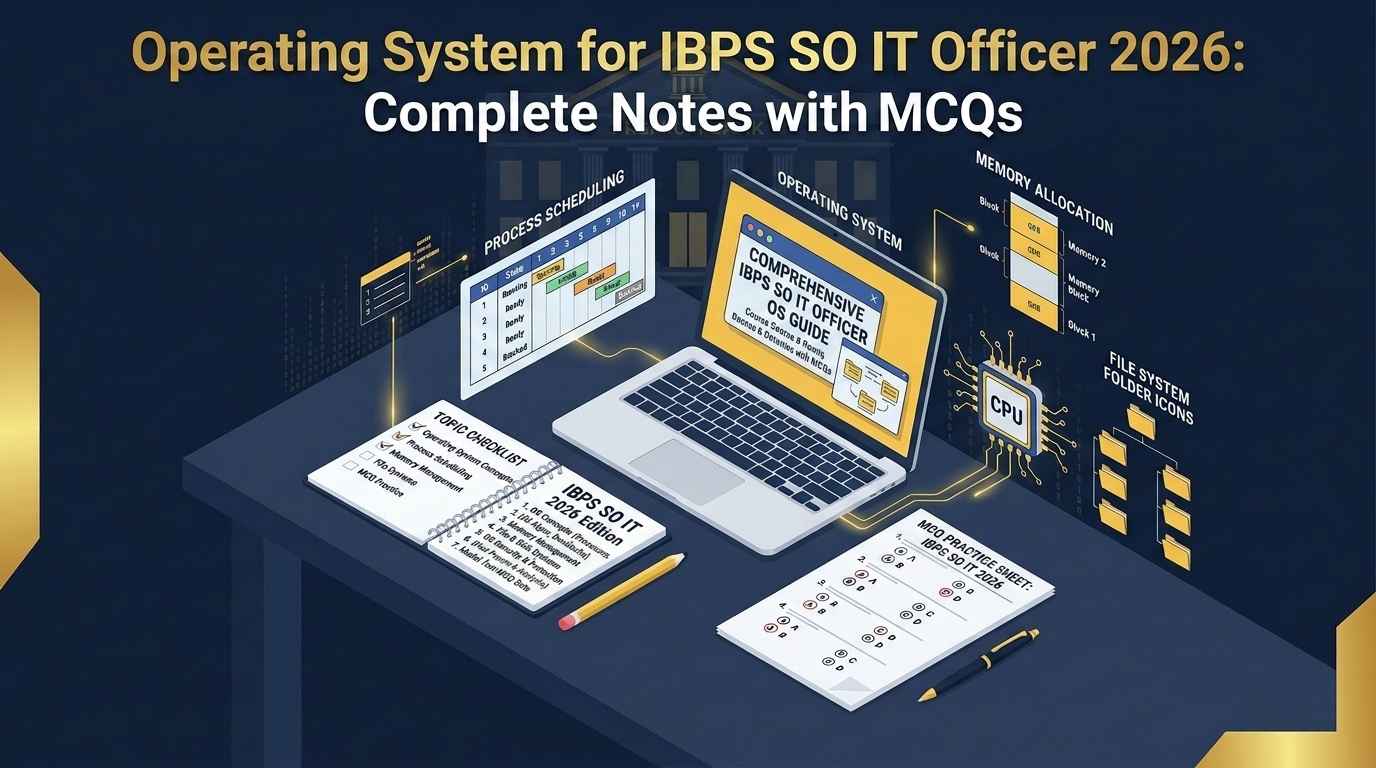
4. Operating System — 5–7 Marks
- Process Management — States, PCB, Context Switching
- CPU Scheduling — FCFS, SJF, Round Robin, Priority Scheduling
- Deadlock — Conditions (Mutual Exclusion, Hold & Wait, No Preemption, Circular Wait), Prevention, Detection, Recovery
- Memory Management — Paging, Segmentation, Virtual Memory, Page Replacement (FIFO, LRU, Optimal)
- File Systems — FAT, NTFS, Inodes
- Inter-Process Communication — Semaphores, Monitors, Mutex, Message Passing
- Linux/Unix basic commands
5. Programming Languages & OOP — 5–7 Marks
- C Language — Pointers, Arrays, Structures, Functions, File handling
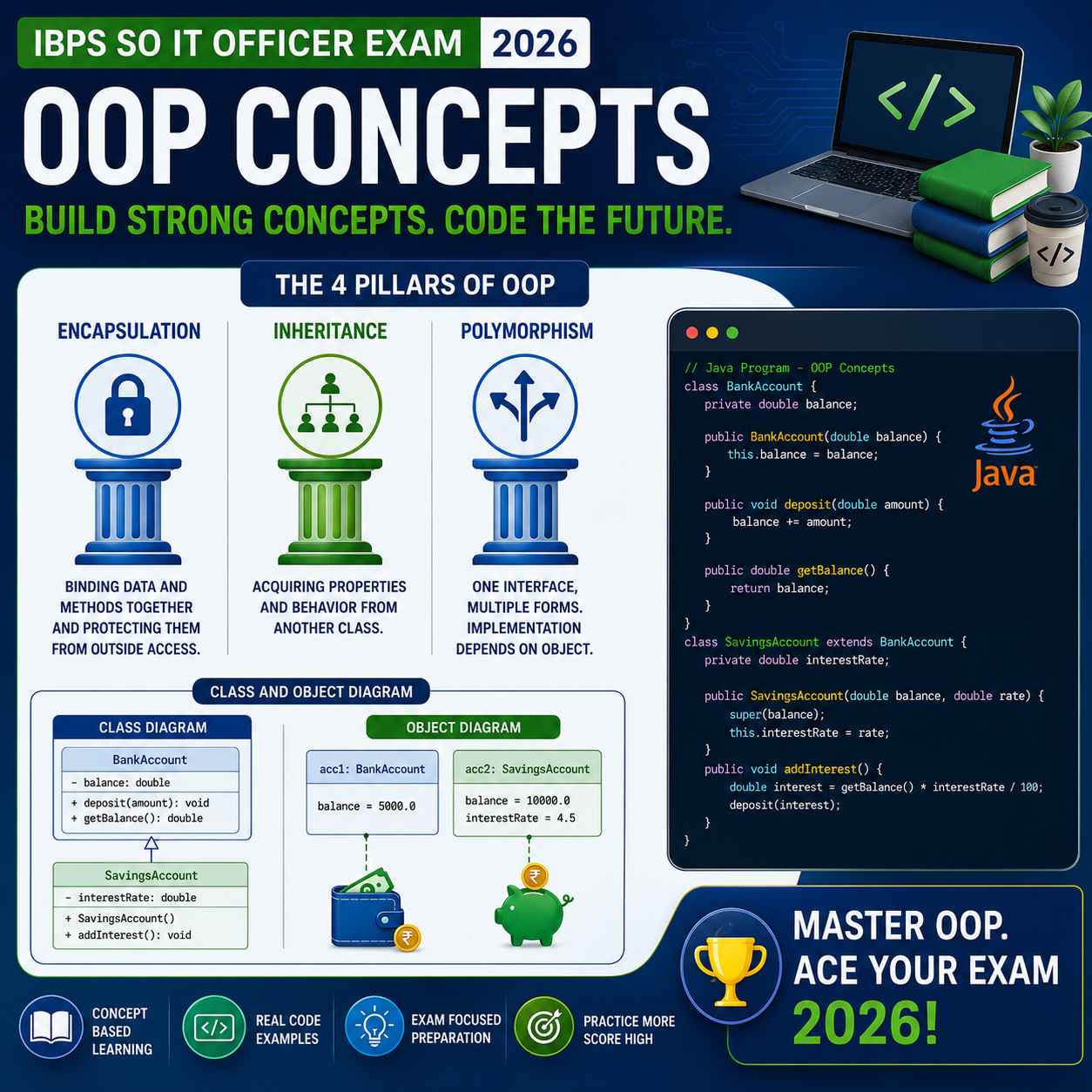
- Object-Oriented Programming — Classes, Objects, Inheritance, Polymorphism, Encapsulation, Abstraction
- Java Basics — JVM, OOP in Java, Exception Handling
- Python Basics — Data types, Built-in functions, List/Dict operations
- Compiler Design — Lexical Analysis, Parsing, Code Generation
OOP concepts are consistently tested. Master them in detail: OOP Concepts for IBPS SO IT Officer 2026.
6. Software Engineering — 4–6 Marks
- SDLC Models — Waterfall, Agile, Spiral, Prototype, V-Model
- Software Testing — Unit, Integration, System, Acceptance, Black-box, White-box, Regression
- Design Patterns — Creational (Singleton, Factory), Structural (Adapter), Behavioral (Observer)
- UML Diagrams — Use Case, Class, Sequence, Activity, State
- Software Project Management — COCOMO Model, Function Point Analysis
- Version Control — Git basics (commit, branch, merge)
7. Computer Organization & Architecture — 4–5 Marks
- Number Systems — Binary, Octal, Hexadecimal conversions and arithmetic
- Boolean Algebra and Logic Gates (AND, OR, NOT, NAND, NOR, XOR)
- Combinational Circuits — Half Adder, Full Adder, Multiplexer, Decoder, Encoder
- Sequential Circuits — Flip-flops (SR, JK, D, T), Registers, Counters
- Memory Hierarchy — Cache (L1/L2/L3), RAM, ROM, Secondary Storage
- Instruction Cycle — Fetch, Decode, Execute, Write-back
- RISC vs CISC Architecture
- Pipelining — Stages, Hazards (Structural, Data, Control)
8. Web Technologies — 3–5 Marks
- HTML, CSS, JavaScript fundamentals
- REST vs SOAP Web Services
- HTTP Methods — GET, POST, PUT, DELETE, PATCH
- Client-Server Architecture
- Session Management — Cookies, Sessions, JWT Tokens
- XML and JSON data formats
- Cloud Computing — IaaS, PaaS, SaaS (with examples)
- Virtualization concepts — Hypervisor, VM, Containers (Docker basics)
9. Cyber Security — 3–5 Marks
- Types of Attacks — Phishing, SQL Injection, XSS, CSRF, DDoS, Man-in-the-Middle, Ransomware
- Encryption — Symmetric (AES, DES, 3DES), Asymmetric (RSA, ECC), Hashing (MD5, SHA-1, SHA-256)
- Digital Signatures and Certificates
- PKI — Public Key Infrastructure
- Firewall types — Packet Filtering, Stateful, Application-level
- IDS vs IPS
- Cyber Laws — IT Act 2000 and its amendments
- RBI Cybersecurity Guidelines (important for banking context)
10. Emerging Technologies — 2–3 Marks
- Artificial Intelligence and Machine Learning basics
- Blockchain fundamentals — Distributed ledger, Smart contracts
- Internet of Things (IoT) — Architecture, Applications
- Big Data — Hadoop, MapReduce, HDFS basics
- Cloud Platforms — AWS, Azure, GCP overview
Topic-Wise Weightage at a Glance
| Topic | Expected Marks |
|---|---|
| DBMS | 15–20 |
| Computer Networks | 8–12 |
| Data Structures & Algorithms | 6–8 |
| Operating System | 5–7 |
| Programming Languages & OOP | 5–7 |
| Software Engineering | 4–6 |
| Computer Organization | 4–5 |
| Web Technologies | 3–5 |
| Cyber Security | 3–5 |
| Emerging Technologies | 2–3 |
| Total | ~50 Questions / 100 Marks |
Prelims Syllabus — English, Reasoning, Quantitative Aptitude
English Language (25 marks)
Reading Comprehension, Cloze Test, Para Jumbles, Fill in the Blanks, Error Spotting, Sentence Improvement, Vocabulary (Synonyms, Antonyms, Idioms)
Reasoning Ability (25 marks)
Puzzles and Seating Arrangements (High weightage), Syllogism, Blood Relations, Direction and Distance, Coding-Decoding, Inequalities, Input-Output, Data Sufficiency
Quantitative Aptitude (25 marks)
Number Series, Simplification, Data Interpretation (Tables, Bar graphs, Pie charts), Arithmetic (Percentage, Ratio, Profit/Loss, SI/CI, Time-Work, Speed-Distance), Quadratic Equations
30-Day Preparation Strategy for IBPS SO IT Officer Syllabus 2026
Week 1 — Foundation (Days 1–7)
- Day 1–2: DBMS — ER model, Relational model, all key types
- Day 3–4: DBMS — Normalization (1NF to BCNF) + SQL queries (write 20 queries daily)
- Day 5–6: Computer Networks — OSI, TCP/IP, IP Addressing
- Day 7: Revision + 20 MCQs on DBMS and Networks
Week 2 — Core Technical (Days 8–14)
- Day 8–9: Data Structures — Arrays, Linked Lists, Stacks, Queues
- Day 10–11: Algorithms — Trees, Graphs, Sorting, Searching + Time Complexity
- Day 12–13: Operating Systems — Scheduling, Deadlock, Memory Management
- Day 14: Full mock test — Weeks 1–2 topics only
Week 3 — Advanced Topics (Days 15–21)
- Day 15–16: OOP Concepts + Programming Languages
- Day 17: Software Engineering — SDLC, Testing types, UML
- Day 18: Computer Organization — Number systems, Logic gates, Pipelining
- Day 19: Web Technologies + Cyber Security
- Day 20: Emerging Technologies + Banking IT context
- Day 21: Full Professional Knowledge mock test (50 questions)
Week 4 — Final Sprint (Days 22–30)
- Days 22–24: Deep revision of DBMS — especially SQL joins and normalization
- Days 25–26: Rapid revision of Networks and DSA
- Days 27–28: 2 full mock tests + detailed error analysis
- Day 29: English + Reasoning + Quant Prelims practice sets
- Day 30: Light revision only — no new topics
Important Dates — CRP SPL-XVI 2026
| Activity | Date |
|---|---|
| Registration Opens | 01 July 2026 |
| Registration Closes | 21 July 2026 |
| Edit Window | 2 days after 21 July 2026 |
| Prelims Call Letter | August 2026 |
| Preliminary Exam | August 2026 |
| Prelims Result | September/October 2026 |
| Mains Call Letter | October 2026 |
| Main Exam | November 2026 |
| Mains Result | November 2026 |
| Interview | November/December 2026 |
| Provisional Allotment | January 2027 |
Participating Banks
Bank of Baroda, Bank of India, Bank of Maharashtra, Canara Bank, Central Bank of India, Indian Bank, Indian Overseas Bank, Punjab National Bank, Punjab & Sind Bank, UCO Bank, Union Bank of India.
Documents Required at the Time of Interview
- Interview Call Letter printout
- System-generated online application form printout
- Date of Birth proof (10th certificate/Birth Certificate)
- Valid photo ID — Aadhaar / PAN / Passport / Voter ID / Driving License
- Educational qualification mark sheets and certificates (result declared by 21.07.2026)
- Caste certificate — SC/ST/OBC (OBC cert issued on or after 01 April 2026)
- EWS certificate (valid for 2026-27, financial year 2025-26)
- Disability certificate (if applicable)
- NOC from employer (if currently in Govt/PSU job)
- 8 copies of the same photograph used in the application
Smart Preparation Tips
DBMS is your biggest opportunity. With 15–20 marks at stake, a candidate who masters DBMS completely has a massive edge. Practice SQL queries every single day — joins, subqueries, GROUP BY, HAVING are consistent exam patterns.
Networks is the second priority. OSI model layers, IP subnetting, and TCP vs UDP are almost always in the paper. Learn them once, thoroughly.
Do not ignore Prelims section-wise cutoffs. Many technical candidates fail Prelims not because of Professional Knowledge, but because they score below cutoff in English or Reasoning. These sections are qualifying — every mark counts.
Add banking IT context. As a bank IT officer, questions sometimes touch UPI architecture, core banking systems (CBS), RBI cybersecurity frameworks, and digital payment systems. Read these separately from a banking perspective.
For a broader career perspective after clearing IBPS SO, read: Software Engineer Salary in India 2026.
Common Mistakes to Avoid
Skipping Normalization. BCNF and 3NF appear every year. Candidates who skip them lose easy marks.
Memorizing theory without SQL practice. Application-based SQL questions are common — you need to actually write and run queries, not just know theory.
Treating all sections equally. Professional Knowledge deserves 70% of your time. English, Reasoning, and Quant need just enough to clear cutoffs.
Applying on the last day. Server load peaks near 21 July 2026. Apply early to avoid technical failures.
Free Resources for IBPS SO IT Officer 2026
- IBPS Official Website — Official notification, call letters, updates
- GeeksforGeeks — Best for DBMS, OS, Networks, and DSA theory + MCQs
- SQL for IBPS SO IT Officer 2026 — Practice-focused SQL guide
- Data Structures for IBPS SO IT Officer 2026 — Complete DSA topic guide
- Previous year papers — Available across exam preparation portals (2023–2025 papers are most relevant)
Frequently Asked Questions (FAQ)
Q1: What is the IBPS SO IT Officer Syllabus 2026 for Mains Professional Knowledge?
The Mains Professional Knowledge covers 10 areas: DBMS (15–20 marks), Computer Networks (8–12 marks), Data Structures & Algorithms (6–8 marks), Operating Systems (5–7 marks), Programming Languages & OOP (5–7 marks), Software Engineering (4–6 marks), Computer Organization (4–5 marks), Web Technologies (3–5 marks), Cyber Security (3–5 marks), and Emerging Technologies (2–3 marks). Total: 50 questions worth 100 marks.
Q2: How many vacancies are there for IBPS SO IT Officer 2026?
As per the official CRP SPL-XVI notification dated 01 July 2026, there are 301 total IT Officer Scale I vacancies. Bank of India has the most (110), followed by Punjab National Bank (100) and Central Bank of India (50). Indian Bank, UCO Bank, and Union Bank of India have not yet reported their vacancies.
Q3: What is the salary for IBPS SO IT Officer Scale I?
The basic pay scale is ₹48,480 – ₹85,920. Officers also receive allowances and perquisites as per the allotted participating bank’s rules.
Q4: Is DBMS enough to clear Professional Knowledge?
DBMS alone (15–20 marks) is not enough — you need to score across all 50 questions. However, mastering DBMS gives you the biggest single advantage. Combine it with Computer Networks (8–12 marks) and DSA (6–8 marks) to build a strong base.
Q5: What is the selection process for IBPS SO IT Officer 2026?
Three stages: Preliminary Exam (August 2026) → Main Exam (November 2026) → Interview (November/December 2026). Final merit = 80% Mains + 20% Interview. Only Professional Knowledge marks count in Mains for merit ranking.
Q6: Can final-year students apply for IBPS SO IT Officer CRP SPL-XVI?
No. Educational qualification results must be declared on or before 21 July 2026. Final-year students whose results are not out by that date are not eligible.
Q7: What is the last date to apply for IBPS SO IT Officer 2026?
The last date is 21 July 2026. Apply well before the deadline — server congestion on the final day is common.
Q8: Which topics appear most frequently in IBPS SO IT Officer Professional Knowledge?
Based on previous year papers, DBMS (especially SQL, Joins, and Normalization), OSI Model in Computer Networks, CPU Scheduling and Deadlock in Operating Systems, and OOP concepts in Programming Languages appear most consistently. These should be your highest priority topics.


4 comments on “IBPS SO IT Officer Syllabus 2026: 5 Proven Steps to Clear CRP SPL-XVI”