
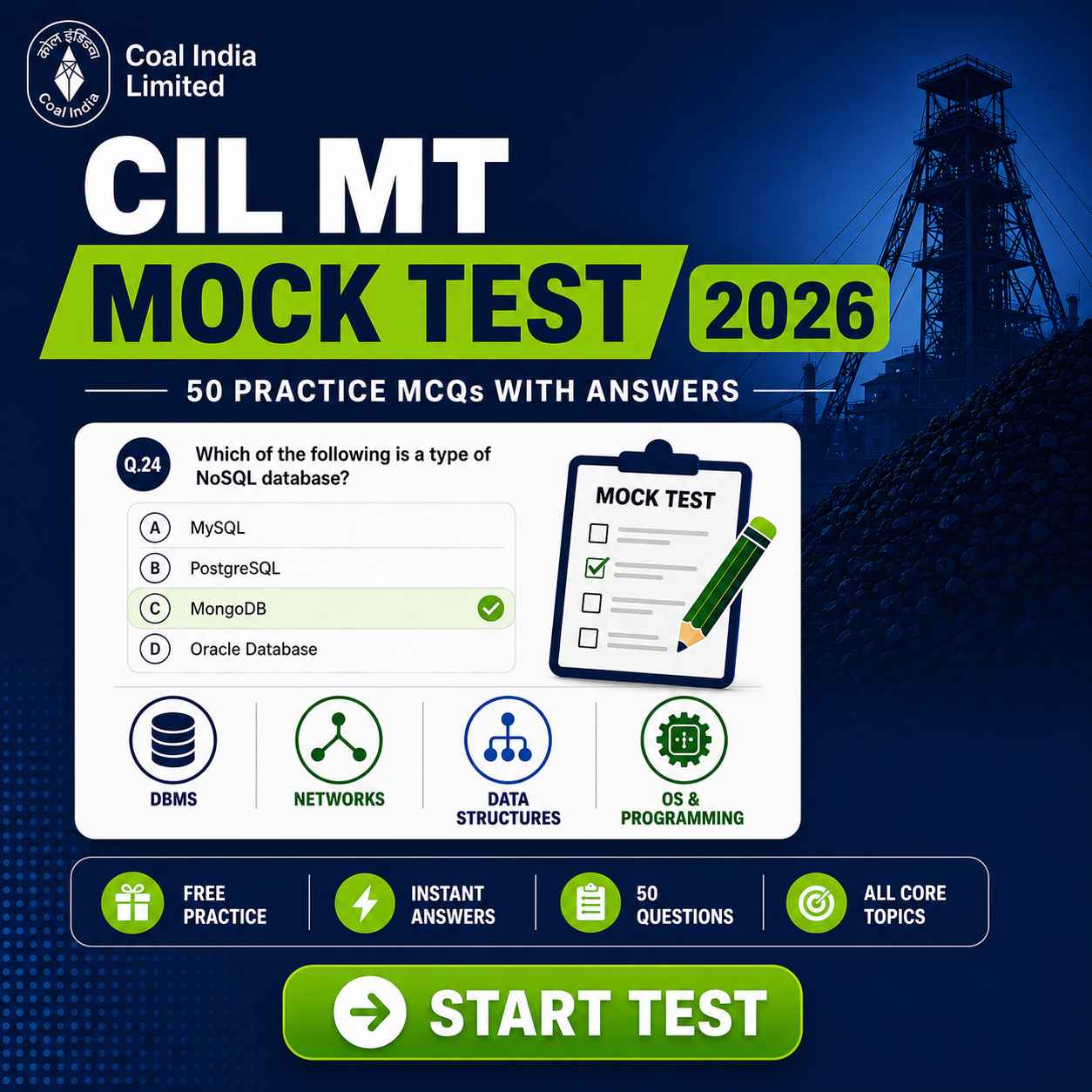
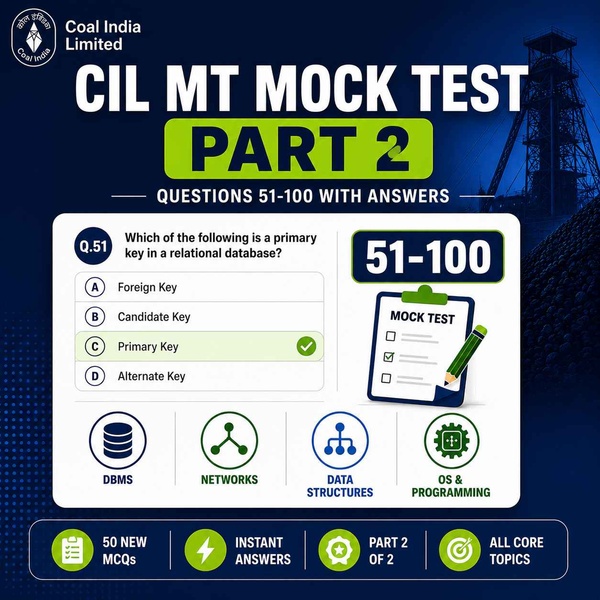
Practising with a CIL MT mock test is one of the most effective ways to prepare for the System discipline examination. Reading theory builds understanding, but solving questions under exam-like conditions builds the speed and accuracy you actually need on test day. This article gives you 50 practice MCQs for the CIL MT System discipline, covering the core computer-science subjects that carry the most weight — DBMS, Computer Networks, Data Structures, Operating Systems, and Programming.
Every question here is based on standard computer-science concepts and the topic pattern of the CIL MT System syllabus. Answers are provided at the end of each section so you can check yourself immediately. Treat this CIL MT mock test as a self-assessment: solve first, then verify, and note every topic where you slipped so you can revise it.
How to Use This CIL MT Mock Test Effectively
A mock test only helps if you use it correctly. Solve all questions in one sitting with a timer — aim for roughly one minute per question to simulate real exam pace. Since the CIL MT 2026 exam has no negative marking, attempt every question, even when unsure. After finishing, check your answers, and most importantly, revisit the concept behind every question you got wrong. The analysis matters more than the score.
CIL MT Mock Test — DBMS (Questions 1-12)
Database management carries the highest weight in the System paper, so start here.
1. Which normal form removes partial dependency?
(a) 1NF (b) 2NF (c) 3NF (d) BCNF
2. Which key uniquely identifies a row and cannot be NULL?
(a) Foreign Key (b) Candidate Key (c) Primary Key (d) Alternate Key
3. Which SQL command removes all rows but keeps the table structure?
(a) DELETE (b) DROP (c) TRUNCATE (d) ERASE
4. ACID property ensuring a transaction is all-or-nothing is?
(a) Consistency (b) Atomicity (c) Isolation (d) Durability
5. Which JOIN returns only matching rows from both tables?
(a) LEFT JOIN (b) RIGHT JOIN (c) INNER JOIN (d) FULL OUTER JOIN
6. A table can have how many primary keys?
(a) 1 (b) 2 (c) Unlimited (d) 0
7. Which clause filters groups after GROUP BY?
(a) WHERE (b) HAVING (c) ORDER BY (d) FILTER
8. A foreign key references which key of another table?
(a) Foreign Key (b) Primary Key (c) Composite Key (d) Unique Key
9. Which is NOT an ACID property?
(a) Atomicity (b) Availability (c) Isolation (d) Durability
10. A relation in BCNF is always in?
(a) 1NF only (b) 2NF only (c) 3NF (d) None
11. Which SQL function counts the number of rows?
(a) SUM() (b) COUNT() (c) TOTAL() (d) NUMBER()
12. A virtual table based on a query result is called?
(a) Index (b) View (c) Cursor (d) Trigger
Answers: 1-(b), 2-(c), 3-(c), 4-(b), 5-(c), 6-(a), 7-(b), 8-(b), 9-(b), 10-(c), 11-(b), 12-(b)
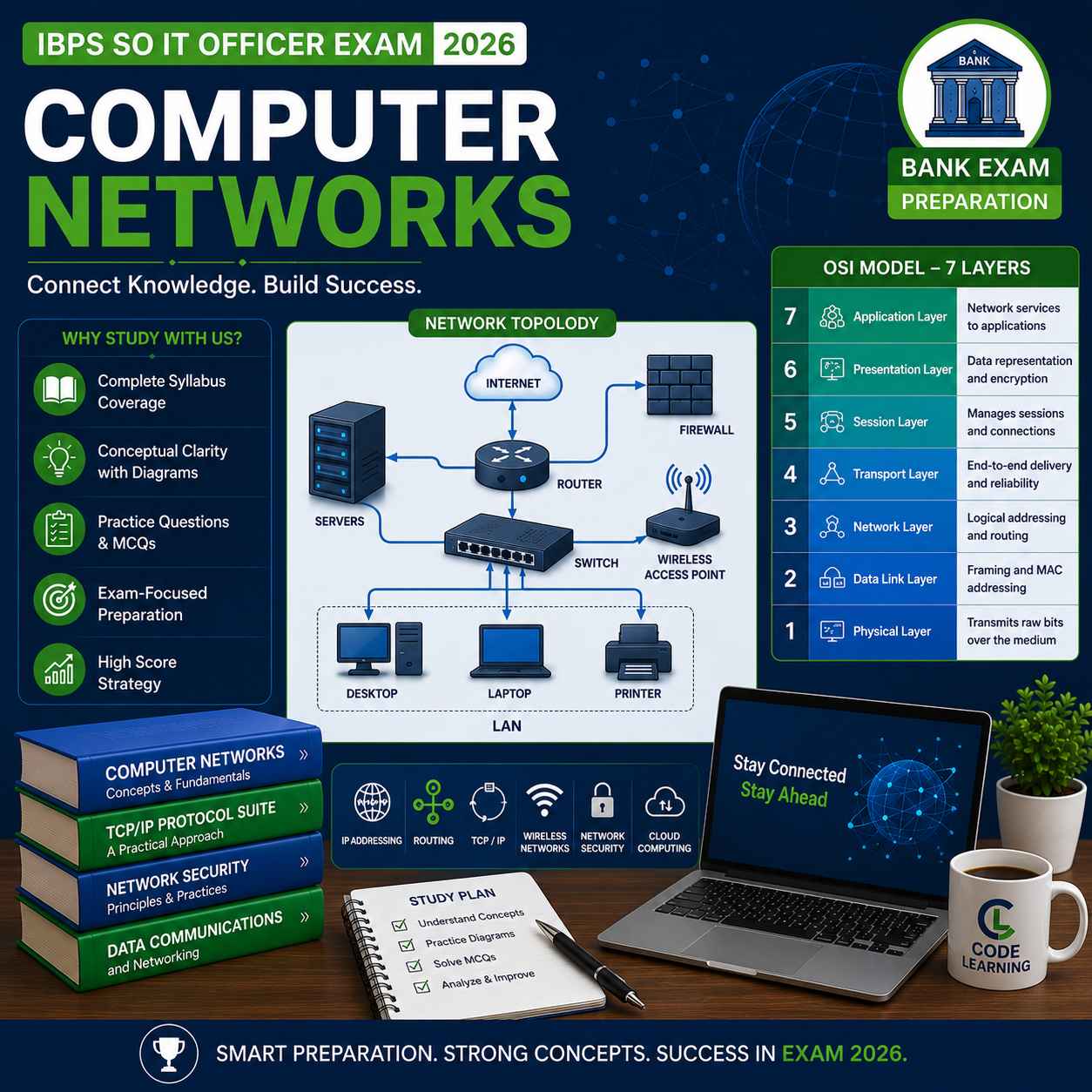
CIL MT Mock Test — Computer Networks (Questions 13-22)
13. How many layers are there in the OSI model?
(a) 5 (b) 6 (c) 7 (d) 4
14. Which protocol is connection-oriented?
(a) UDP (b) TCP (c) IP (d) ICMP
15. The default port number for HTTPS is?
(a) 80 (b) 21 (c) 443 (d) 25
16. A switch operates at which OSI layer?
(a) Physical (b) Data Link (c) Network (d) Transport
17. What is the length of an IPv6 address?
(a) 32 bits (b) 64 bits (c) 128 bits (d) 256 bits
18. Which device works at the Network layer?
(a) Hub (b) Switch (c) Router (d) Repeater
19. Which protocol translates domain names to IP addresses?
(a) DHCP (b) DNS (c) FTP (d) SMTP
20. The default port for HTTP is?
(a) 80 (b) 443 (c) 21 (d) 110
21. Which topology connects all devices to a central hub?
(a) Bus (b) Ring (c) Star (d) Mesh
22. Which protocol is used to send email?
(a) POP3 (b) IMAP (c) SMTP (d) HTTP
Answers: 13-(c), 14-(b), 15-(c), 16-(b), 17-(c), 18-(c), 19-(b), 20-(a), 21-(c), 22-(c)
CIL MT Mock Test — Data Structures (Questions 23-34)
23. Which data structure follows LIFO order?
(a) Queue (b) Stack (c) Linked List (d) Tree
24. The time complexity of binary search is?
(a) O(n) (b) O(n²) (c) O(log n) (d) O(1)
25. Which data structure follows FIFO order?
(a) Stack (b) Queue (c) Tree (d) Graph
26. Worst-case time complexity of Quick Sort is?
(a) O(n log n) (b) O(n) (c) O(n²) (d) O(log n)
27. Inorder traversal of a Binary Search Tree gives?
(a) Random order (b) Sorted order (c) Reverse order (d) Level order
28. Which traversal uses a Queue?
(a) DFS (b) BFS (c) Inorder (d) Preorder
29. The best-case time complexity of Bubble Sort is?
(a) O(n²) (b) O(n) (c) O(log n) (d) O(1)
30. A complete binary tree with n nodes has a height of approximately?
(a) n (b) n/2 (c) log n (d) n²
31. Which sorting algorithm is the fastest on average?
(a) Bubble Sort (b) Selection Sort (c) Quick Sort (d) Insertion Sort
32. A stack is used in which traversal?
(a) BFS (b) DFS (c) Level order (d) None
33. Which data structure is used to implement recursion?
(a) Queue (b) Stack (c) Array (d) Graph
34. The time complexity to access an element in an array by index is?
(a) O(n) (b) O(log n) (c) O(1) (d) O(n²)
Answers: 23-(b), 24-(c), 25-(b), 26-(c), 27-(b), 28-(b), 29-(b), 30-(c), 31-(c), 32-(b), 33-(b), 34-(c)
CIL MT Mock Test — Operating Systems (Questions 35-43)
35. Which scheduling algorithm gives minimum average waiting time?
(a) FCFS (b) SJF (c) Round Robin (d) Priority
36. How many conditions are necessary for a deadlock?
(a) 2 (b) 3 (c) 4 (d) 5
37. Internal fragmentation occurs in?
(a) Segmentation (b) Paging (c) Swapping (d) Compaction
38. Which is NOT a deadlock condition?
(a) Mutual Exclusion (b) Hold and Wait (c) Preemption (d) Circular Wait
39. The Linux command to list files is?
(a) dir (b) ls (c) list (d) show
40. Which memory management technique suffers from external fragmentation?
(a) Paging (b) Segmentation (c) Both (d) None
41. A program in execution is called a?
(a) Thread (b) Process (c) Function (d) Module
42. Which scheduling algorithm uses time quantum?
(a) FCFS (b) SJF (c) Round Robin (d) Priority
43. Virtual memory is implemented using?
(a) Paging (b) Segmentation (c) Both (d) Caching
Answers: 35-(b), 36-(c), 37-(b), 38-(c), 39-(b), 40-(b), 41-(b), 42-(c), 43-(c)
CIL MT Mock Test — Programming & General IT (Questions 44-50)
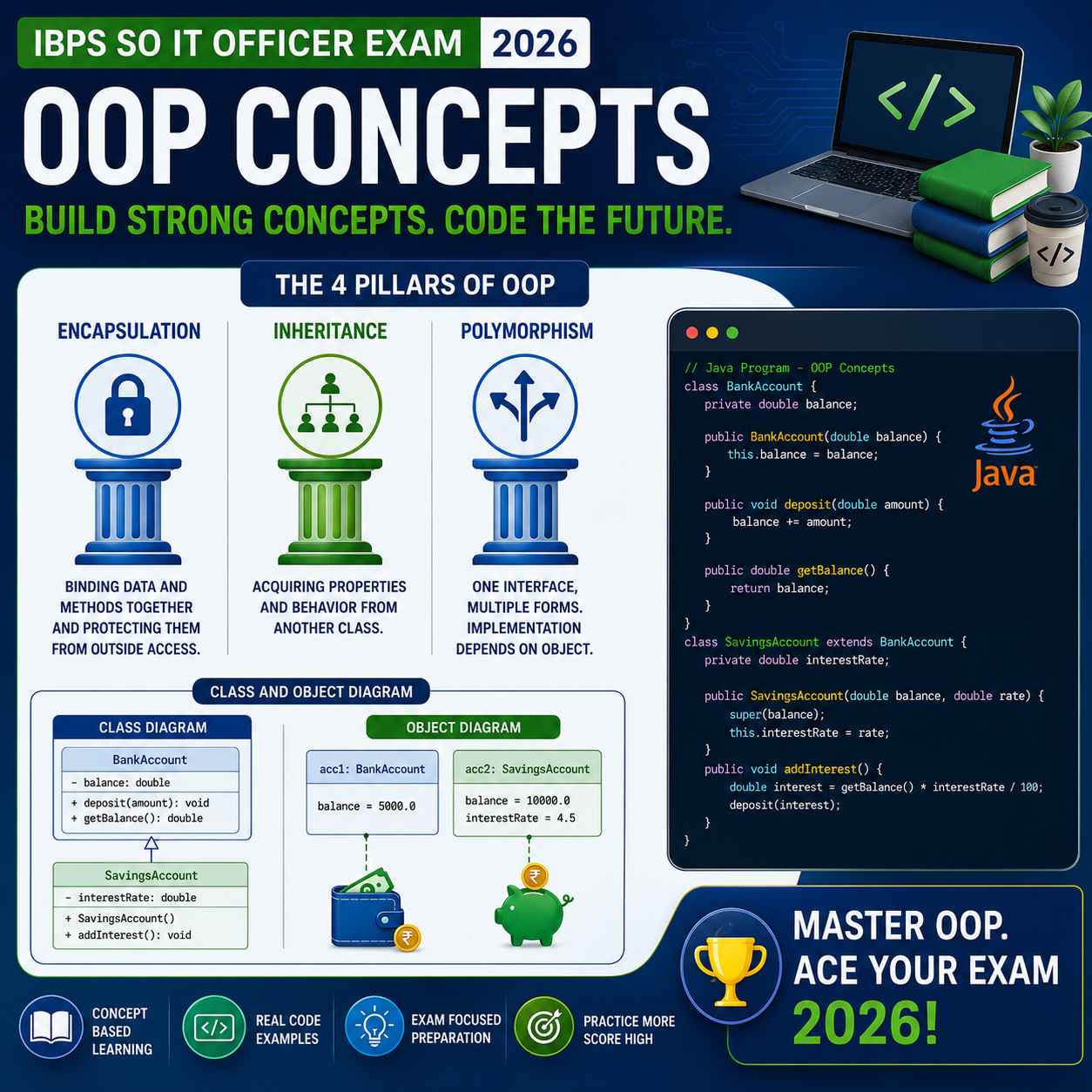
44. Which is NOT an Object-Oriented Programming concept?
(a) Inheritance (b) Encapsulation (c) Compilation (d) Polymorphism
45. Which language is platform-independent due to bytecode?
(a) C (b) C++ (c) Java (d) Assembly
46. What does OOP concept “Encapsulation” mean?
(a) Hiding data (b) Reusing code (c) Multiple forms (d) Overriding
47. Which is a primitive data type in Java?
(a) String (b) Array (c) int (d) Class
48. The process of hiding implementation details is?
(a) Inheritance (b) Abstraction (c) Polymorphism (d) Overloading
49. Which operator is used for inheritance in C++?
(a) :: (b) : (c) -> (d) .
50. Which protocol secures data using encryption on the web?
(a) HTTP (b) FTP (c) SSL/TLS (d) SMTP
Answers: 44-(c), 45-(c), 46-(a), 47-(c), 48-(b), 49-(b), 50-(c)
How to Score Yourself on This CIL MT Mock Test
Count one mark for each correct answer out of 50. Use this rough self-assessment:
| Score | What It Means |
|---|---|
| 40-50 | Excellent — strong command of core subjects |
| 30-39 | Good — revise weak topics and practise more |
| 20-29 | Average — focus seriously on high-weightage areas |
| Below 20 | Needs work — strengthen fundamentals first |
Whatever your score, the topics you missed are your roadmap. Note them down and revise those concepts before attempting your next mock.
Strengthen Weak Topics With These Guides
If this CIL MT mock test exposed weak areas, study the relevant subject in depth using these complete guides:
- DBMS Complete Study Guide
- Computer Networks Study Guide
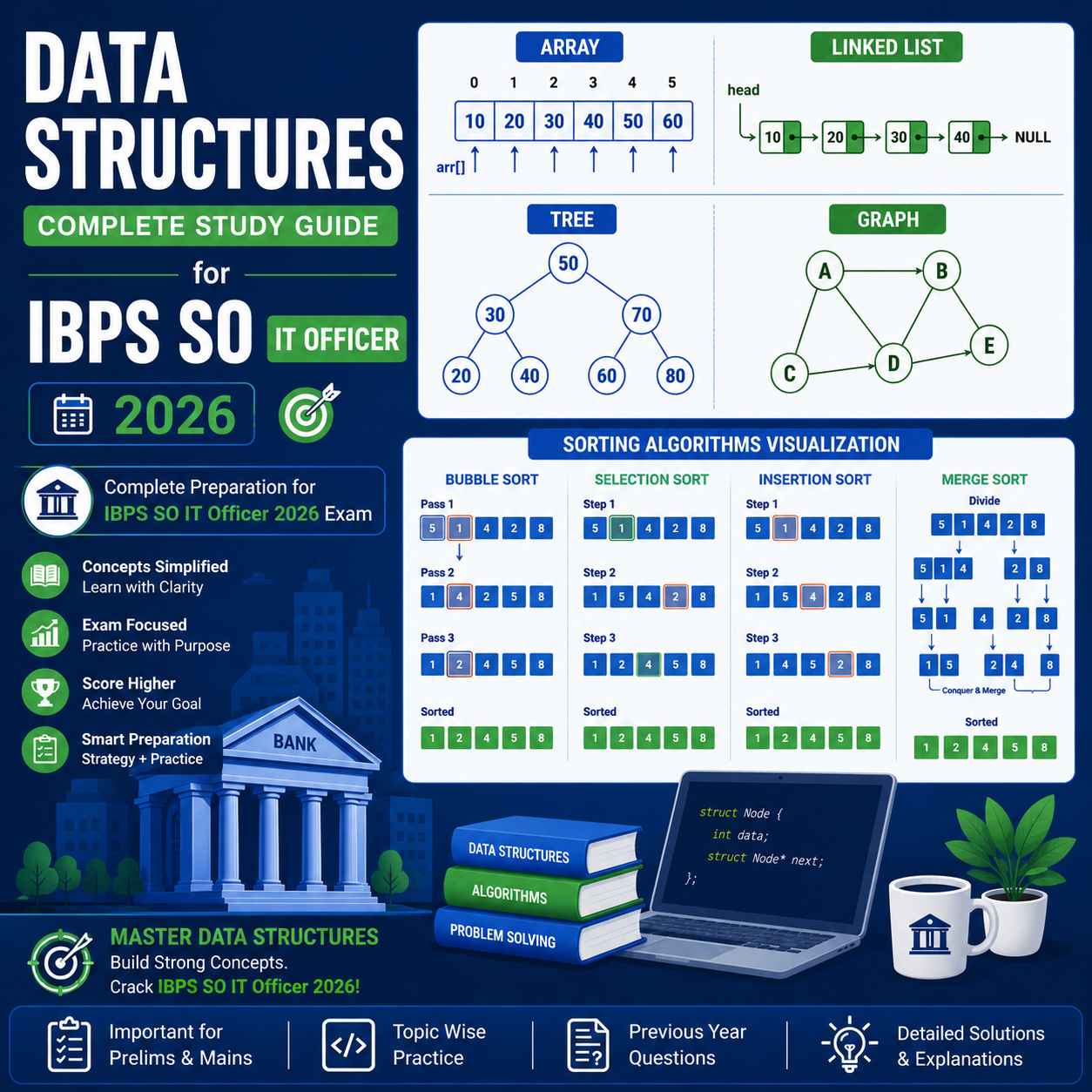
- Data Structures Study Guide
- Operating Systems Study Guide
Frequently Asked Questions
How many questions are in the CIL MT System exam?
The CIL MT examination has 200 questions total across two papers — Paper I (general aptitude) and Paper II (professional knowledge for your discipline), each carrying 100 marks.
Is there negative marking in the CIL MT 2026 mock test pattern?
The official CIL MT 2026 exam has no negative marking, so you should attempt every question. Practise your mocks the same way — leave nothing blank.
Which subjects are most important for the CIL MT System paper?
DBMS and Computer Networks carry the highest weight, followed by Data Structures and Operating Systems. Prioritise these in your preparation.
How many mock tests should I solve before the exam?
Aim for at least 10 to 15 full-length mock tests, analysing your mistakes after each one. Consistent mock practice builds both speed and accuracy.
Are these MCQs based on the actual CIL MT exam?
These questions are based on standard computer-science concepts aligned with the CIL MT System syllabus pattern. They are for practice and concept-testing, not reproductions of actual exam questions.
Final Word on This CIL MT Mock Test
Regular practice with a CIL MT mock test is what separates well-prepared candidates from the rest. These 50 questions cover the core System-discipline subjects, but one mock is just the beginning — solve more, analyse every mistake, and steadily strengthen your weak areas. Combined with thorough subject study and good time management, consistent mock practice gives you the confidence to walk into the exam hall ready.
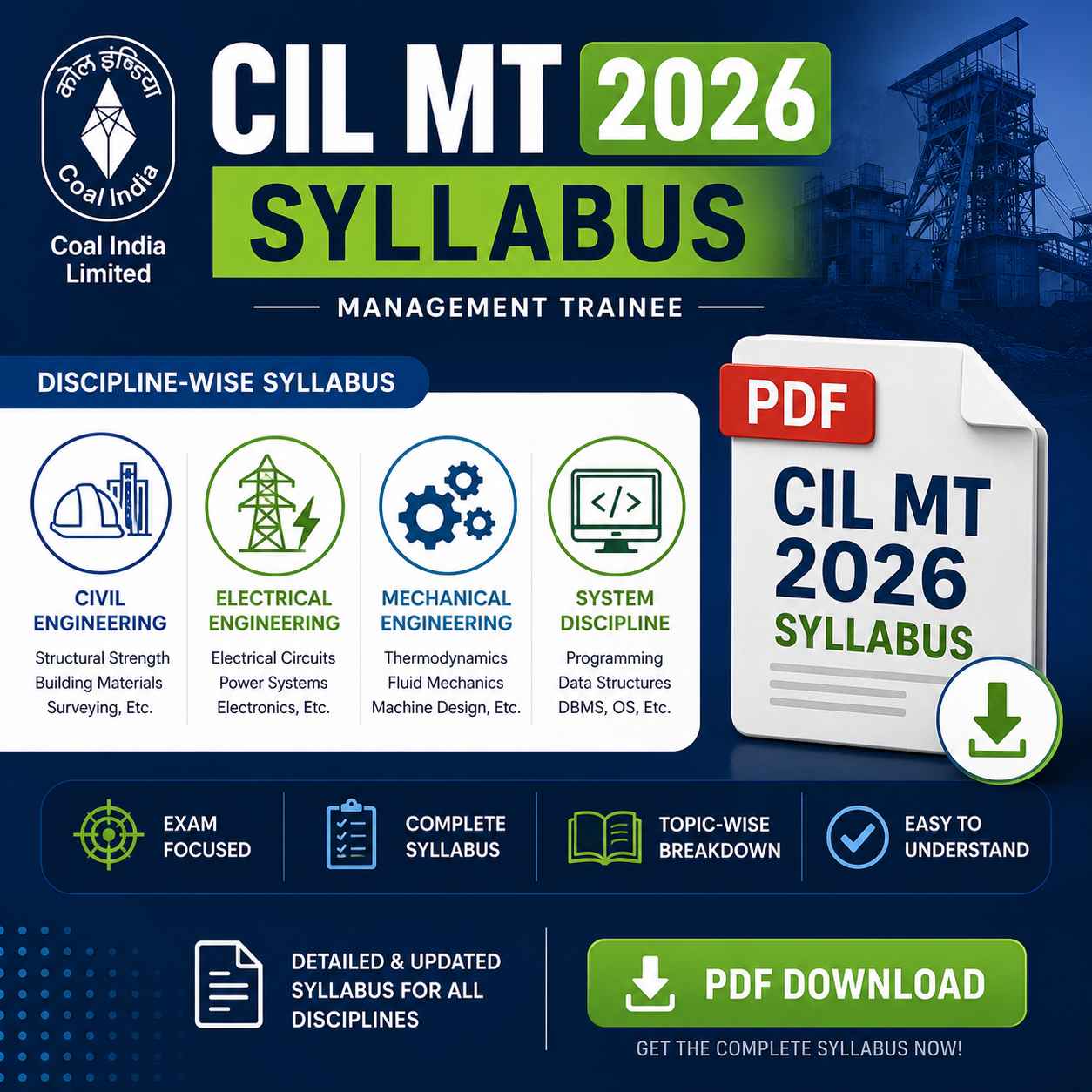
For the complete syllabus and exam strategy, see our CIL MT Syllabus 2026 guide and How to Crack CIL MT 2026 strategy guide. Bookmark this page and return to re-test yourself as your preparation progresses. For official exam details, always refer to www.coalindia.in.
Disclaimer: These practice questions are based on standard computer-science concepts aligned with the CIL MT System syllabus and are intended for self-assessment and concept revision. They are not actual or predicted exam questions. The exam pattern (no negative marking, 200 marks) is based on Coal India’s official notification, Advertisement 03/2026. Always verify current exam details on the official Coal India website.






Very helpful Mcq with effective guidance