
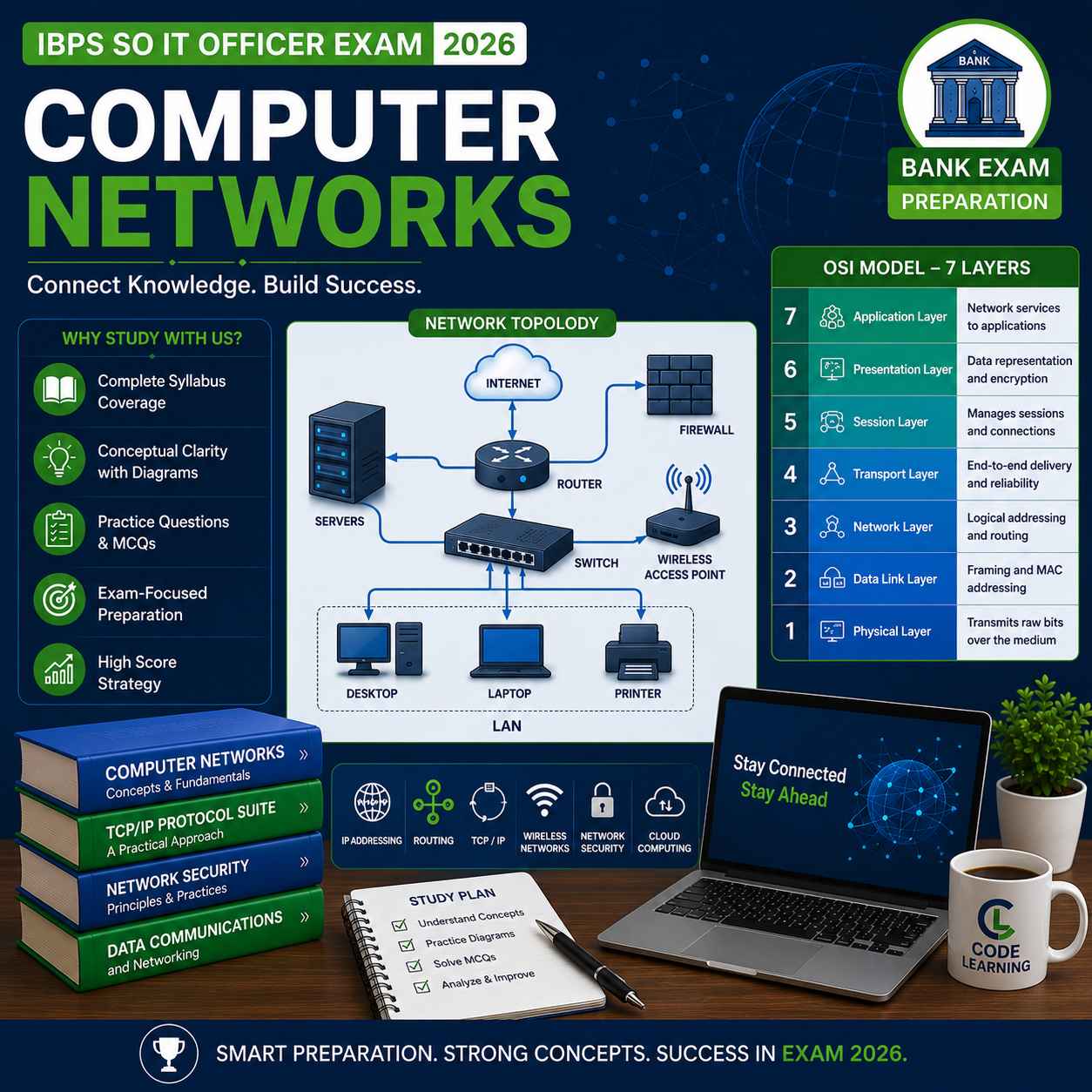
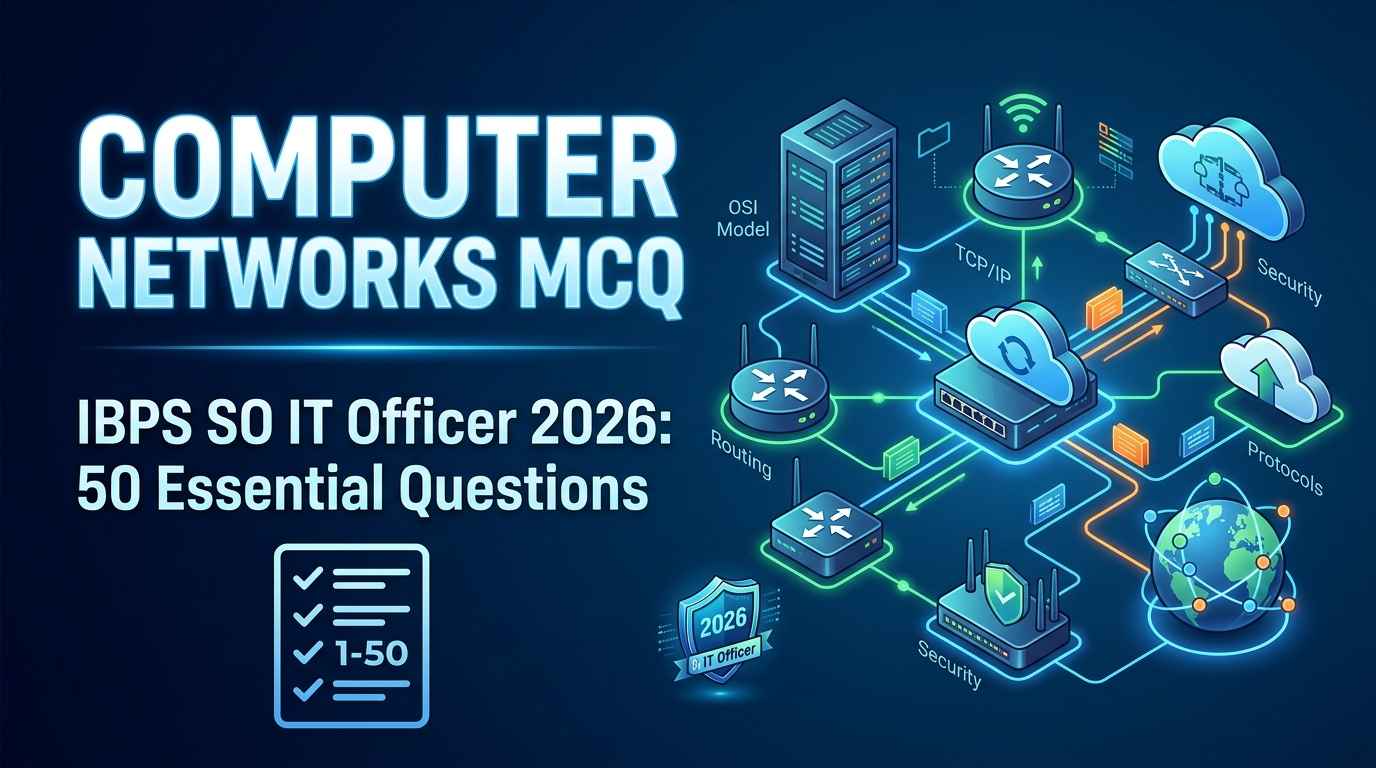
Master Computer Networks for IBPS SO IT Officer 2026 with our complete study guide covering OSI Model, TCP/IP, protocols, network topologies, IP addressing, and top MCQs. Computer Networks is one of the most scoring topics in the IBPS SO IT Officer Professional Knowledge section, contributing 8-12 marks every year. With smart preparation using this guide, you can confidently solve all networking questions and significantly boost your overall rank.
In this comprehensive guide on Computer Networks for IBPS SO IT Officer 2026, we’ll cover the complete syllabus, important concepts, previous year questions, memory tricks, and proven strategies that toppers use. Whether you’re starting fresh or doing final revision, this article gives you everything needed to crack the networking section of bank IT officer exam.
Why Computer Networks is Important for IBPS SO IT Officer 2026
Computer Networks holds significant weightage in the Computer Networks for IBPS SO IT Officer 2026 exam. Here’s why mastering this section is crucial:
- High Weightage: 8-12 questions appear from Computer Networks in Professional Knowledge section.
- Conceptual Questions: Most questions are based on understanding, easier than memorization-heavy topics.
- Job Relevance: As a bank IT officer, you’ll handle network infrastructure daily.
- Common Topic: Same syllabus appears in CIL MT, SBI SO, RBI Grade B exams.
- Banking Critical: Banks rely heavily on network security, ATM networks, and online banking.
- Interview Topic: Networking concepts are frequently asked in interview rounds.
Complete Syllabus – Computer Networks for IBPS SO IT Officer 2026
Understanding the syllabus helps focus on high-yield topics. Here’s the detailed Computer Networks for IBPS SO IT Officer 2026 breakdown:
| Topic | Sub-Topics | Expected Questions | Difficulty |
|---|---|---|---|
| OSI Model | 7 Layers, Functions, Examples | 2-3 | Medium |
| TCP/IP Model | 4 Layers, Protocols, Comparison | 1-2 | Medium |
| Network Topologies | Bus, Star, Ring, Mesh, Hybrid | 1-2 | Easy |
| Network Devices | Router, Switch, Hub, Bridge, Gateway | 1-2 | Easy-Medium |
| IP Addressing | IPv4, IPv6, Classes, Subnetting | 2-3 | Medium-Hard |
| Protocols | HTTP, HTTPS, FTP, SMTP, DNS, TCP, UDP | 2-3 | Easy-Medium |
| Network Security | Firewall, SSL, Encryption | 1-2 | Medium |
| Wireless Networks | WiFi, Bluetooth, Cellular | 1 | Easy |
OSI Model – 7 Layers for Computer Networks IBPS SO 2026
The OSI (Open Systems Interconnection) Model is the most asked topic in Computer Networks for IBPS SO IT Officer 2026. Master all 7 layers with their functions:
| Layer | Name | Function | Protocols/Devices |
|---|---|---|---|
| 7 | Application Layer | User interface and network services | HTTP, FTP, SMTP, DNS |
| 6 | Presentation Layer | Data encryption, compression, translation | SSL, JPEG, MPEG |
| 5 | Session Layer | Session establishment and termination | NetBIOS, RPC |
| 4 | Transport Layer | End-to-end delivery, reliability | TCP, UDP |
| 3 | Network Layer | Routing and IP addressing | IP, ICMP, Router |
| 2 | Data Link Layer | Frame creation, MAC addressing | Ethernet, Switch, Bridge |
| 1 | Physical Layer | Bit transmission over medium | Cables, Hub, Repeater |
Memory Trick for OSI Layers:
“All People Seem To Need Data Processing” (Top to Bottom)
- Application
- Presentation
- Session
- Transport
- Network
- Data Link
- Physical
Or use: “Please Do Not Throw Sausage Pizza Away” (Bottom to Top)
TCP/IP Model – Computer Networks for IBPS SO IT Officer 2026
The TCP/IP Model is widely used in modern networks. It has 4 layers compared to OSI’s 7 layers. Understanding both models is essential for Computer Networks for IBPS SO IT Officer 2026:
| TCP/IP Layer | OSI Equivalent | Protocols |
|---|---|---|
| Application | Application + Presentation + Session | HTTP, FTP, SMTP, DNS, Telnet |
| Transport | Transport | TCP, UDP |
| Internet | Network | IP, ICMP, ARP |
| Network Access | Data Link + Physical | Ethernet, WiFi |
OSI vs TCP/IP Comparison (Important for Exam):
| Feature | OSI Model | TCP/IP Model |
|---|---|---|
| Layers | 7 layers | 4 layers |
| Developed By | ISO | DoD (US Department of Defense) |
| Approach | Theoretical | Practical |
| Reliability | More reliable theory | Less reliable |
| Usage | Reference model | Implemented in Internet |
Network Topologies – Computer Networks for IBPS SO IT Officer 2026
Network topology defines how devices are connected. This topic appears in every Computer Networks for IBPS SO IT Officer 2026 exam:
1. Bus Topology
- All devices connected to single cable (backbone)
- Advantages: Cheap, easy to install
- Disadvantages: Single point of failure, slow with many devices
2. Star Topology
- All devices connected to central hub/switch
- Advantages: Easy to manage, fault isolation
- Disadvantages: Hub failure brings down network
3. Ring Topology
- Devices connected in circular loop
- Advantages: Equal access, no collisions
- Disadvantages: One break disrupts entire network
4. Mesh Topology
- Every device connected to every other device
- Advantages: High reliability, multiple paths
- Disadvantages: Expensive, complex
5. Hybrid Topology
- Combination of two or more topologies
- Advantages: Flexible, scalable
- Disadvantages: Complex design and maintenance
Network Devices for Computer Networks IBPS SO 2026
Understanding network devices is critical for Computer Networks for IBPS SO IT Officer 2026. Each device operates at specific OSI layer:
| Device | OSI Layer | Function |
|---|---|---|
| Hub | Layer 1 (Physical) | Broadcasts data to all ports (outdated) |
| Switch | Layer 2 (Data Link) | Forwards data based on MAC address |
| Bridge | Layer 2 (Data Link) | Connects two network segments |
| Router | Layer 3 (Network) | Routes data between different networks |
| Gateway | All Layers | Connects networks with different protocols |
| Repeater | Layer 1 (Physical) | Amplifies signal for longer distance |
| Modem | Layer 1 (Physical) | Modulates/demodulates signals |
| Access Point | Layer 2 (Data Link) | Wireless connection device |
| Firewall | Layer 3+ (Network) | Security filter for traffic |
IP Addressing – Computer Networks for IBPS SO IT Officer 2026
IP Addressing is a complex but high-scoring topic. Master IPv4 and IPv6 for Computer Networks for IBPS SO IT Officer 2026:
IPv4 Address Classes:
| Class | Range | Default Subnet Mask | Usage |
|---|---|---|---|
| Class A | 1.0.0.0 to 126.255.255.255 | 255.0.0.0 (/8) | Large networks |
| Class B | 128.0.0.0 to 191.255.255.255 | 255.255.0.0 (/16) | Medium networks |
| Class C | 192.0.0.0 to 223.255.255.255 | 255.255.255.0 (/24) | Small networks |
| Class D | 224.0.0.0 to 239.255.255.255 | N/A | Multicasting |
| Class E | 240.0.0.0 to 255.255.255.255 | N/A | Research/Reserved |
IPv4 vs IPv6 Comparison:
| Feature | IPv4 | IPv6 |
|---|---|---|
| Length | 32 bits | 128 bits |
| Format | Decimal (e.g., 192.168.1.1) | Hexadecimal (e.g., 2001:db8::1) |
| Total Addresses | 4.3 billion | 340 undecillion |
| Header Size | 20 bytes | 40 bytes |
| Security | Optional (IPsec) | Built-in (IPsec) |
| Configuration | Manual or DHCP | Auto-configuration |
Special IP Addresses (Frequently Asked):
- 127.0.0.1: Loopback address (localhost)
- 0.0.0.0: Default route or unspecified address
- 192.168.x.x: Private network (Class C)
- 10.0.0.0/8: Private network (Class A)
- 172.16.0.0/12: Private network (Class B)
- 255.255.255.255: Broadcast address
Common Network Protocols – Computer Networks for IBPS SO IT Officer 2026
Memorize these protocols with their port numbers — frequently asked in Computer Networks for IBPS SO IT Officer 2026:
| Protocol | Full Form | Port | Purpose |
|---|---|---|---|
| HTTP | HyperText Transfer Protocol | 80 | Web browsing |
| HTTPS | HTTP Secure | 443 | Secure web browsing |
| FTP | File Transfer Protocol | 21 | File transfer |
| SFTP | Secure FTP | 22 | Secure file transfer |
| SSH | Secure Shell | 22 | Remote secure login |
| Telnet | Telecommunication Network | 23 | Remote login (insecure) |
| SMTP | Simple Mail Transfer Protocol | 25 | Email sending |
| POP3 | Post Office Protocol v3 | 110 | Email receiving |
| IMAP | Internet Message Access Protocol | 143 | Email access |
| DNS | Domain Name System | 53 | Name resolution |
| DHCP | Dynamic Host Configuration Protocol | 67/68 | IP assignment |
| TCP | Transmission Control Protocol | – | Reliable connection |
| UDP | User Datagram Protocol | – | Fast connectionless |
TCP vs UDP – Important for Computer Networks IBPS SO
TCP vs UDP is a guaranteed question in Computer Networks for IBPS SO IT Officer 2026. Master these differences:
| Feature | TCP | UDP |
|---|---|---|
| Connection | Connection-oriented | Connectionless |
| Reliability | Reliable (acknowledgment) | Unreliable (no ack) |
| Speed | Slower | Faster |
| Header Size | 20 bytes | 8 bytes |
| Flow Control | Yes | No |
| Examples | HTTP, HTTPS, FTP, Email | DNS, Video streaming, VoIP |
| Use Case | When reliability matters | When speed matters |
Top 20 Computer Networks Questions for IBPS SO IT Officer 2026
Practice these Computer Networks for IBPS SO IT Officer 2026 previous year questions:
- Q. How many layers in OSI model?
Answer: 7 layers - Q. Which OSI layer handles routing?
Answer: Network Layer (Layer 3) - Q. Which protocol is connection-oriented?
Answer: TCP - Q. Default port for HTTPS?
Answer: 443 - Q. Which device works at Network Layer?
Answer: Router - Q. IPv4 address length?
Answer: 32 bits - Q. IPv6 address length?
Answer: 128 bits - Q. Loopback IP address?
Answer: 127.0.0.1 - Q. Which topology has central node?
Answer: Star Topology - Q. Protocol used for email sending?
Answer: SMTP - Q. Full form of DNS?
Answer: Domain Name System - Q. Port number for SSH?
Answer: 22 - Q. Which is faster – TCP or UDP?
Answer: UDP - Q. Switch operates at which layer?
Answer: Layer 2 (Data Link) - Q. Total classes in IPv4 addressing?
Answer: 5 (A, B, C, D, E) - Q. Which device broadcasts to all ports?
Answer: Hub - Q. Encryption happens at which OSI layer?
Answer: Presentation Layer (Layer 6) - Q. MAC address length?
Answer: 48 bits (6 bytes) - Q. Maximum IP addresses in IPv4?
Answer: 4.3 billion (2^32) - Q. Which protocol assigns IP automatically?
Answer: DHCP
Network Security Basics for IBPS SO IT Officer 2026
Network security is critical for banking — frequently asked in Computer Networks for IBPS SO IT Officer 2026:
Common Network Security Concepts:
- Firewall: Hardware/software filter for incoming/outgoing traffic
- SSL/TLS: Secure Sockets Layer for encrypted communication
- VPN: Virtual Private Network for secure remote access
- Encryption: Converting data to unreadable format (Symmetric & Asymmetric)
- Authentication: Verifying user identity
- DDoS: Distributed Denial of Service attack
- MITM: Man-in-the-Middle attack
- IDS/IPS: Intrusion Detection/Prevention System
Symmetric vs Asymmetric Encryption:
| Feature | Symmetric | Asymmetric |
|---|---|---|
| Keys | Single shared key | Public + Private key pair |
| Speed | Fast | Slow |
| Security | Less secure | More secure |
| Examples | AES, DES, 3DES | RSA, ECC, Diffie-Hellman |
Wireless Networks – Computer Networks for IBPS SO 2026
Wireless networking concepts are increasingly important in Computer Networks for IBPS SO IT Officer 2026:
WiFi Standards:
| Standard | Speed | Frequency | Year |
|---|---|---|---|
| 802.11a | 54 Mbps | 5 GHz | 1999 |
| 802.11b | 11 Mbps | 2.4 GHz | 1999 |
| 802.11g | 54 Mbps | 2.4 GHz | 2003 |
| 802.11n (WiFi 4) | 600 Mbps | 2.4/5 GHz | 2009 |
| 802.11ac (WiFi 5) | 3.5 Gbps | 5 GHz | 2013 |
| 802.11ax (WiFi 6) | 9.6 Gbps | 2.4/5/6 GHz | 2019 |
Subnetting Basics for Computer Networks IBPS SO 2026
Subnetting questions appear in advanced Computer Networks for IBPS SO IT Officer 2026 exam. Quick reference:
CIDR Notation Examples:
- /8: 255.0.0.0 — Class A default (16 million hosts)
- /16: 255.255.0.0 — Class B default (65,534 hosts)
- /24: 255.255.255.0 — Class C default (254 hosts)
- /25: 255.255.255.128 — 126 hosts
- /26: 255.255.255.192 — 62 hosts
- /27: 255.255.255.224 — 30 hosts
- /28: 255.255.255.240 — 14 hosts
- /29: 255.255.255.248 — 6 hosts
- /30: 255.255.255.252 — 2 hosts
Subnet Formula:
- Total Hosts: 2^n – 2 (where n = host bits)
- Total Subnets: 2^m (where m = subnet bits)
- Subtract 2: One for network address, one for broadcast
Smart Tips to Score 100% in Computer Networks IBPS SO 2026
- Master OSI Model: Most questions revolve around OSI layers — memorize functions of each.
- Protocol Port Numbers: Memorize all common protocol port numbers.
- Practice IP Calculations: Subnetting and CIDR notation appear regularly.
- Visualize Topologies: Draw diagrams for each network topology.
- TCP vs UDP: Know all 7-8 differences between these protocols.
- Previous Year Papers: Last 5 years cover 70% of patterns repeated.
- Network Devices Layer Mapping: Each device’s OSI layer is frequently asked.
- Use Memory Tricks: “All People Seem To Need Data Processing” for OSI.
- Time Management: 45 seconds per networking MCQ.
- Mock Tests: Take 5+ networking-focused mock tests.
Common Mistakes to Avoid in Computer Networks Section
- ❌ Confusing OSI and TCP/IP model layers.
- ❌ Mixing up TCP and UDP characteristics.
- ❌ Wrong IP class identification (memorize ranges).
- ❌ Forgetting protocol port numbers.
- ❌ Not understanding subnet mask calculations.
- ❌ Confusing different network devices’ layers.
- ❌ Misidentifying topology types in diagrams.
- ❌ Forgetting that switch is Layer 2, router is Layer 3.
- ❌ Not knowing IPv4 vs IPv6 differences clearly.
- ❌ Skipping wireless networking topics.
30-Day Computer Networks Study Plan for IBPS SO 2026
📅 Week 1: Fundamentals (Days 1-7)
- Day 1-2: Networking basics, types of networks (LAN, WAN, MAN)
- Day 3-4: OSI Model (all 7 layers in depth)
- Day 5-6: TCP/IP Model and comparison
- Day 7: 25 MCQs practice
📅 Week 2: Core Concepts (Days 8-14)
- Day 8-9: Network topologies and devices
- Day 10-11: IP addressing (IPv4 and IPv6)
- Day 12-13: Subnetting and CIDR
- Day 14: 40 MCQs practice
📅 Week 3: Protocols (Days 15-21)
- Day 15-16: TCP, UDP, IP protocols
- Day 17-18: Application protocols (HTTP, FTP, SMTP, DNS)
- Day 19-20: Network security basics
- Day 21: 50 MCQs practice
📅 Week 4: Advanced & Mastery (Days 22-30)
- Day 22-23: Wireless networks and standards
- Day 24-25: Encryption and authentication
- Day 26-27: Previous year papers
- Day 28-29: Full-length mock tests
- Day 30: Final revision + weak topics
Computer Networks for Other Bank IT Exams – Comparison
Good news! Computer Networks for IBPS SO IT Officer 2026 syllabus matches other bank IT exams closely:
| Exam | Network Questions | Difficulty | Focus Areas |
|---|---|---|---|
| IBPS SO IT Officer | 8-12 | Medium | OSI, TCP/IP, IP Addressing |
| CIL MT Systems | 10-12 | Medium-Hard | Same + Network Security |
| SBI SO Systems | 8-10 | Medium | OSI Model focus |
| RBI Grade B | 6-8 | Easy-Medium | Basic networking |
For complete IBPS SO IT Officer preparation, check our IBPS SO IT Officer Syllabus 2026 Complete Guide. Also master DBMS for IBPS SO IT Officer 2026 as it’s the highest-scoring section.
Last 24 Hours Revision Notes – Computer Networks IBPS SO 2026
Use this quick cheat sheet before your exam:
- ✅ OSI Layers: 7 (App, Pres, Sess, Trans, Net, Data Link, Phy)
- ✅ TCP/IP Layers: 4 (App, Trans, Internet, Net Access)
- ✅ TCP vs UDP: TCP=reliable, UDP=fast
- ✅ IPv4: 32-bit, decimal format
- ✅ IPv6: 128-bit, hexadecimal format
- ✅ Router: Layer 3, routes between networks
- ✅ Switch: Layer 2, uses MAC address
- ✅ Hub: Layer 1, broadcasts to all ports
- ✅ HTTPS Port: 443
- ✅ DNS Port: 53
- ✅ SMTP Port: 25
- ✅ SSH Port: 22
- ✅ FTP Port: 21
- ✅ Loopback IP: 127.0.0.1
- ✅ MAC Address: 48 bits, 6 bytes
Free Resources to Practice Computer Networks IBPS SO 2026
- GeeksforGeeks: Computer Networks tutorials and MCQs
- Studytonight: Networking concepts with examples
- Sanfoundry: 1000+ MCQs on Computer Networks
- JavaTpoint: Detailed networking notes
- IndiaBix: Aptitude-style networking practice
- YouTube: Gate Smashers, Knowledge Gate channels
Also Read – Complete IBPS SO IT Officer 2026 Study Series
- 📖 IBPS SO IT Officer Syllabus 2026 – Complete Guide
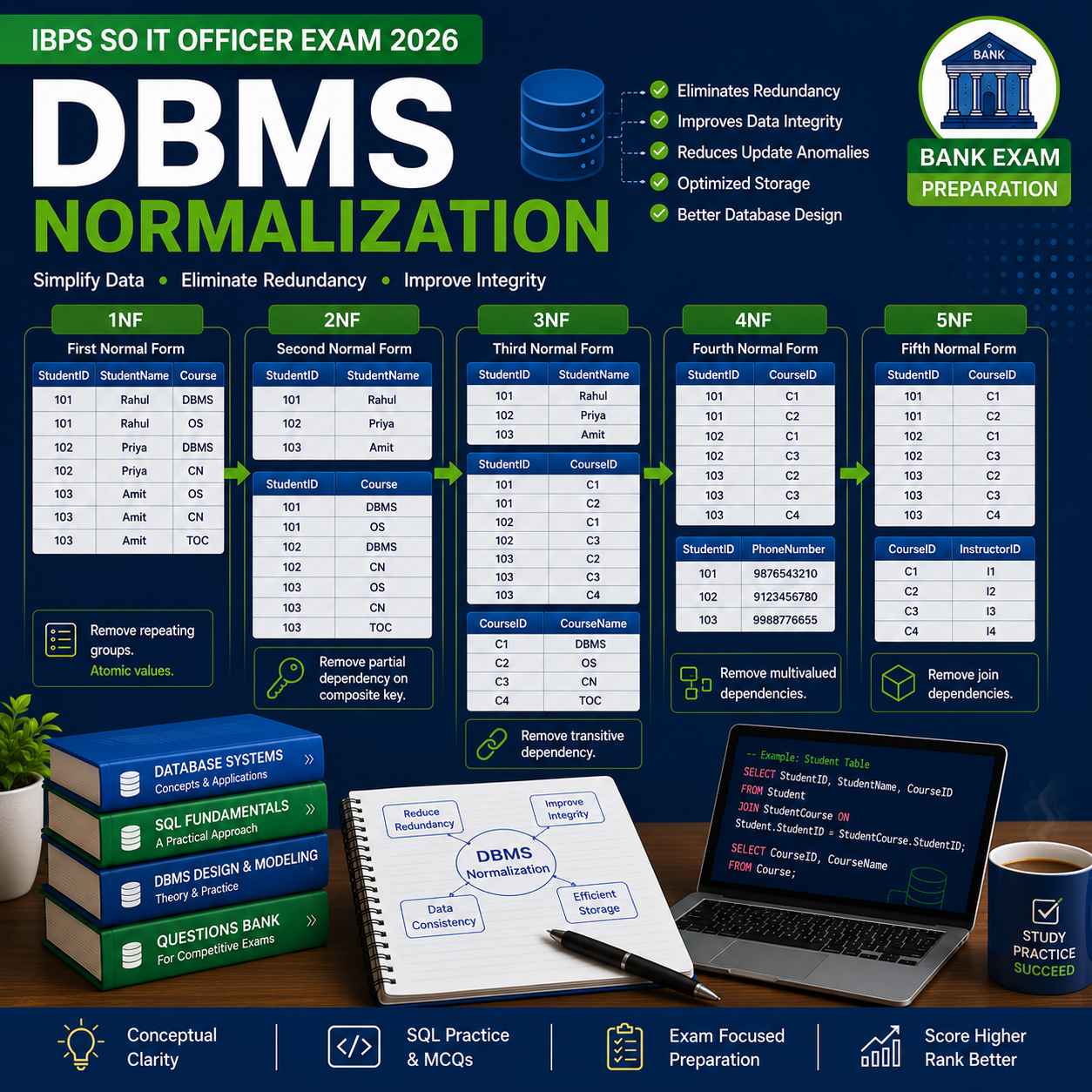
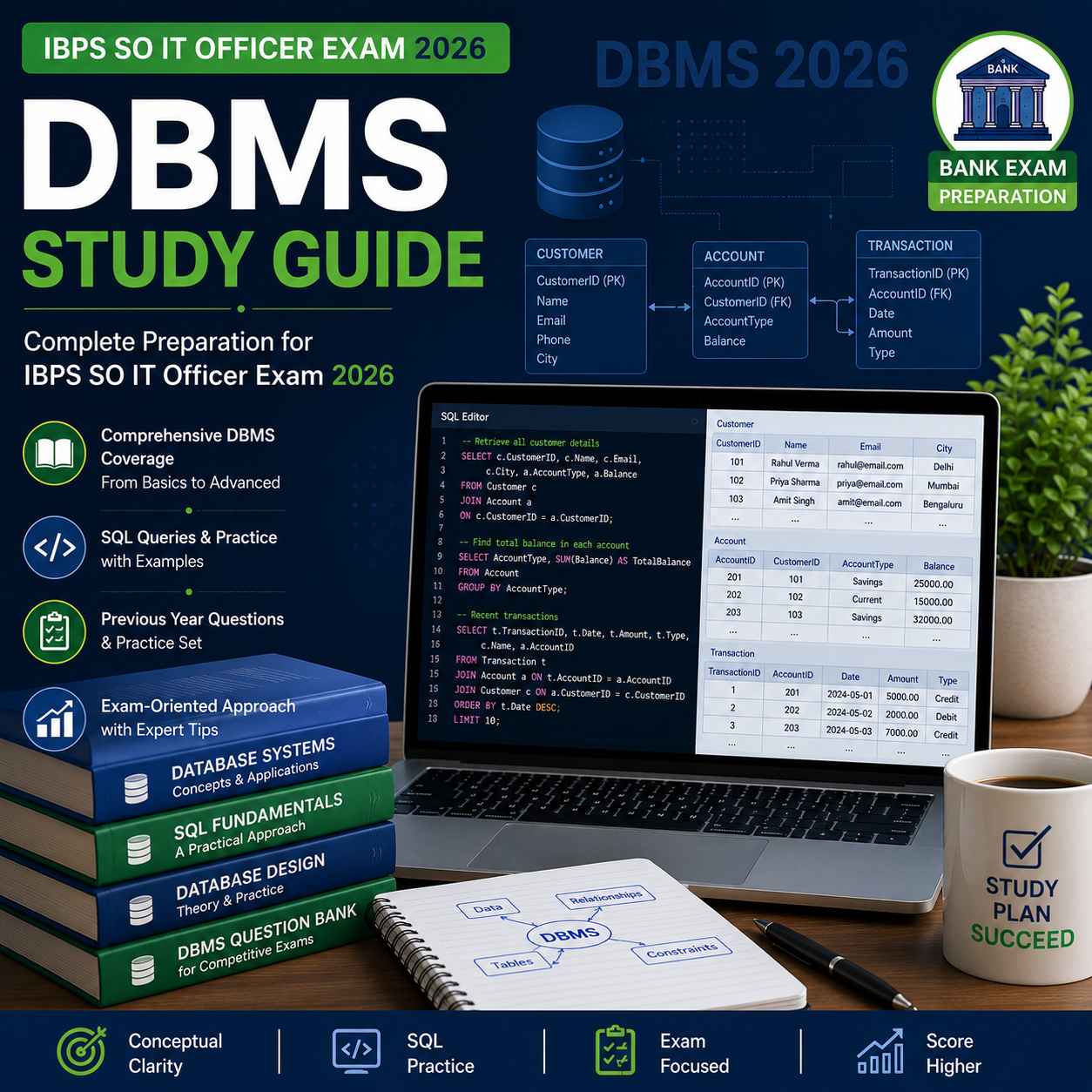
- 📖 DBMS for IBPS SO IT Officer 2026 Complete Study Guide
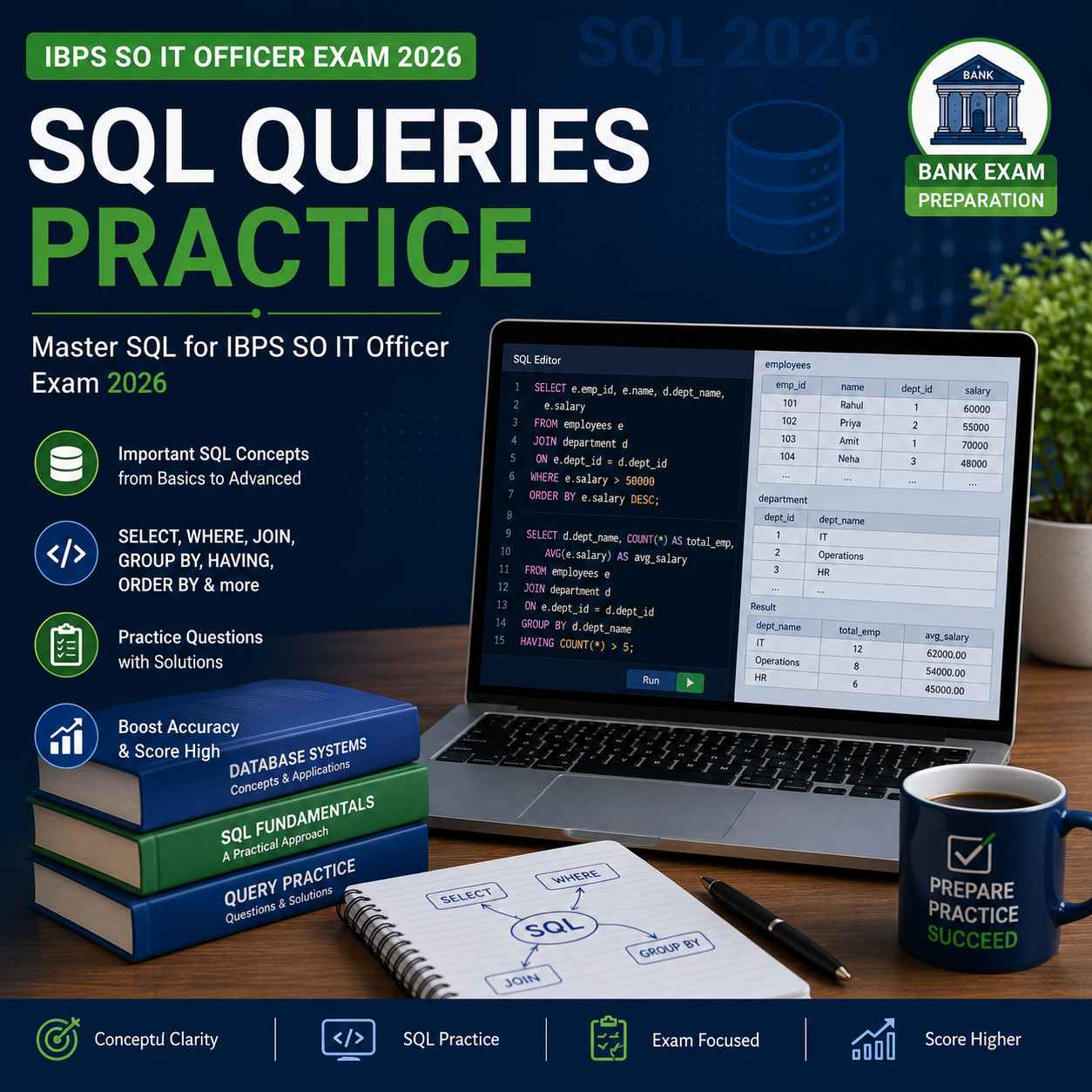
- 📖 SQL for IBPS SO IT Officer 2026 – Best 50 Practice Questions
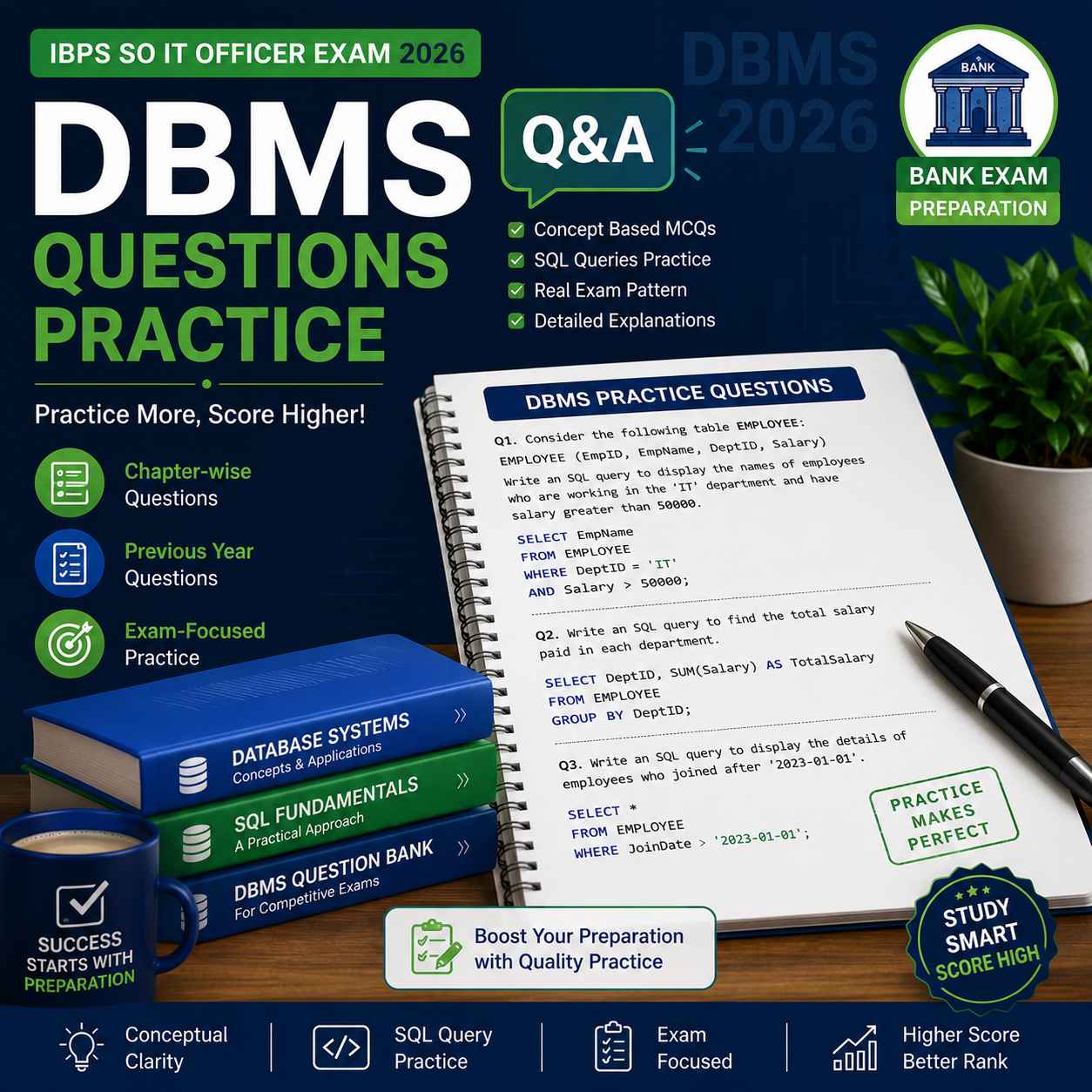
- 📖 DBMS Important Questions for IBPS SO 2026
- 📖 DBMS Normalization for IBPS SO – 1NF to 5NF
Final Thoughts on Computer Networks for IBPS SO IT Officer 2026
Mastering Computer Networks for IBPS SO IT Officer 2026 is essential for success in the bank IT officer exam. Focus primarily on OSI Model, TCP/IP, network devices, IP addressing, and protocols — these topics cover 80% of networking questions. Use the memory tricks provided, practice regularly, and revise through quick cheat sheets.
Remember that networking is not just an exam topic — it’s the foundation of modern banking infrastructure. As a future bank IT officer, you’ll work with networks daily, making this knowledge invaluable beyond the exam. With 30 days of focused study using this guide, you can confidently solve 90%+ of networking questions in the actual exam.
Ready to crack the Computer Networks section? Bookmark CodeLearning.in for daily study material, complete guides, and free resources for IBPS SO IT Officer, CIL MT Systems, SBI SO, and other bank IT exams. Drop your questions in comments — our team responds within 24 hours. Stay tuned for tomorrow’s article on Data Structures for IBPS SO IT Officer 2026! 🎯
Disclaimer: The networking concepts and questions provided are based on standard curriculum and previous year IBPS SO IT Officer exam patterns. Exam patterns may vary year to year. Always refer to the official IBPS notification at www.ibps.in for latest exam updates and syllabus.




6 comments on “Computer Networks for IBPS SO IT Officer 2026 — Complete Notes & MCQs”