

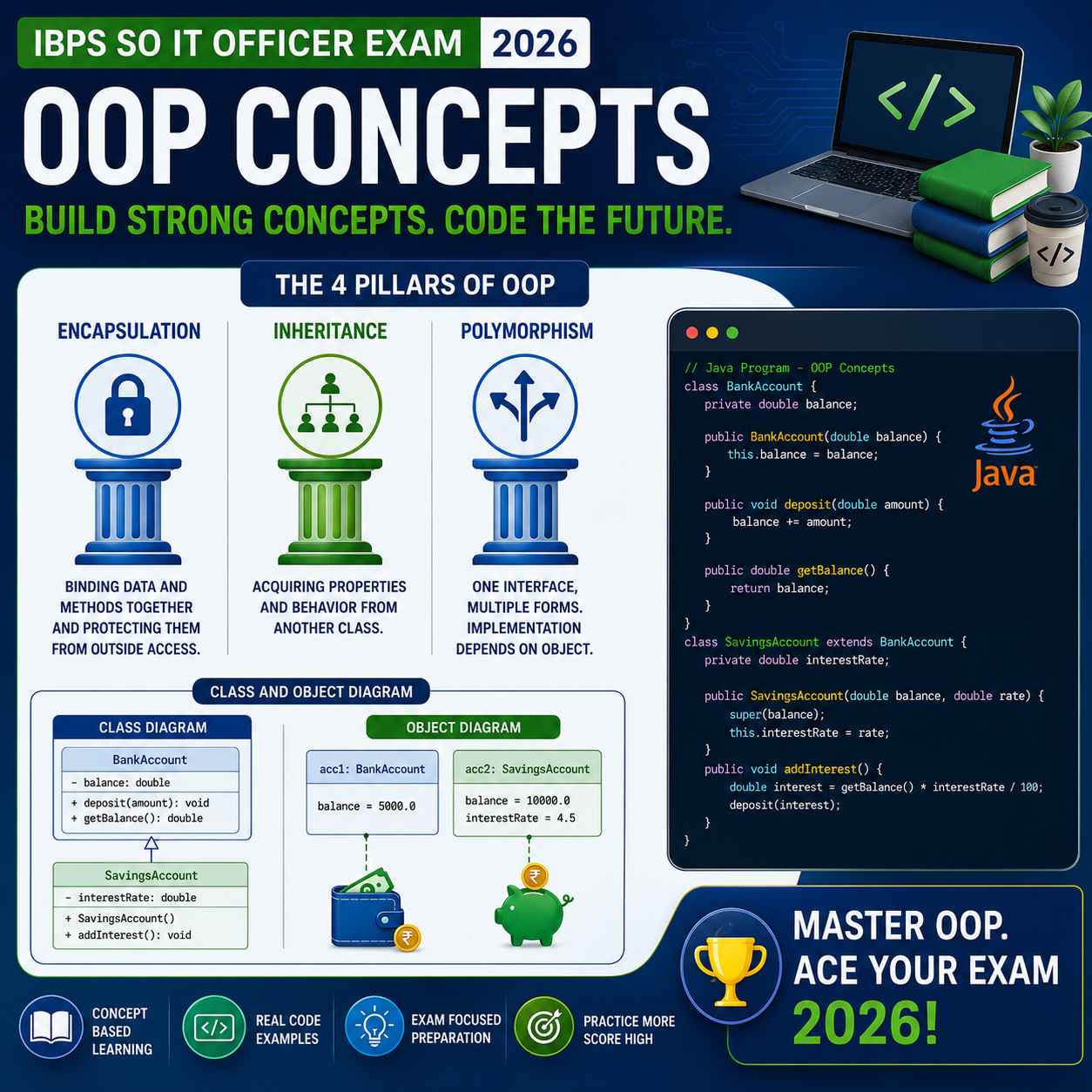
Master OOP Concepts for IBPS SO IT Officer 2026 with our complete study guide covering inheritance, polymorphism, encapsulation, abstraction, classes, objects, and top MCQs. Object-Oriented Programming is one of the most important topics in the IBPS SO IT Officer Professional Knowledge section, contributing 5-7 marks every year. With proper preparation using this guide, you can score full marks in OOP questions and significantly boost your final rank.
In this comprehensive guide on OOP Concepts for IBPS SO IT Officer 2026, we’ll cover the complete OOP syllabus, important concepts with examples, comparisons, top MCQs, memory tricks, and proven preparation strategies. Whether you’re a beginner or doing last-minute revision, this article gives you everything needed to crack the OOP section of bank IT officer exam.
Why OOP Concepts are Important for IBPS SO IT Officer 2026
OOP holds significant weightage in the OOP Concepts for IBPS SO IT Officer 2026 exam. Here’s why mastering this section is crucial:
- Consistent Weightage: 5-7 questions appear from OOP every year.
- Conceptual Topic: Questions test understanding, not memorization.
- Programming Foundation: OOP is base for Java, C++, Python, C#.
- Job Relevance: Bank software developed using OOP languages.
- Common Topic: Same syllabus in CIL MT, SBI SO, NIELIT, GATE CSE.
- Interview Critical: OOP concepts asked in 90% of tech interviews.
What is OOP? – Basics for IBPS SO IT Officer 2026
Object-Oriented Programming (OOP) is a programming paradigm based on the concept of “objects” which contain data (attributes) and code (methods). It organizes software design around data rather than functions and logic.
OOP vs Procedural Programming:
| Feature | Procedural | OOP |
|---|---|---|
| Focus | Functions and procedures | Objects and data |
| Approach | Top-down | Bottom-up |
| Data Access | Free access | Controlled (encapsulation) |
| Reusability | Limited | High (inheritance) |
| Examples | C, Pascal, FORTRAN | Java, C++, Python, C# |
| Security | Less secure | More secure |
4 Main Pillars – OOP Concepts for IBPS SO IT Officer 2026
The 4 fundamental pillars of OOP Concepts for IBPS SO IT Officer 2026 are tested every year. Master these:
| Pillar | Definition | Example |
|---|---|---|
| 1. Encapsulation | Binding data and methods together | Class with private variables |
| 2. Inheritance | One class inherits from another | Child class from Parent class |
| 3. Polymorphism | One name, multiple forms | Method overloading/overriding |
| 4. Abstraction | Hide complexity, show essentials | Interface or abstract class |
1. Encapsulation – OOP Concepts for IBPS SO 2026
Encapsulation is the bundling of data (variables) and methods (functions) that operate on the data into a single unit called a class. It restricts direct access to internal data.
Key Features:
- Data hiding using private access modifier
- Access via public getter and setter methods
- Provides data security
- Reduces complexity
- Increases maintainability
Real-World Example:
Medical capsule: The capsule encapsulates the medicine. You can take the medicine without knowing internal composition. Similarly, in OOP, a class encapsulates data and methods.
Java Example (Simple):
class BankAccount {
    private double balance;  // Private (Encapsulated)

    public double getBalance() {  // Getter
        return balance;
    }

    public void setBalance(double amount) {  // Setter
        if(amount > 0) this.balance = amount;
    }
}
2. Inheritance – OOP Concepts for IBPS SO IT Officer 2026
Inheritance is the mechanism by which one class (child/derived) acquires properties and behaviors of another class (parent/base). It promotes code reusability.
Types of Inheritance:
| Type | Description | Languages Supported |
|---|---|---|
| Single | One parent → One child | Java, C++, Python |
| Multilevel | Chain: A → B → C | Java, C++, Python |
| Hierarchical | One parent → Multiple children | Java, C++, Python |
| Multiple | Multiple parents → One child | C++, Python (NOT Java) |
| Hybrid | Combination of multiple types | C++, Python |
Important Points:
- Java: Does NOT support multiple inheritance (uses interfaces instead)
- Diamond Problem: Ambiguity in multiple inheritance
- Java keyword:
extendsfor class inheritance - C++ syntax:
class Child : public Parent
Real-World Example:
Vehicle (parent class) → Car, Bike, Truck (child classes). All vehicles share common properties like wheels, engine but cars/bikes have specific features.
3. Polymorphism – OOP Concepts for IBPS SO IT Officer 2026
Polymorphism means “many forms”. It allows objects of different classes to be treated as objects of a common parent class. Same method name behaves differently for different objects.
Types of Polymorphism:
1. Compile-Time Polymorphism (Static)
- Achieved through Method Overloading
- Same method name, different parameters
- Resolved at compile time
- Also called early binding
2. Runtime Polymorphism (Dynamic)
- Achieved through Method Overriding
- Child class redefines parent’s method
- Resolved at runtime
- Also called late binding
Method Overloading vs Method Overriding:
| Feature | Overloading | Overriding |
|---|---|---|
| Class | Same class | Parent and child class |
| Parameters | Different | Same |
| Return Type | Can be different | Must be same |
| Binding | Compile-time | Runtime |
| Inheritance | Not required | Required |
| Polymorphism Type | Static (Early) | Dynamic (Late) |
4. Abstraction – OOP Concepts for IBPS SO IT Officer 2026
Abstraction is the concept of hiding complex implementation details and showing only essential features. It focuses on “what” an object does rather than “how” it does it.
How to Achieve Abstraction:
1. Abstract Classes
- Cannot be instantiated directly
- Can have both abstract and concrete methods
- Use
abstractkeyword in Java - Child class must implement abstract methods
2. Interfaces
- 100% abstraction (in Java before version 8)
- Only abstract methods (traditionally)
- Class can implement multiple interfaces
- Used to achieve multiple inheritance in Java
Abstract Class vs Interface:
| Feature | Abstract Class | Interface |
|---|---|---|
| Methods | Abstract + Concrete | Abstract (default methods in Java 8+) |
| Variables | Any type | public static final only |
| Inheritance | Single inheritance | Multiple inheritance allowed |
| Constructor | Yes | No |
| Access Modifiers | Any | Public only |
| Keyword | extends | implements |
Real-World Example:
Car ignition: You press the start button (interface) but don’t see internal engine workings (implementation hidden). That’s abstraction!
Class and Object – OOP Concepts for IBPS SO 2026
Class and Object are the foundation of OOP Concepts for IBPS SO IT Officer 2026. Master these basics:
Class:
- Blueprint or template
- Logical entity
- Doesn’t occupy memory
- Declared once, used many times
- Contains attributes and methods
Object:
- Instance of class
- Physical entity
- Occupies memory
- Multiple objects per class
- Created using
newkeyword
Class vs Object:
| Feature | Class | Object |
|---|---|---|
| Definition | Blueprint | Instance |
| Memory | No memory allocated | Memory allocated |
| Existence | Logical | Physical |
| Declaration | Once | Multiple times |
| Example | Car (concept) | BMW, Audi (specific cars) |
Constructors – OOP Concepts for IBPS SO IT Officer 2026
A constructor is a special method that initializes objects when they are created. Important topic in OOP Concepts for IBPS SO IT Officer 2026:
Key Features:
- Same name as class
- No return type (not even void)
- Called automatically on object creation
- Can be overloaded
- Cannot be inherited or overridden
Types of Constructors:
| Type | Description |
|---|---|
| Default Constructor | No parameters, auto-created if none defined |
| Parameterized Constructor | Takes parameters to initialize |
| Copy Constructor | Creates object by copying another object |
| Static Constructor | Initializes static members (C#) |
Access Modifiers – OOP Concepts for IBPS SO 2026
Access modifiers control visibility of class members. Important for OOP Concepts for IBPS SO IT Officer 2026:
| Modifier | Same Class | Same Package | Child Class | Outside Package |
|---|---|---|---|---|
| public | Yes | Yes | Yes | Yes |
| protected | Yes | Yes | Yes | No |
| default | Yes | Yes | No | No |
| private | Yes | No | No | No |
Top 20 OOP Questions for IBPS SO IT Officer 2026
Practice these OOP Concepts for IBPS SO IT Officer 2026 previous year questions:
- Q. How many main pillars of OOP?
Answer: 4 (Encapsulation, Inheritance, Polymorphism, Abstraction) - Q. Which OOP concept hides data?
Answer: Encapsulation - Q. Java does not support which inheritance?
Answer: Multiple Inheritance (uses interfaces) - Q. Method overloading is which type of polymorphism?
Answer: Compile-time (Static) - Q. Method overriding is which type of polymorphism?
Answer: Runtime (Dynamic) - Q. Which keyword is used for inheritance in Java?
Answer: extends - Q. Which keyword is used for interface in Java?
Answer: implements - Q. Abstract class can be instantiated?
Answer: No - Q. Constructor has what return type?
Answer: No return type - Q. Which access modifier is most restrictive?
Answer: private - Q. What is diamond problem?
Answer: Ambiguity in multiple inheritance - Q. Which OOP language doesn’t support classes?
Answer: JavaScript (uses prototypes traditionally) - Q. Can interface have method body in Java 8+?
Answer: Yes (default methods) - Q. Which is logical entity – Class or Object?
Answer: Class - Q. What is “this” keyword?
Answer: Refers to current object - Q. What is “super” keyword?
Answer: Refers to parent class - Q. Can constructor be overloaded?
Answer: Yes - Q. Can constructor be overridden?
Answer: No - Q. Which is faster – method overloading or overriding?
Answer: Overloading (compile-time) - Q. Which OOP concept achieves code reusability?
Answer: Inheritance
OOP Languages Comparison – For IBPS SO 2026
Different OOP languages tested in OOP Concepts for IBPS SO IT Officer 2026:
| Language | Year | Multiple Inheritance | Pure OOP? |
|---|---|---|---|
| C++ | 1985 | Yes | No (supports procedural) |
| Java | 1995 | No (via interfaces) | Almost (primitives exist) |
| Python | 1991 | Yes | Yes |
| C# | 2000 | No (via interfaces) | Almost |
| Smalltalk | 1972 | No | Yes (purest OOP) |
| Ruby | 1995 | Yes (via mixins) | Yes |
Memory Tricks – OOP Concepts for IBPS SO 2026
Trick 1: 4 Pillars Memorize
“PIE-A” = Polymorphism, Inheritance, Encapsulation, Abstraction
Trick 2: Overloading vs Overriding
- Overloading = One class (both start with O)
- Overriding = Parent-child (different classes)
Trick 3: Compile vs Runtime
- Method Overloading = Compile time (both have “l”)
- Method Overriding = Runtime (different)
Trick 4: Class vs Object
- Class = Cookie Cutter (template)
- Object = Actual Cookie (real thing)
Trick 5: Inheritance Types
“SMHMH” = Single, Multilevel, Hierarchical, Multiple, Hybrid
Common Mistakes – OOP Concepts for IBPS SO Exam
- ❌ Confusing method overloading and overriding.
- ❌ Forgetting Java doesn’t support multiple inheritance.
- ❌ Mixing up class and object definitions.
- ❌ Not knowing constructor cannot be inherited.
- ❌ Confusing abstract class and interface.
- ❌ Wrong access modifier scope understanding.
- ❌ Forgetting “this” vs “super” keyword usage.
- ❌ Misidentifying compile-time vs runtime polymorphism.
- ❌ Not knowing all 5 types of inheritance.
- ❌ Confusing pure OOP and partial OOP languages.
30-Day Study Plan – OOP Concepts for IBPS SO 2026
📅 Week 1: Basics (Days 1-7)
- Day 1-2: OOP introduction, class and object
- Day 3-4: Constructors and destructors
- Day 5-6: Access modifiers
- Day 7: 25 MCQs practice
📅 Week 2: Encapsulation & Inheritance (Days 8-14)
- Day 8-9: Encapsulation, getter/setter
- Day 10-11: Inheritance and its 5 types
- Day 12-13: Diamond problem and Java’s solution
- Day 14: 30 MCQs practice
📅 Week 3: Polymorphism & Abstraction (Days 15-21)
- Day 15-16: Method overloading vs overriding
- Day 17-18: Abstract class and interface
- Day 19-20: this and super keywords
- Day 21: 35 MCQs practice
📅 Week 4: Mastery (Days 22-30)
- Day 22-23: OOP languages comparison
- Day 24-25: Real-world OOP examples
- Day 26-27: Previous year papers
- Day 28-29: Mock tests
- Day 30: Final revision + weak topics
Best Books for OOP – IBPS SO IT Officer 2026
- The Complete Reference Java by Herbert Schildt
- Head First Java by Kathy Sierra (beginner-friendly)
- Object-Oriented Programming with C++ by E. Balagurusamy
- Python Object-Oriented Programming by Steven F. Lott
- IBPS SO IT Officer Professional Knowledge by Arihant Publications
- Programming in Java by Sachin Malhotra
Last 24 Hours Cheat Sheet – OOP IBPS SO 2026
- ✅ 4 Pillars: Encapsulation, Inheritance, Polymorphism, Abstraction
- ✅ Encapsulation: Data hiding via private + getter/setter
- ✅ Inheritance: Code reusability (Java: extends)
- ✅ Polymorphism: Many forms (overloading + overriding)
- ✅ Abstraction: Hide complexity (abstract class + interface)
- ✅ Overloading: Same class, compile-time
- ✅ Overriding: Parent-child, runtime
- ✅ Java NO Multiple Inheritance: Uses interfaces
- ✅ Constructor: Same name as class, no return type
- ✅ Class: Blueprint, no memory
- ✅ Object: Instance, has memory
- ✅ Pure OOP: Smalltalk, Python, Ruby
OOP for Other Bank IT Exams Comparison
| Exam | OOP Questions | Focus Areas |
|---|---|---|
| IBPS SO IT Officer | 5-7 | 4 Pillars, Java basics |
| CIL MT Systems | 6-8 | Same + Design patterns |
| SBI SO Systems | 4-6 | Basic OOP concepts |
| GATE CSE | 8-10 | All topics in depth |
For complete preparation, check our IBPS SO IT Officer Syllabus 2026 Complete Guide and master DBMS for IBPS SO IT Officer 2026 for highest weightage section.
Free Resources to Practice OOP for IBPS SO 2026
- GeeksforGeeks: Java OOP tutorials with examples
- Programiz: OOP concepts simplified
- Sanfoundry: 1000+ Java OOP MCQs
- JavaTpoint: Detailed OOP notes
- W3Schools: Beginner-friendly tutorials
- YouTube: Apna College, CodeWithHarry channels
Also Read – Complete IBPS SO IT Officer 2026 Study Series
- 📖 IBPS SO IT Officer Syllabus 2026 – Complete Guide
- 📖 DBMS for IBPS SO IT Officer 2026
- 📖 Computer Networks for IBPS SO IT Officer 2026
- 📖 Data Structures for IBPS SO IT Officer 2026
- 📖 Operating System for IBPS SO IT Officer 2026
Final Thoughts on OOP Concepts for IBPS SO IT Officer 2026
Mastering OOP Concepts for IBPS SO IT Officer 2026 is achievable with the systematic approach in this guide. Focus on 4 pillars (Encapsulation, Inheritance, Polymorphism, Abstraction), class vs object, and method overloading vs overriding — these cover 80% of OOP questions. Use memory tricks, practice regularly, and revise cheat sheets before exam.
Remember that OOP is the foundation of modern software development. As a future bank IT officer, you’ll work with Java/Python applications daily. With 30 days of focused study using this guide, you can confidently solve all OOP questions and significantly boost your overall score in the IBPS SO IT Officer exam.
Ready to crack the OOP section? Bookmark CodeLearning.in for daily study material, complete guides, and free resources for IBPS SO IT Officer, CIL MT Systems, SBI SO, and other bank IT exams. Drop your questions in comments — our team responds within 24 hours! 🎯
Disclaimer: The OOP concepts and questions provided are based on standard computer science curriculum and previous year IBPS SO IT Officer exam patterns. Exam patterns may vary year to year. Always refer to the official IBPS notification at www.ibps.in for latest updates and syllabus.





1 comment on “OOP Concepts for IBPS SO IT Officer 2026 — Best Notes & MCQs”